|
|
|
|
|
|
|
|
|
 Posted: Thu Jul 19, 2007 3:47 pm Posted: Thu Jul 19, 2007 3:47 pm
Begynder Dansk
Beginner Danish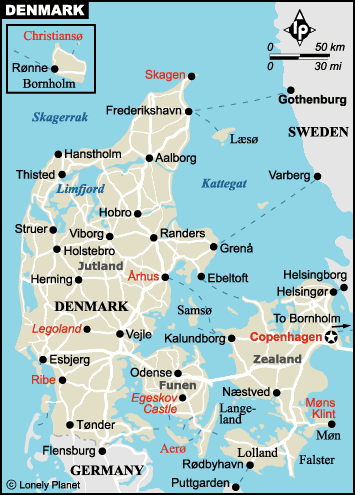
While I'm not a native of Denmark, I do have native speaker assisting me in the creation of these lessons. However, having no prior experience in teaching lessons for a language, I have to ask you to bare with me, as there might be a mistake (or quite a few). If you notice any of them, please contact me, or post in the thread, and I will fix it.
Since, as I said, I'm new to teaching a language, I would love it if anyone gave me suggestions as to what to teach in following lessons. Or, if you have any advice to make the lessons better, then feel free. I appreciate both suggestions, and advice. If there is anything you don't understand, please don't be afraid of me asking questions. Or, if you just have a question in general about Danish unrelated to a lesson, then PM me with it. I'd love to answer any questions you have, as long as I can. If I can't answer it, I have two Danes here who surely can. wink
If you wish to, you are welcome to try to speak Danish or use your phrases in the thread, as well as ask questions. If you don't want to have to copy & paste æ, ø, å (assuming most don't have it on their keyboard), then you can use ae for æ, oe for ø, and aa for å.
Legend
Lessons will be taught like this.
[English word] - [Danish word] (Pronunciation)
I.E. - Mouse - Mus (Moose)
and
[English Phrase]
[Danish phrase] (Pronunciation)
(Literal meaning)
[Alternate Danish phrase] (Pronunciation)
(Literal meaning)
I.E. My name is...
Jeg hedder... (Yai Hea-ther)
(I am called)
Mit navn er... (Mit nown air)
(My name is)
|
 |
|
|
|
|
|
|
|
|
|
|
|
|
|
Posted: Thu Jul 19, 2007 3:48 pm
Tips/Ekstra
Tips/Extra
These lessons alone won't be enough to help you become fluent in Danish. There are quite a few other things you can do to help with pronunciation, vocabulary, and more. Such as, you could make flash cards for yourself to help you memorize words, and their meaning. But you have other options, too.
1.) Listen to Danish music
Not only is it something fun to do, but it can help you with pronunciation, and recognition of words when spoken. Especially if you read over the lyrics while listening to the song playing. (But be careful, Danish does tend to have quite a bit of slang, which can become confusing in Rap songs, as well as others.) A few suggestions are Nephew, I don't think they have too much rap, Tue West, and Johnny Deluxe. (Look them up on YouTube and Google Video.) I encourage you to especially listen to the song Hvor Små Vi Er, it's very touching and has little rap in it.
2.) Buy a Dictionary
An absolute must if you're really interested in learning any language. However, if you (or your parents) do not have much money to invest in this, you can use www.ordbogen.com. You can look up 2 words a day for free. If you want to look up more, you have to pay, but it's actually worth it; you pay $15 US dollars for a one year subscription. Unfortunately it might be difficult for you to understand how to go through the process (I could help you with it, or Disturbed could if you would like) but I would only suggest that if you're very serious about learning the language.
3.) Buy a Danish Program
Rosetta Stone is a very famous Language program, but also very expensive. Only do this if you really have the extra money, and are absolutely certain you want to learn the language. Then, you need to know, this is not a "stand-alone" program. You cannot learn the entire language with that program alone. You're still going to need a dictionary, and probably other programs to accompany it.
If you, or your parents, do not have that kind of money, then you can download BYKI for free, it is also quite nice and effective. Or, if you do have a little bit of money, you can buy the BYKI program for Danish, which is much better than the free version, and quite helpful.
4.) Speak/Type Danish
There is a Danish Guild on Gaia (Den Danske Guild), which I would encourage you to join if you're really interested in Danish. They can also prove to be quite helpful with teaching you Danish. Or, if you feel too shy to do that, visit the Language General Discussion, both my boyfriend and I hang out there and we'd love to help you improve. KoKo is also there! smile
|
|
|
|
|
|
|
|
|
|
|
|
|
|
|
|
|
|
Posted: Thu Jul 19, 2007 3:49 pm
Det Danske Sprog
The Danish LanguagePronunciation
The pronunciation below, though not exact in any way, is somewhat close, and will give you a general idea. Besides that, here is a clip with me speaking a bit of Danish to try to show you how they sound. Pronunciation below is credit @ www.dkheadlines.com.
Vowels
a sounds like e in egg.
Or sounds like sound between a in ban and a in barn but without the r sound.
e sounds like a in ache but very short.
Or sounds like a shortened ee in see.
Or sounds like e in open.
i sounds like a sound between e in egg and i in ill.
Or sounds like e in see.
o sounds like o in old.
Or sounds like a in cap.
u similar to oo on booth.
y sounds like ew in few but with lips more rounded.
Or similar to German ö.
æ sounds like a in ache but very short.
ø similar to German ö sounds like e in let pronounced with lips tightly rounded.
Or similar to ir in bird but without the r and with lips more rounded.
å sounds like au in caught.
Or sounds like o in old.
Consonants
B as b in bit when final or between vowels as w in win
C before a consonant, a, o or u as k in kit, elsewhere as in set
D when final or between vowels similar to th in this elsewhere as d in dig.
After l, n or r or before t or s it is rarely pron.
F as f in fit
G as g in get, after vowels it is rarely pronounced. Between vowels and at the end of a syllable as a softened g in get. As in some foreign loan words as s in vision.
H silent before j and v.
Elsewhere as h in his.
J as y in yet.
K as k in kit. Between vowels ands at the end of a syllable as g in get .
L as l in lip.
M as m in meet.
N as n in no.
P as p in pan. Between vowels and at the end of a syllable as b in bit.
Q similar to English. (Not really. It's pronounced like Kv. neutral I'm not sure why they said it's similar to English.)
R at the beginning of a word or after a consonant sounds like a strong guttural h, the Spanish j in Jose or as the French r in rue.
Elsewhere between vowels or before a consonant it often becomes part of the vowel sound or is lost
S as s in sit
T as t in tin. Between vowels and at the end of a syllable as d in do. In final position similar to th in this .
V when final sounds like oo in boot.
Elsewhere as v in van.
W as v in van.
X as x in taxi.
Z as s in sun.
Declension
In Danish there are two genders: Common and Neuter. The common nouns use 'en', and the neuter nouns use 'et'. The following is some examples, as copied from Wikipedia, to assist you in understand how this words. Credit for everything beneath the 'Declension' is credit @ Wikipedia.org.
Singular
Indefinite (Common) - en dreng / en sag / en kvinde / en ske
Definite (Common) - drengen / sagen / kvinden / skeen
Indefinite (Neuter) - fængsel / æble / lyn /
Definite (Neuter) - fængslet / æblet / lynet /
Plural
Indefinite (Common) - drenge / sager / kvinder / skeer
Definite (Common) - drengene / sagerne / kvinderne / skeerne
Indefinite (Neuter) - fængsler / æbler / lyn /
Definite (Neuter) - fængslerne / æblerne / lynene /
Neuter monosyllabics are unchanged in plural. Other nouns take either -e or -er. Otherwise there is little correspondence between declension and gender or sense and gender. In order to correctly decline a noun, one must look it up in a dictionary or memorise the declension form and the gender.
Note that if the final syllable ends in unstressed -e, -el, -en, or -er, the e will disappear if a grammatic ending starting with an e is added. E.g. the declension of "fængsel" above is quite regular. This is known as the Danish apocope.
There are many nouns with irregular plural. Here are some typical examples:
Singular
Indefinite (Common) - en mand / en bonde / en drink / en sten / en risiko
Definite (Common) - manden / bonden / drinken / stenen / risikoen
Indefinite (Neuter) - et barn / et hus / et våben /
Definite (Neuter) - barnet / huset / våbenet /
Plural
Indefinite (Common) - mænd / bønder / drinks / sten / risici
Definite (Common) -mændene / bønderne / drinkene / stenene / risiciene
Indefinite (Neuter) - børn / huse / våben
Definite (Neuter) - børnene / husene / våbnene
Some have the "wrong" regular form, some have vowel change with or without a suffix, and some are foreign words using their native plural. In all cases it is only the plural indefinite that is irregular. Singular definite always just adds -en or -et. Plural definite adds -ne to the indefinite if it has a standard plural suffix, -ene if not.
If you would like to see more information on this, please visit this page.
Sentence Structure
Danish is an 'SVO' language. For those who do know know what SVO stands for, it stands for subject, verb, object. In other words, in a sentence, the subject comes first, the verb second, and the object is last. It is imperative for you to know this when constructing a sentence in Danish. Also, if you weren't already aware, English is also an 'SVO' language.
However, something you must keep in mind, is that Danish switches to 'VSO' when asking a question. Remember, this is verb, subject, object. Meaning that the verb comes first, subject second, and the object last.
I.E.- "Hvordan har du det?" (is literally) "How have you that?"
Also, just because both English and Danish are classified under 'SVO' doesn't mean that you can simply translate a word from English-Danish, slap it in a sentence, and be correct. No language is quite that simple, I'm afraid. smile
Capitalization
To be added.
|
|
|
|
|
|
|
|
|
|
|
|
|
|
|
Posted: Thu Jul 19, 2007 3:51 pm
Lektion Én
Lesson One
Before we get into phrases, and such, I'm going to start with something pretty simple. That is, colors, days, months, and numbers. All very easy to learn. If you notice the pronunciation a bit off, don't just tell me it's wrong, tell me how you think it should be. Or, if you see any other errors, please let me know. (There are bound to be quite a few. wink )
If a word doesn't have (parentheses) with word pronunciation in them, then that's because they're spoken the way they sound. Like, December, is pretty much the same as the English way of saying it.
Farver
Colors
Black - Sort (So-art)
Blue - Blå (Bl-ow)
Brown - Brun (Br-oon)
Gray - Grå (Gr-ow)
Green - Grøn (Gr-on)
Orange - Orange (Or-ang-sha)
Pink - Lyserød (Lue-saa-row)
Purple - Lilla (Lee-la)
Red - Rød (R-ow)
White - Hvid (V-eel)
Yellow - Gul (G-ool)
Dage
Days
Sunday - Søndag (Soon-day)
Monday - Mandag (Man-day)
Tuesday - Tirsdag (Tears-day)
Wednesday - Onsdag (Uns-day)
Thursday - Torsdag (Toors-day)
Friday - Fredag (Fray-day)
Saturday - Lørdag (Loor-day)
Måneder
Months
January - Januar (Ya-nu-ar)
February - Februar (Fe-bu-ar)
March - Marts
April - April (A-preel)
May - Maj (My)
June - Juni (Yoo-nee)
July - Juli (Yoo-lee)
August - August (Ow-gust)
September - September
October - Oktober
November - November
December - December
Numre
Numbers
Zero - Nul
One - En (Een)
Two - To (Toe)
Three - Tre (Tray)
Four - Fire (Fee-ar)
Five - Fem
Six - Seks (Sex)
Seven - Syv (Sue)
Eight - Otte (Oh-teh)
Nine - Ni (Nee)
Ten - Ti (Tee)
Eleven - Elleve (El-va)
Twelve - Tolv (To-lw)
Thirteen - Tretten (Tra-ten)
Fourteen - Fjorten (Fyor-ten)
Fifteen - Femten
Sixteen - Seksten (Sighs-ten) [Sighs as in "She sighed"]
Seventeen - Sytten (Sue-ten)
Eighteen - Atten
Nineteen - Nitten (Knit-ten)
Twenty - Tyve (Tuy-ve)
Now, an important thing for you to know before we proceed, is that when it comes to numbers higher than Twenty... Danes do not say it in the English order. We say, "Twenty-one". They say, "one and twenty" ; "enogtyve" = en og tyve. It's the same with all the letters 1-9. Remember, "og", meaning and, is pronounced 'oh'.
Twenty-one - Enogtyve (Een-oh-tuy-ve)
Twenty-two - Toogtyve
Twenty-three - Treogtyve
Thirty - Tredive (Treal-ve)
Thirty-one - Enogtredive
Forty - Fyrre (Fuy-rre)
Forty-one - Enogfyrre
Fifty - Halvtreds (Hal-tres)
Fifty-one - Enoghalvtreds
Sixty - Tres (Tr-ess)
Sixty-one - Enogtres
Seventy - Halvfjerds (Hal-fye-ers)
Seventy-one - Enoghalvfjerds
Eighty - Firs (Feers)
Eighty-one - Enogfirs
Ninety - Halvfems (Hal-femms)
Ninety-one - Enoghalvfems
One-hundred - Ethundrede (It-hoon-re-the)
One-hundred one - Ethundredeoget
|
|
|
|
|
|
|
|
|
|
|
|
|
|
|
|
|
|
Posted: Thu Jul 19, 2007 3:52 pm
Lektion To
Lesson Two
You'll notice in this lesson that there will be phrases underlined. This is because it is the preferred phrase, or the one that is most commonly used. Therefore I suggest use of it above the other available ones. However, that doesn't mean you have to use it. You can use whatever you want to use–it's just a suggestion. (: Also, for some words, there's another way to pronounce it... I.E.- Hvad. Can be pronounced, when said quickly "Vah", or other "Vell". There'll be a (Pronunciation / Pronunciation) by the word, giving you two options. One will be outlined, telling you which one is preferred in this case.
"Please" på Dansk
"Please" in Danish
In English, to be polite, we say "please" a lot. Such as, "Please pass me the salt.", or "Can I please have a toy?". The Danish (semi-)equivalent would be be om meaning pray about... Used typically at the dinner table when asking a person to pass something, such as the salt. However, even then, it isn't used very often, either. Therefore, we can conclude that Danish doesn't really have the word "Please". So when trying to be polite in Danish you have to look for other routes other than the simple word of please.
Ja, Nej og Jo
Yes, No, and Yes
Yes - Ja (Yeh)
No - Nej (Nigh)
Yes - Jo (Yo)
In English "Yes" and "No" are two of the most important words, and some of the first ones you learn. Naturally, you use both of them hundreds of times each and every day. Of course Danish couldn't be so easy. While they have one word for No (Nej), they have two for Yes (Ja, and Jo). So when do you use Ja, and when do you use Jo? This is actually surprisingly not as hard as you may think it would be. First some examples then an explanation.
Example 1:
Andreas: "Vil du give mig et glas af vand?"
(Literally: "Will you give me a glass of water?"
Camilla: "Ja."
(Literally: "Yes.")
Andreas: "Tak."
(Literally: "Thanks.")
Example 2:
Andreas: "Vil du give mig et glas af vand?"
(Literally: "Will you give me a glass of water?")
Camilla: "Nej, jeg vil ikke."
(Literally: "No, I will not.")
Andreas: "Jo, be om."
(Literally: "Yes, pray about." Can be translated into "Yes, please.")
Basically, "Jo" is the "Yes" you use after someone says something negative, like "No". Otherwise you do not use Jo. There are situations you can use Jo in it, but it's rather complicated so for now just use this guideline in using Ja, Nej, and Jo.
Det Basale
The Basics
Hello - Hej (Hi)
Good Morning - God Morgen (Go Mo-arn)
Good Afternoon - God Efter (Go Eff-tur)
Good Evening - God Aften (Go Aff-den)
Good Night - Godnat (Go nat)
Goodbye - Farvel (Faa-vell)
See ya - Vi ses (Vee sess)
What - Hvad (Vell / Vah)
When - Hvornår (Vohr-noor)
Where - Hvor (Vohr)
Why - Hvorfor (Vohr-fohr)
How - Hvordan (Vohr-dan)
If - Hvis (Vihs)
Sorry - Undskyld (Awn-skew-l)
I am sorry - Jeg undskylder (Yigh awn-skew-l)
You are welcome - Selv tak (Sel tahk)
Thank You
Tak (Tahk)
(Thanks)
Mange Tak (Mahng-ey tahk)
(Many Thanks)
Tusend Tak (Too-sen tahk)
(Thousand Thanks)
Tak skal du have. (Tahk skale doo hay-vey)
(Thanks shall you have.)
Basale Sætninger
Basic Sayings
How are you?
Hvordan har du det? (Vohr-dan hahr doo day)
(How have you that?)
Hvordan går det? (Vohr-dan gohr day)
(How goes that?)
I'm doing good.
Jeg har det godt. (Yigh hahr day got)
(I have that good.)
Jeg har det fint. (Yigh hahr day feent)
(I have that fine.)
I'm doing okay.
Jeg har det O.K. (Yigh hahr day oo-koo)
(I have that O.K.)
Jeg overlever. (Yigh oh-wer-lee-ver)
(I survive.)
I'm doing badly.
Jeg har det ikke godt. (Yigh hahr day eeh-kuh)
(I have that not good.)
Jeg har det slemt. (Yigh hahr day sl-eh-mt)
(I have that bad.)
What is your name?
Hvad hedder du? (Va he-ther doo)
(What are you called?)
Hvad er dit navn? (Va ehr deet nown)
(What is your name?)
My name is...
Jeg hedder... (Yigh he-ther)
(I am called...)
Mit navn er... (Meet nown ehr)
(My name is...)
Where do you come from?
Hvor kommer du fra? (Vohr come-ehr doo fra)
(Where are come you from?)
I come from...
Jeg kommer fra... (Yigh come-ehr fra)
(I am come from...)
Do you speak English/Danish?
Taler du Engelsk/Dansk? (Tay-luhr doo Ehn-gehl-sk/Dehn-sk)
(Talk you English/Danish?)
Snakker du Engelsk/Dansk? (Snah-guhr doo Ehn-gehl-sk/Dehn-sk)
(Chat you English/Danish?)
Kan du tale Engelsk/Dansk? (Kahn doo tay-luh Ehn-gehl-sk/Dehn-sk)
(Can you talk English/Danish?)
Kan du snakke Engelsk/Dansk? (Kahn doo snah-guh Ehn-gehl-sk/Dehn-sk)
(Can you chat English/Danish?)
I speak English/Danish.
Jeg kan snakke Engelsk/Dansk. (Yigh kahn snah-guh Ehn-gehl-sk/Dehn-sk)
(I can chat English/Danish.)
Jeg kan tale Engelsk/Dansk. (Yigh kahn tay-luh Ehn-gehl-sk/Dehn-sk)
(I can talk English/Danish.)
Did/Do you understand?
Forstod/Forstår du det? (For-stohl/For-stoor doo day)
(Understood/Understand you that?)
I understand.
Jeg forstår. (Yigh for-stoor)
(I understand.)
Jeg forstår det. (Yigh for-stoor day)
(I understand that.)
I didn't/do not understand (that).
Jeg kan ikke forstod/forstår (det). (Yigh kahn eeh-kuh for-stohl/for-stoor (day))
(I can not understood/understand (that).)
Could you speak a bit more slowly?
Kan du tale langsommerer? (Kahn doo tay-luh lahng-soh-mer-her)
(Can you talk slower?)
Could you please repeat that?
Kan du gentage det? (Kahn doo gen-tay day)
(Can you repeat that?)
What is that in English/Danish?
Hvad betyder det på Engelsk/Dansk? (Vah beh-tuh-the day pooh Ehn-gehl-sk/Dehn-sk)
(What means that on English/Danish?)
What does "–" mean?
Hvad betyder "–"? (Vah beh-tuh-the)
(What means "-"?)
|
|
|
|
|
|
|
|
|
|
|
|
|
|
|
Posted: Thu Jul 19, 2007 3:54 pm
Lektion Tre
Lesson Three
Most people probably don't know how to say "man", or "woman" in Danish. Let alone he, she, etc... Therefore I decided the next imperative thing to teach would be this. smile Hopefully soon we'll be able to move onto people constructing their own sentences.
Important: I will be making a voice clip for every lesson soon to help with pronunciation. This one does not yet have one. You're forewarned that if you try pronouncing merely with the 'help' beside the Danish word, you'll probably get it wrong.
Jeg synes, jeg tror, jeg tænker
I think, I think, I think
When I use my dictionary and look up the word 'think', I get three different results... In Danish there are three different ways to say 'I think', and each one has a different specific meaning, and time of use. Therefore it's imperative to know which one to use to properly express yourself in Danish.
Synes basically means 'I have the opinion of...' For example, you could say: "Jeg synes din trøje er fed." Which means: "I think your shirt is cool.".
Tror basically means 'I believe that, but am not completely sure...' For example, you could say: "Jeg tror nok hans bil er blå." Which means: "I think his car is probably blue."
Tænker basically means 'I have a thought/I have thoughts' For example, you could say: "Jeg tænker ofte på dig." Which means: "I often think about you."
Now, this is a bit more complicated than some other aspects of the Danish language, so it's perfectly understandable if you use the wrong word in your expression. If you feel you need further help, please feel free to contact me and I would be happy to assist you.
Du og dig
You and you
In Danish there are two types of ways to say you (and more than that if you're trying to be formal, but since most Danes aren't formal anymore we won't get into that). Unfortunately I can't be quite so explanatory on this, because I don't 100% understand it myself yet. However I can teach you the rule for the two different ways of saying you (du and dig).
As you should already know (if you've read my previous lessons) that Danish is a SVO (Subject, Verb, Object) language, but when asking a question becomes VSO (Verb, Subject, Object).
Example:
In English you would ask, "Do you love me?"
In Danish you would ask, "Elsker du mig?" Elsker is the verb, du is the subject, and mig is the object. It literally translates into "Loving you me?"
In a sentence you use 'du' when 'you' is the subject in the sentence, and you use 'dig' when 'you' is the object in the sentence. I'll give you another example to help you understand.
Example:
"Hvis jeg siger, at jeg elsker dig, vil du så sige, at du også elsker mig?" Translated meaning for meaning means: "If I say that I love you, will you then say that you love me too?" In the first part of the sentence 'you' is the object, but in the second part it is the subject. This is the best example I can think of, and I hope it helps. smile
Folk
People
Boy - (en) dreng (dur-eng)
Girl - (en) pige (pee-yeh)
Man - (en) mand (maun)
Woman - (en) kvinde (kah-vee-neh)
He - Han (hann)
She - Hun (huun)
Him - Ham (hahm)
Her - Hende (hee-neh)
His - Hans (hanns)
Hers - Hendes (hee-nehs)
I - Jeg (yigh)
Me - Mig (migh)
Mine - Min/Mit (meen/meet)
You - Dig (digh)
Your(s) - Din/Dit (deen/deet)
We - Vi (Vee)
Ours - Vores (Vohr-ahs)
Mom - Mor (Mohr)
Dad - Far (Fahr)
Sister - Søster (Syh-ster)
Brother - Bror (Bwor)
Daughter - Datter (Dah-tur)
Son - Søn (Soohn)
Mom's Mom (Grandmother) - Mormor (Mohr-mohr)
Mom's Dad (Grandfather) - Morfar (Mohr-fahr)
Mom's Sister (Aunt) - Moster (Moh-ster)
Mom's Brother (Uncle) - Morbror (Mohr-bwor)
Dad's Mom (Grandmother) - Farmor (Fahr-mohr)
Dad's Dad (Grandfather) - Farfar (Fahr-fahr)
Dad's Sister (Aunt) - Faster (Feh-ster)
Dad's Brother (Uncle) - Farbror (Fahr-bwor)
Cousin (Girl) - Kusine (Kuh-see-neh)
Cousin (Boy) - Fætter (Feh-tur)
Niece - Niece (Nee-eh-suh)
Nephew - Nevø (Neh-vuh)
Dyr
Animals
Dog - (en) hund (hoohn)
Cat - (en) kat
Fox - (en) ræv (rah-oh)
Mouse - (en) mus (moose)
Rabbit - (en) kanin (ka-een)
Hamster - (et) hamster (hahm-stur)
Wolf - (en) ulv (Oo-lv)
|
|
|
|
|
|
|
|
|
|
|
|
|
|
|
|
|
|
Posted: Thu Jul 19, 2007 3:55 pm
|
|
|
|
|
|
|
|
|
|
Posted: Thu Jul 19, 2007 3:56 pm
|
|
|
|
|
|
|
|
|
|
|
|
|
Posted: Thu Jul 19, 2007 3:57 pm
|
|
|
|
|
|
|
|
|
|
Posted: Thu Jul 19, 2007 3:58 pm
|
|
|
|
|
|
|
|
|
|
|
|
|
Posted: Thu Jul 19, 2007 3:59 pm
|
|
|
|
|
|
|
|
|
|
Posted: Thu Jul 19, 2007 4:00 pm
|
|
|
|
|
|
|
|
|
|
|
|
|
Posted: Thu Jul 19, 2007 4:01 pm
|
|
|
|
|
|
|
|
|
|
Posted: Thu Jul 19, 2007 4:02 pm
Sjove Ting
Fun Things
Once I have posted all of the lessons, I will then make a Quiz for everyone to take. You can then post, or preferably PM it to me and I will grade it. However, that will of course not be up for at least two more months, probably more. Therefore, I'm also going to include some other fun things you can do... Like translating easy songs. If you have any other ideas for fun things to do, just tell me.
Quizzer
Quizzes
To be added when all of the lessons have been completed
Spil
Games
The first game is song translation, to Danish, and from Danish. Unfortunately I don't know any "easy" songs off-hand so I'll list some songs that I've personally translated in the past that were fairly easy for me. So if you want to, you can make an attempt, and for all the effort you put into it (correct or not) you'll get a certain amount of gold. To give you an estimate, if you work on it for a week and get it 100% correct I'll probably give you 5k, and if the song difficulty is higher then you might even get a letter. Remember, effort. However, since I am offering some goldies for this, there are some expectations I have. When you send the translation, via PM, I want it in this formation:
(Danish Text) - Jeg elsker dig! Jeg elsker dig! Elsker du mig?
(Literal English Text) - I love you! I love you! Love you me?
(Regular English) - I love you! I love you! Do you love me?
Please keep in mind that I will be able to tell if you slapped something together with a translator, and you will get nothing if you do that and send it to me. stare
If there is a word that cannot be found in a dictionary (as in, it's slang, or something else) then you can message me and I'll tell you the meaning. wink
Song #1 - Bare Sig Til by Niarn (Danish - English)
Song #2 - Op med håret by UFO Yepha
Song #3 - Hvor små vi er by (Too many Danish artists to count) (Danish - English)
Song #4 The Second You Sleep by Saybia (English - Danish)
|
|
|
|
|
|
|
|
|
|
|
|
|
|
|
|
|
|
Posted: Thu Jul 19, 2007 4:03 pm
Open to posting, but thread is still under construction. smile
|
|
|
|
|
|
|
|
|
|
|
|
|
|
|
|
|
|