|
|
|
|
|
|
|
|
|
 Posted: Sat Feb 17, 2007 5:09 pm Posted: Sat Feb 17, 2007 5:09 pm
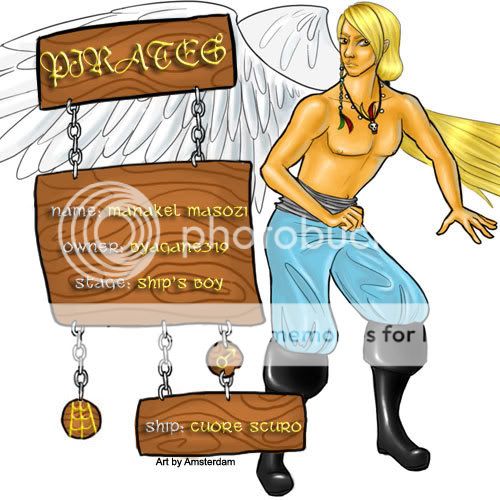 Welcome to the Logs of Manakel Masozi, owned by Byagane319. This is a private journal, please do not post without permission.  Info Name: Manakel Masozi Owner: Byagane319 Stage: Ship's Boy Crew Position: Rigging Rat Ship: Cuore Scuro Description:Before Mana was born, his father, Jeremiah, was a sailor and his mother, Ariel, a tavern wench. When they met it was love at first sight and he refused to leave her behind when it came time to sail. He brought her aboard and made her his wife on the sea. His crew was very unhappy about having a woman aboard, and one that was currently sleeping with the captain. But he paid them no mind and continued to sail with her. Storms seemed to follow them and the crew demanded that the captain leave his wife on land and come back to see her on occasion. But he refused, saying that he didn’t have the land to do so and he would pine away without her there. Finally he raided enough ships to buy his wife a nice little home and even hire a few servants. He would leave his wife there for a month or two, then grow lonely and return to be with her. He would also take her out with him, again defying his crew’s wishes to keep a woman off their ship. Then, Ariel became pregnant. Jeremiah was overjoyed at the news, but they were far out at sea. They set sail for their home, knowing she would be well along in her pregnancy by the time they reached it. He knew he had to keep his child healthy, but they were not able to keep fresh meats on board to make his son strong. So, despite all pleas by his crew, he began to kill the sea birds that came to eat the refuse thrown off the ship. This was completely against all things that sailors held dear. Sea gulls were the eyes of God on the sea and were to never be harmed. But Jeremiah was determined to have a strong healthy child no matter what the crew said. He even went so far as to challenge God to do something about his actions, claiming he was merely doing what a good husband should and providing for his family. No retribution came then, but it would come later in a horrible form. They finally reached port and Ariel was nearly ready to give birth. Back in their home, Ariel confided in her most trusted nurse, Ramla, that she was worried about her husband. What would he do if the child was still born or worse, so weakened from the voyage that it dies? Ramla was a practitioner of voodoo, so she offered to help protect the child from all harm at its birth. When Ariel went into labor, Ramla was there, and asked the spirits to guide the child safely into this world. And thus, Mana was born a healthy happy child. But something was wrong. Mana had yellow eyes which seemed to peer right into your soul if he stared at you for too long. And then there were the strange bumps on Mana’s back. They were just around the shoulder blades and felt rather solid. At first they were just treated as his bone sticking out for being too thing. But after a few months, it was obvious they were something else, and they were growing. To hide the malformation, Ramla was told to keep Mana with her in the small hut she lived in on the property. She was more than happy to keep the child, showering him with the love and affection his mother no longer wished to give him. As Mana grew he was tutored in a variety of subjects, making him very well educated. Since he was kept hidden, all he really did was read. But his happy life was not to last long. Guilt had begun to creep into his mother's heart and she blamed her husband for the child’s deformity. When the small numbs started to grow soft down and eventually feathers, it was revealed that Mana was growing wings. Ariel couldn’t take it any more; she cursed her child to be a demon brought into this world by her husband and his prideful ways. When Mana was only six years old she went to a cliff, where the sea birds nested along the rocks, and threw herself from its heights. Jeremiah was devastated at the death of his wife and cursed God again for taking her from him. He blamed God for all his misfortunes, right up to his death a few years later. Ramla disappeared from the home, not wanting to be sold again into slavery, and took Mana with her. They traveled to the Caribbean and set up a home on a small island where voodoo was a common practice. She renamed him Manakel Masozi, the tears of the angel of oceans. Mana grew up with the knowledge that he was inherently different than the other children. His skin was much paler than theirs, his hair was blonde, and he had two white wings protruding from his back. Many avoided him and he usually stayed home with his foster mother. He began to believe everyone carried a curse with them, as not all could be physically seen. Ramla taught him the ways of voodoo and told him he had to find the path in life he was supposed to walk. It was when a pirate attack came to the small island that Mana found his calling. Soaring into the sky he defeated many of the pirates, most calling him the wrath of God upon them. It was from one of these pirates that he learned of the cursed ship, Cuore Scuro. He said goodbye to his foster mother, promising to return for visits, and flew off to find the ship and join its ranks as one of the cursed. His most common saying is "The father's sins are visited upon his children." 
|
 |
|
|
|
|
|
|
|
|
|
|
|
|
|
Posted: Sat Feb 17, 2007 6:46 pm
 Rules Rules1. Please do not post unless you have permission. 2. Follow all Gaia TOS and Pirates Rules 3. Mana's opinions aren't mine, please keep that in mind. Table of Contents1. You are here ^_^ 2. Mana's Stats 3. Mana's History 4. The Sea Gull 5. Mana's Cabin 6. Friends and Shipmates 7. Enemies 8. What's in a name? 9. Fighting Styles 10. Important Events 11. Fan Art 12. Current RPs 13. Links to Other RPs 14. Credits
|
|
|
|
|
|
|
|
|
|
|
|
|
|
|
|
|
|
Posted: Sat Feb 17, 2007 6:53 pm
Name: Manakel Masozi (real name unknown) Nicknames: Mana (most common), Angel boy (he hates that), Kel (only Ramla calls him that), Bird Man (Will's affectionate name for him) Age:18 Height: 5'9" Weight: 150 lbs Eye Color: Golden Yellow Gender: Male Sexuality: Unknown, he's still a virgin Family: Jeremiah (father, deceased), Ariel (mother, deceased), Ramla Masozi (foster mother, alive and well) Nationality: English but now considers himself Haitian Languages: French, English, and Haitian Creole Marital Status: No woman has touched me Children:: I fear for them should I ever have them Wing Span: 10-11 feet Likes: Reading, flying, his cat, fresh water, an intelligent coversation, and preening. Favorite Colors: Blue, yellow, white Favorite Food: Anything Haitian but also loves sushi! Favorite Weapon: Mana doesn't normally fight with a weapon, unless you count his wings. But if he were to ever use a weapon, it would be some sort of mace or club so he would beat people over the head as he swooped down on them. Dislikes: Fog, arrows, the completely ignorant, people touching his wings, molting Clothes: Mana hates wearing anything that requires alteration for his wings, so he is usually topless. He's always wearing blue or white pants so when he flies, he can remain unseen. His boots are very strong and cushioned for constant landing on the deck. His VERY long blonde hair is kept in a loose ponytail tied at his shoulders. He does braid one little bit with some beads his foster mother gave him. He also wears his skull necklace for protection. When he is on shore, he wears a long yellow cloak to hide his wings Personality: Mana is normally rather quiet around strangers. He will open up a bit if you make him comfortable but he will never talk much about his past. If you are actually designated as a friend, he will do his best to defend you and even give you a fly around occationally. To his enemies he can be a real pain as he likes to swoop down and attack you. When relaxing Mana loves a good book as he is one of the few pirates who is actually literate. He's more than happy to read to others for entertainment but if he's moody, just leave him with his book. He is very loyal to Captain Teneck since he was allowed to join the crew even though he was not an original cursed member. He see's the ship as his only option for a life off the island he's called home for so many years. Curse: Mana's curse has two parts. The phyiscal part is his eyes and wings. He has been able to fly since he was at least 8 years old, but wasn't allowed to practice much until he moved to the island with Ramla. He is a very strong flier and can stay in the air for hours. His eyes are actually his greatest weapon as they are binocular. He can naturally see as far as the best telescope so he makes for a great scout. The other part of the curse is emotional. Mana is both feared and adored for the white wings on his back as they make him look like an angel. But this kills his sex life and even the most sinful whore fears bringing the antichrist into this world by sleeping with a fallen angel. So Mana has never known love outside of the mother's love of Ramla. They are physical reminds of his father's sins that he cannot wash away. He fears should he ever have children, they will carry his curse as well.
|
|
|
|
|
|
|
|
|
|
|
|
|
|
|
Posted: Sat Feb 17, 2007 6:57 pm
|
|
|
|
|
|
|
|
|
|
|
|
|
Posted: Sat Feb 17, 2007 6:59 pm
((All this was taken from Wikipedia)) Gulls are birds in the family Laridae. They are most closely related to the terns (family Sternidae), auks, and skimmers, and more distantly to the waders. Most gulls belong to the large genus Larus. They are typically medium to large birds, usually grey or white, often with black markings on the head or wings. They have stout, longish bills, and webbed feet. Most gulls, particularly Larus species, are ground nesting carnivores, which will take live food or scavenge opportunistically. The live food often includes crabs and small fish. Apart from the kittiwakes, gulls are typically coastal or inland species, rarely venturing far out to sea. The large species take up to four years to attain full adult plumage, but two years is typical for small gulls. Gulls — the larger species in particular — are resourceful and highly-intelligent birds, demonstrating complex methods of communication and a highly-developed social structure. Certain species (e.g. the Herring Gull) have exhibited tool use behaviour. Many species of gull have learned to co-exist successfully with man and have thrived in human habitats. Others rely on kleptoparasitism to get their food. Two terms are in common usage among gull enthusiasts for subgroupings of the gulls: Large white-headed gulls for the 16 Herring Gull-like species from Great Black-backed Gull to Lesser Black-backed Gull in the taxonomic list below White-winged gulls for the two Arctic-breeding species Iceland Gull and Glaucous Gull Hybridisation between species of gull occurs quite frequently, although to varying degrees depending on the species involved (see Hybridisation in gulls). The taxonomy of the large white-headed gulls is particularly complicated. In common usage, members of various gull species are often called sea gulls or seagulls. This name is used by laypeople to refer to a common local species or all gulls in general, and has no fixed taxonomic meaning. The Glaucous Gull, Larus hyperboreus is a large gull which breeds in the arctic regions of the northern hemisphere and the Atlantic coasts of Europe. It is migratory, wintering from in the North Atlantic and North Pacific oceans as far south as the British Isles and northernmost states of the USA, also on the Great Lakes. A few birds sometimes reach the southern USA and northern Mexico. This species breeds colonially or singly on coasts and cliffs, making a lined nest on the ground or cliff. Normally, 2-4 light brown eggs with dark chocolate splotches are laid. This is a large and powerful gull, very pale in all plumages, with no black in the wings or tail. Adults are pale grey above, with a thick yellow bill. Immatures are very pale grey with a pink and black bill. This species is larger and thicker billed than the similar Iceland Gull, and is as large as the Great Black-backed Gull. They take four years to reach maturity. The call is a "laughing" cry like Herring Gull. These are omnivores like most Larus gulls, and they will scavenge as well as seeking suitable small prey. These birds forage while swimming or walking, also may pick up items off water or catch small birds while flying. They often follow fishing boats and are one of the most predatory gulls.
|
|
|
|
|
|
|
|
|
|
|
|
|
|
|
Posted: Sat Feb 17, 2007 7:02 pm
DescriptionMana's cabin, or at least his side of the cabin, is rather unusual. Due to his wings, he cannot sleep on his back so he has fashioned a flat bed on the floor instead of the normal hanging hammock used by other pirates. This gives him a bit more room to stretch his wings and lets him sleep comfortably on his stomach. Next to his bed is a small voodoo shrine inside a cabinet that he says prayers to every morning and every night. Anything from small cups of rum to statues of spirits to dead chickens can be found here; depending on what ritual he is performing. He also has candles, insence, and some tobacco to burn as offerings to the spirits. He is extremely protective of this and does not like anything to be touched. Just above his bed he put a large shelf to place all his other valuables. His valuables include the bed of his beloved Darling Nicky. He found the small tabby when he was on the island about to leave for the first time with the Cuore Scuro. He took the animal as a sign of good fortune on the sea and gave it the name Darling Nicky, for he had no darling of his own. As one of his favorite colors was purple, he gave Nicky a little bow on her tail. Nicky sleeps between his clothes and his small collection of statues. Inventory*A black twine necklace with a stone skull charm, also has and red feather and a yellow feather on it *Black twine to tie his hair back *A few beads and feathers for his braid *5 differnet spirit statues for his shrine (Mami Wata, Eshu, Obatala, Shango, and Agwé) *3 partially burned candles *A bottle of rum *a small bag of tobacco *Incense sticks *a belt *extra pants *his boots *a comb for his wings *yellow cloak for shore leave  My Treasure Box My Treasure Box 6 dubloons - from battle with Dementia 10 dubloons - best over all journal contest 1 dubloon - Honorable Mention Pirate Avy 5 dubloons - Attack on Merchant Ship 10 dubloons - Tome Keeper Total = 32 dubloons
|
|
|
|
|
|
|
|
|
|
|
|
|
|
|
|
|
|
Posted: Sat Feb 17, 2007 7:04 pm
 Jasper: Jasper: One of my shipmates here on the Cuore Scuro. Poor guy, iguana blood makes cold weather a pain. But he's good to talk to. We both hate fog so we complain together a lot.  Wicktoria: Wicktoria: A female with a bat curse. She is one of my fellow rigging rats. She's usually precise and to the point.  William: William: Another rigging rat friend of mine. He and I get along quite well despite him always calling me "bird-man". He means no harm by it and we are usually joking around up in the sails. He trusts in my sight to find our next score. He is also my roommate, a quite fellow with his own secrets to keep. I suppose it is best we are together.  Captain Teneck: Captain Teneck: This is the man I owe my current position too. He took me onto his ship even though I did not carry the curse the rest of his crew did. I suppose having my own curse gives me some sort of belonging amongst his crew. Currently he is the only one aboard who knows my past, and I plan to keep it that way  Valentine: Valentine: He's one of the ship's gunners. Thought I don't fancy getting my wings too close to that maw on his stomach.  Amie: Amie: A feline woman of the ship. If she were tan, she would remind me of my darling. Some seem to think I should be scared of her as she is feline and I am bird. But I am not all that frightened of her. We are on good terms and I think highly of her. She seems to think I have some romantic advantage over women having these wings.  Clovis: Clovis: Our cook. Not bad for a guy with one arm. I'm still not too sure as to his breeding. But Bondyè loves us all despite how we appear.  Diego: Diego: The blind spaniard. He is our craftsman, and a good one at that. He has always intrigued me as he seems to know where everyone is at all times.  Darling Nicky: Darling Nicky: My faithful cat. I got her when she was just a kitten. She's such a big girl now. She always makes me smile when I come down to sleep. She'll take a nap on my wings if I take a nap. Thankfully none though the other ship we attacked might not be to happy with us at the moment.
|
|
|
|
|
|
|
|
|
|
|
|
|
|
|
Posted: Sat Feb 17, 2007 7:07 pm
((This is all from Wikipedia and a few other websites. This is mostly what Mana practices but some of it might be incorrect. I apologize for any mistakes. I'm only doing it for culture)) The term Vodou (Vodu or Vudu in Benin; and Togo; also Vodon, Vodoun, Voudou, or other phonetically equivalent spellings. In Haiti; Vudu (an Ewe word, also used in the Dominican Republic) is by some individuals applied to the branches of a West African ancestral religious tradition. It is important to note that the word "Voodoo" is the most common and known usage in American and popular culture, and is viewed as offensive by the Afro-Diaspora practicing communities. However, the different spellings of this term can be explained as follows: The word "Voodoo"' is used to describe the Creole tradition of New Orleans, Vodou is used to describe the Haitian Vodou Tradition, while Vudon and Vodun and Vodoun are used to describe the deities honoured in the Brazilian Jeje (Ewe) nation of Candomble as well as West African Vodoun, and in the African-American Diaspora. When the word "Vodou/Vodoun" is capitalized, it denotes the Religion proper. When the word is used in small caps, it denotes the actual deities honored in each respective tradition. Its roots are believed to be varied and include the Fon, Mina, Kabye, Ewe, and Yoruba peoples of West Africa, from western Nigeria to eastern Ghana. In Benin, Vodun is the national religion, followed by around 80% of the population, or some 4½ million people. The word Vodún "Vodoun" "Vudu" is the Fon-Ewe word for spirit. Voodoo in Haiti is highly influenced by Central African traditions. The Kongo rites, also known in the north of Haiti as Lemba (originally practiced among the Bakongo) and is as widespread as the West African elements. The Vodoun religion was suppressed during slavery and Reconstruction in the United States, but maintained most of its West African elements. Creolized Haitian Vodou is practiced by less than 1% of African-Americans, but is the most widely known and written New World Vodou religion, and is the religion of Haiti. In Haitian Voodu or Sèvis Gine or "African Service" in Haiti, a form of Vodou, Haitian Vodou also has strong elements from the Bakongo of Central Africa and the Igbo and Yoruba of Nigeria, although many different people or nations of Africa have representation in the liturgy of the Sèvis Gine. Among these other nations are the Taíno and Arawak Indians, venerated as the indigenous population (and hence, a form of ancestors) of the island now known as Hispaniola. A large and significant portion of Haitian Vodou most often overlooked by scholars, especially English-speaking ones, until recently is the Kongo component. The entire Northern area of Haiti is especially influenced by Kongo practice. In the North, it is more often called Kongo Rite or Lemba, from the Lemba cult of the Loango area and Mayombe. In the south, Kongo influence is called Petro. Many loas or lwas (also a Kikongo term) are of Kongo origin such as Basimbi, Lemba, etc. Haitian creole forms of Vodou exist in Haiti, the Dominican Republic, parts of Cuba, the United States, and other places that Haitian immigrants dispersed to over the years. However, it is important to note that the Vodoun religion existed in the United States, having been brought over by West Africans enslaved in America, specifically from the Ewe, Fon, Mina, Kabaye, and Nago groups. Some of its more enduring forms still exist in the Gullah Islands. There is a re-emergence of these Vodoun traditions in America, which maintains the same linealritual and cosmological elements as is practiced in West Africa. These and other African-diasporic religions such as Lukumi or Regla de Ocha (also known as Santería) in Cuba, Candomblé and Umbanda in Brazil, all religions that evolved among descendants of transplanted Africans in the Americas. It is also important to not that although other Haitian Vodou is culturally known as Creolized, its cosmology, rituals and divine power is completely African, and could stand on its own minus all other cultural and linguistic influences.  Beliefs BeliefsHaitian Vodouisants believe, in accordance with widespread African tradition, that there is one God who is the creator of all, referred to as "Bondyè" (from the French "Bon Dieu" or "Good God"). Bondyè is distinguished from the God of "the whites" in a dramatic speech by the houngan Boukman at Bwa Kayiman, but is often considered the same God of other religions, such as Christianity and Islam. Bondyè is distant from His/Her/Its creation though, and so it is the spirits or the "mysteries", "saints", or "angels" that the Vodouisant turns to for help, as well as to the ancestors. The Vodouisant worships God, and serves the spirits, who are treated with honor and respect as elder members of a household might be. There are said to be twenty-one nations or "nanchons" of spirits, also sometimes called "lwa-yo". Some of the more important nations of lwa are the Rada (corresponding to the Gbe-speaking ethnic groups in the modern-day Republic of Benin, Nigeria, and Togo); the Nago (synonymous with the Yoruba-speaking ethnicities in Nigeria, the Republic of Benin, and Togo); and the numerous West-Central African ethnicities united under the ethnonym Kongo. The spirits also come in "families" that all share a surname, like Ogou, or Ezili, or Azaka or Ghede. For instance, "Ezili" is a family, Ezili Dantor and Ezili Freda are two individual spirits in that family. The Ogou family are soldiers, the Ezili govern the feminine spheres of life, the Azaka govern agriculture, the Ghede govern the sphere of death and fertility. In Dominican Vodou, there is also an Agua Dulce or "Sweet Waters" family, which encompasses all Amerindian spirits. There are literally hundreds of lwa. Well known individual lwa include Danbala Wedo, Papa Legba Atibon, and Agwe Tawoyo. In Haitian Vodou, spirits are divided according to their nature in roughly two categories, whether they are hot or cool. Cool spirits fall under the Rada category, and hot spirits fall under the Petwo category. Rada spirits are familial and congenial, while Petwo spirits are more combative and restless. Both can be dangerous if angry or upset, and despite claims to the contrary, neither is "good" or "evil" in relation to the other. Everyone is said to have spirits, and each person is considered to have a special relationship with one particular spirit who is said to "own their head", however each person may have many lwa, and the one that owns their head, or the "met tet", may or may not be the most active spirit in a person's life in Haitian belief. In serving the spirits, the Vodouisant seeks to achieve harmony with their own individual nature and the world around them, manifested as personal power and resourcefulness in dealing with life. Part of this harmony is membership in and maintaining relationships within the context of family and community. A Vodou house or society is organized on the metaphor of an extended family, and initiates are the "children" of their initiators, with the sense of hierarchy and mutual obligation that implies. Most Vodouisants are not initiated, referred to as being "bosal"; it is not a requirement to be an initiate in order to serve one's spirits. There are clergy in Haitian Vodou whose responsibility it is to preserve the rituals and songs and maintain the relationship between the spirits and the community as a whole (though some of this is the responsibility of the whole community as well). They are entrusted with leading the service of all of the spirits of their lineage. Priests are referred to as "Houngans" and priestesses as "Manbos". Below the houngans and manbos are the hounsis, who are initiates who act as assistants during ceremonies and who are dedicated to their own personal mysteries. One does not serve just any lwa but only the ones they "have" according to one's destiny or nature. Which spirits a person "has" may be revealed at a ceremony, in a reading, or in dreams. However all Vodouisants also serve the spirits of their own blood ancestors, and this important aspect of Vodou practice is often glossed over or minimized in importance by commentators who do not understand the significance of it. The ancestor cult is in fact the basis of Vodou religion, and many lwa like Agasou (formerly a king of Dahomey) for example are in fact ancestors who are said to have been raised up to divinity. Liturgy and practice After a day or two of preparation setting up altars, ritually preparing and cooking fowl and other foods, etc., a Haitian Vodou service begins with a series of Catholic prayers and songs in French, then a litany in Kreyòl and African "langaj" that goes through all the European and African saints and lwa honored by the house, and then a series of verses for all the main spirits of the house. This is called the "Priyè Gine" or the African Prayer. After more introductory songs, beginning with saluting the spirit of the drums named Hounto, the songs for all the individual spirits are sung, starting with the Legba family through all the Rada spirits, then there is a break and the Petwo part of the service begins, which ends with the songs for the Gede family. As the songs are sung spirits will come to visit those present by taking possession of individuals and speaking and acting through them. Each spirit is saluted and greeted by the initiates present and will give readings, advice and cures to those who approach them for help. Many hours later in the wee hours of the morning, the last song is sung, guests leave, and all the exhausted hounsis and houngans and manbos can go to sleep. On the individual's household level, a Vodouisant or "sèvitè"/"serviteur" may have one or more tables set out for their ancestors and the spirit or spirits that they serve with pictures or statues of the spirits, perfumes, foods, and other things favored by their spirits. The most basic set up is just a white candle and a clear glass of water and perhaps flowers. On a particular spirit's day, one lights a candle and says an Our Father and Hail Mary, salutes Papa Legba and asks him to open the gate, and then one salutes and speaks to the particular spirit like an elder family member. Ancestors are approached directly, without the mediating of Papa Legba, since they are said to be "in the blood". Values and ethics The cultural values that Vodou embraces center around ideas of honor and respect — to God, to the spirits, to the family and society, and to oneself. There is also a notion of relative propriety — and what is appropriate to someone with Dambala Wedo as their head may be different from someone with Ogou Feray as their head. For example, one spirit is very cool and the other is very hot. Coolness overall is valued, and so is the ability and inclination to protect oneself and one's own if necessary. Love and support within the family of the Vodou society seems to be the most important consideration. Generosity in giving to the community and to the poor is also an important value. One's blessings come through the community and there is the idea that one should be willing to give back to it in turn. Since Vodou has such a community orientation, it is sometimes seen as an extension of the beliefs in the old Soviet Union, and, since the dissolution of the USSR, has drawn many Russian initiates. There are no "solitaries" in Vodou, only people separated geographically from their elders and house. A person without a relationship of some kind with elders will not be practicing Vodou as it is understood in Haiti and among Haitians. In the view of some the Haitian Vodou religion is an ecstatic rather than a fertility based tradition and because of this some do not have prohibitions against gay men and lesbian women. Although it is rare, there are hounfos or temples in Haiti whose clergy are entirely gay males or lesbians, etc.
|
|
|
|
|
|
|
|
|
|
|
|
|
|
|
|
|
|
Posted: Sat Feb 17, 2007 7:08 pm
ManakelManakel is the angel of the oceans and is charged with protecting and guiding the animals, fish and plant life that live in the sea. He encourages us to get in touch with our deep inner wisdom Masozi Gender: Masculine & Feminine Usage: African Means "tears" in Tumbuka.
|
|
|
|
|
|
|
|
|
|
|
|
|
|
|
Posted: Sat Feb 17, 2007 7:09 pm
This is where I will put Mana's many fighting abilities. Both physically and from the air.
|
|
|
|
|
|
|
|
|
|
|
|
|
|
|
|
|
|
Posted: Sat Feb 17, 2007 7:10 pm
 HaitiHistory HaitiHistory((I'm only recording the history of the island for the first few hundred years as anything beyond 1800s is not "piratey" enough for me ^_^ )) The island of Hispaniola, of which Haiti occupies the western third, was originally inhabited by the Taíno and Arawak peoples. Christopher Columbus landed at Môle Saint-Nicolas on December 5, 1492, and claimed the island for Spain. Nineteen days later on Christmas Eve, 1492, the Santa Maria ran aground near the present site of Pen-island Cap-Haitien and Columbus was forced to leave 39 men, founding the settlement of La Navidad . Ayiti, which means "mountainous land", is a name used by its early inhabitants, the Taino-Arawak people, who also called it Bohio, meaning "rich villages", and Quisqueya, meaning "high land". The Taínos were a seafaring branch of the South American Arawaks. Taíno means "the good" or "noble" in their language. A system of cacicazgos (chiefdoms) existed, called Marien, Maguana, Higuey, Magua and Xaragua, which could be subdivided. The cacicazgos were based on a system of tribute, consisting of the food grown by the Taíno. Among the cultural signs that they left were cave paintings around the country, which have become touristic and nationalistic symbols of Haiti. Xaragua is modern day Leogane, a city in the southwest. One of the earliest leaders to fight off European conquest was Queen Anacoana, a Taino princess from Xaragua who married Chief Caonabo, a Taino King from Maguana. The two fought hard against the Europeans; she was captured by the Europeans and executed in front of her people. Other noted Taino leaders from Haiti are Chief Guacanagari, Chief Guama and Chief Hatuey (who later fled to Cuba and helped fight the Spaniards there). Cacique Henri, another Taino chief, fought victoriously against the Spaniards in the Bahoruco to gain freedom for himself and his people. The town associated with this history is Anse a Pitres, near the south-eastern town of Jacmel. Most of the Taino-Arawak people are extinct, with majority mixing with African slaves and European conquerors. Colonial Rule Enslavement, harsh treatment of the natives, and especially epidemic diseases such as smallpox caused the Arawak and Taino population to plummet over the next quarter-century. In response, the Spanish began to import African slaves to search for gold on the island. Spanish interest in Hispaniola waned, however, after the 1520s, when vast reserves of gold and silver were discovered in Mexico and South America. Fearful of pirate attacks, the king of Spain in 1609 ordered all colonists on Hispaniola to move closer to the capital city, Santo Domingo. However, this resulted in British, Dutch and French pirates establishing bases on the island's abandoned northern and western coasts. French settlement of the island began in 1625, and in 1664 France formally claimed control of the western portion of the island. By the 1697 Treaty of Ryswick, Spain ceded the western third of Hispaniola to France. France named its new colony Saint-Domingue. While the Spanish side of the island was largely neglected, the French side prospered and became the richest colony in the Western Hemisphere, exporting large amounts of sugar and coffee. French colonial society contained three population groups: Europeans (about 32,000 in 1790) who held political and economic control; the gens de couleur, some 28,000 free blacks (about half of which had mulatto background) who faced second-class status; and the slaves, who numbered about 500,000. (Living outside French society were the maroons, escaped ex-slaves who formed their own settlements in the highlands.) At all times, a majority of slaves in the colony were African-born, as the very brutal conditions of slavery prevented the population from experiencing growth through natural increase. African cultures thus remained strong among slaves until the end of French rule. Geography Haiti's terrain consists mainly of rugged mountains with small coastal plains and river valleys. The east and central part is a large elevated plateau. The highest point in Haiti is Chaine de la Selle at 2,680 m (8,793 feet). The 360-km (224-mile) border is shared with the Dominican Republic. In 1925, Haiti was a lush tropical paradise, with 60% of its original forest covering the lands and mountainous regions. People 90% of Haitians are of predominate western African (Songhai) descent . The rest are White or mulatto, including descent from French, Levantine, Spanish, Italian, German, Dominican, Arab, and East Indian ancestors. There is a very small percentage within the minority who are of Japanese origin. Up to a million Haitians live in the Dominican Republic. LanguageHaiti's official languages are French and Haitian Creole (Kreyòl Ayisyen). Nearly all Haitians speak the latter, a creole based primarily on French and African languages, with some Taíno, Portuguese and Spanish influences. Spanish is spoken near the border due to the proximity of the Dominican Republic and is increasingly being spoken westward from the border as Dominican and Cuban trade influence Haitian affairs. Some Haitians also speak American English. ReligionRoman Catholicism is the state religion, which the majority of the population professes. An estimated 20 percent of the population practices Protestantism. Protestant churches of numerical strength are Assemblées de Dieu, the Convention Baptiste d'Haïti, the Seventh-day Adventists, the Church of God, the Church of the Nazarene, the Église Episcopale d'Haïti and the Mission Evangelique Baptiste du Sud-Haïti. A small percentage of the population in Haiti also practice the religion of Vodou or Voodoo, whether exclusively or alongside their Roman Catholic observances. Some of Haiti's traditions and artistic styles reflect a unique syncretism, or combination, of Roman Catholicism and the African-derived Vodou (or Vodoun). MusicThe music of Haiti is easily distinguished from other styles. It includes kompa, twobadou, rasin and kadans. Other musical genres popular in Haiti include Trinidadian Soca, merengue (originating either in the Dominican Republic or Haiti), and zouk (a combination of kompa and music from the French Antilles). Musicians such as T-Vice and Carimi perform regularly in the United States and Québec. Sweet Micky is unarguably one of the greatest legends of Kompa music, he is called the President of Kompa. The most successful and well known Haitian artist of this epoch is Wyclef Jean, who is internationally recognized for being one of the first Haitian artists to find commercial success. CuisineThe cuisine of Haiti is influenced in a large part by French cuisine as well as some native staples originating from African and Taíno cuisine such as cassava (kasav), yam, and maize (mayi). Haitian food, though unique in its own right, shares much in common with the rest of Latin America. Some popular dishes are: Haitian cuisine Diri ak Pwa: Rice and Beans Grillo: Fried Pork Tasso: Fried Goat Canard Fri: Fried duck Sòs poulet: Chicken in sauce Mayi moulen: Cornmeal Sòs pwa: a sweet bean sauce Legume: Vegetables (okra, eggplant, tomatoes, and more ingredients) Poisson: Fish La Bouillie: A sort of porridge made from green bananas or fine grain corn meal Diri au Let: A dessert composed of sweetened milk and rice Bananne Fri/Peze: (Fried Plantains, also popular in the Dominican Republic) Lambi: Conch Cribiche: Shrimp Diri A Pwa Rouge: Rice with Red Beans Langue Beuff: (loosely translated: Cow's Tongue)The tongue of a cow cooked similar to the cooking of chicken. It is also a flaky pastry coated with sugar. Casave a Manba: Casava bread with peanut butter Akasan: Cornmeal Milk Fresco: Similar to the Italian Ice they also serve this in Puerto Rico Diri ak Jon jon=Riz Noir au Champions: Black rice with mushrooms Polet Le Manrango: Baked chicken legs and wings coated with ketchup and parmesan cheese Marinade: chicken mixed with flour, and fried in oil. Friture/Fritage: a mixture of fried=frit foods; Grillot, marinade, patate, bananne peze/fri, accra, served with piklese= a dressing made of very hot and spicey peppers. Beyen: Fried bananna dessert: made with very ripe bannanas, mixed with some flour, fried into little round patties served with sugar sprinkled on top. A preferred seasoning known as Epis in Haiti is commonly referred to as Sofrito by the rest of the region, a basic recipe goes as following: Celery Scallion Red peppers Green peppers Cilantro Onion Garlic Vegetable Oil Tomatoes (optional, but used in some provinces) All of the ingredients are blended together and a dash of sugar or Adobo is added. Salt should not be included or subsituted for the recipe. This seasoning is used to condiment or prepare meats, cooked rice and/or stews.
|
|
|
|
|
|
|
|
|
|
|
|
|
|
|
Posted: Sat Feb 17, 2007 7:12 pm
Mana's Full Picture  Mana's Darling Nicky ^_^  Me and William after battle 
|
|
|
|
|
|
|
|
|
|
|
|
|
|
|
|
|
|
Posted: Sat Feb 17, 2007 7:13 pm
Again we are victorious against a merchant ship. The captain wishes to return to the original island where we make berth. Meanwhile, William has confessed to me that he wishes to be a captain one day. As he is my dearest friend, I have offered to help him make his curse permanent and donate my dubloons to buying a ship for him when we have enough.
|
|
|
|
|
|
|
|
|
|
|
|
|
|
|
Posted: Sat Feb 17, 2007 7:16 pm
|
|
|
|
|
|
|
|
|
|
|
|
|
Posted: Sat Feb 17, 2007 7:18 pm
|
|
|
|
|
|
|
|
|
|
|
|
|