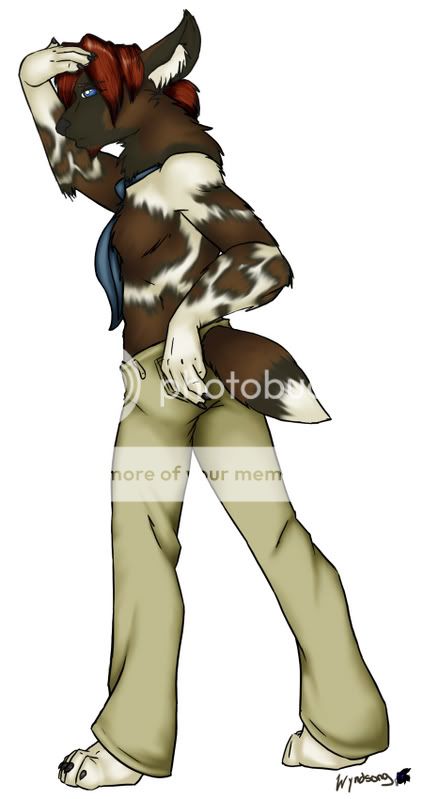
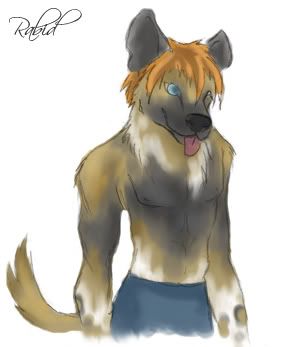
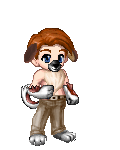
Character Name: Brian Mitchell Grant
Random Trivia:Age: 28
Height: 6'3"
Weight: ~215 lbs
Birthplace: Ontario, Canada
Likes: Pink Lemonade, Animals, Apple Tea, Taking Notes, Observing Behaviours, Sketching, Bowling, Karaoke, Culture Shocks, And Strawberry Margaritas
Dislikes: Poachers, Beer, Bigots, Farmers, Scorpions, Sandstorms, Government Officials, Puppy Mills, Politics, Rap Music, Sport Hunters
InventoryPackage of pocket-kleenex
Wallet with:
-About $100 Cdn
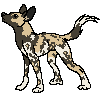
-Picture of Brian with an African Wild Dog
-Picture of a young man with wild, curly red hair
Cellphone
Notebook
Sketchbook
Several small notepads
Brown leather briefcase
Spare shirt
The Howls of August by Michael Runtz
Wolf Country by John and Mary Theberge
Several hastily-written paragraphs stapled together
Various field-notes
Brian is very much a child at heart; he�s enthusiastic, loves his work, and can occasionally be a bit excitable. He�s incredibly friendly, but at the same time a bit socially inept. He tends to become absorbed in his work and has difficulty relating to other people outside of a teammate context. Brian is forever observing, and finds himself struggling to involve himself rather than sit back and absorb information. His sense of justice and morality is overwhelmingly strong at times, and he finds that while often unable to associate with other people, he�s very good at sympathising and seeing things from their point of view. He always has a notebook or sketchpad on hand, and feels the itch of science in the back of his mind when he discovers something new. Forever recording and analyzing, Brian finds the simplest pleasure in being alone with his notebook to mull over information and hypothesize, seeking patterns and highlighting irregularities and their causes.
Character Background: Brian always considers himself lucky for his upbringing. His parents, though they spoiled him a little and were very lenient with their rules, loved him and his younger brother to no end. When, at the age of two, he visited the zoo for his very first time, he discovered a passion and adoration for animals. From that moment on, unless it had an animal in it, nothing would do. He would read only bedtime stories that had animals in them, and would play with only toys that had some manner of beast or bug portrayed on it. As he grew, so did his love for nature. Growing up with a house right up against a little creek, Brian would spend hours in the backyard, listening to bird calls and inspecting abandoned burrows. By the time he was sixteen, he knew that whatever he did in life would have to have something to do with animals- but what?
For a long while, he considered pursing the trail of a wildlife artist. He teachers encouraged him, but their criticism of his loose, sketchy style and his dislike of working with paint of any sort soon threw him off that pathway. His next attempt at finding the perfect career also failed, but proved to be insightful. He wanted to be a zookeeper. Attending the Toronto Zoo as a volunteer and assistant was at first gratifying, but Brian soon grew weary of scooping up feces, knowing exactly what that animal had eaten and knowing he would find nothing new or exciting if he bothered to check. The animals seemed to reflect his boredom with the job, walking the same path around the same enclosures, following the same routine every day. Brian realised upon graduating high school (two years early at the age of sixteen, having skipped ahead in elementary) that what he wanted was to roam the wild, and learn things about the animals that roamed as well. After what seemed an impossibly short time in university, he was out in the field, working for the government.
Brian at first loved his job, but found that he was treated condescendingly, and had more paperwork and tedious exploits than real adventures. After having worked that job for a few years, he got a call. There was a research team that was looking for a new ecologist to join the team- they�d heard about his penchant for working hands-on and he was just the sort of guy they needed, and would he be interested in the job? Brian jumped on it immediately, working to help procure DNA samples for this research group, funded by a company called Feral Labs. He�d never heard of them before, and never met his superiors one-on-one, but what did he care? It was his dream job!
By the time he was twenty-eight he had worked with the research group for three years, and was considered one of the leading authorities on the behavioural patterns of large mammalian predators, specifically those of the family Canidae. He had collected blood samples from wild animals across the world- Wolves from Algonquin Park in Canada, Coyotes from Yellowstone in the United States, Dingoes from pockets of natural forests in Southeast Asia, and even the elusive Dholes of the jungles in India. His latest capture had been of an African Wild Dog, one of a steadily declining group that had been suffering from disease picked up through interaction with domestic dogs. He had returned to the local branch of their research centre, known by him and others of his team as the water hole, to file the paperwork. Unwittingly he stumbled across files he clearly had never been meant to see. Files relating to the testing of genetic mutation on human beings. Live humans beings. He flew into an outrage, and, threatening to reveal the files to authorities, demanded of his superiors an explanation.
During his work at the facility, Brian discovers the real purpose of his research and DNA collecting. Enraged by the use of humans for what he considers "pointless vindictive experimentation spurred only by curiosity" and the fact that he'd been lied to for years by his superiors and co-workers, he threatened to go to the government with what he knew. Before he could, the head of the research facility, one good doctor Moreau, offered him a chance to talk things over and explain what was really going on. Surely it was a misunderstanding. Always willing to see the good in people, Brian allowed himself to be taken to the island to "talk things over".

Zachary, 'Dragon': unfriendly animals to avoid:
>>>>Gaius- Big (?)
>>>>Rex - Lion: Antisocial, violent.
Long term stay- request for camera w/ telephoto lense?
>>>>(Name?) - Cobra - Mentally unstable - strangulation?
Room 1 and 5 - Ambrose, Pyroth
To see: 1, 5, 14, 57
Room 57 - Lucas
>>>>Dhole
>>>>Notes: Expressive ears and tail, fur
>>>>>>>> Residence 2 months
Strong suspicion - DNA splicing of canine
DNA Samples encountered so far:
>>>>Unknown ("Dragon")
>>>>Coleoidea: I
>>>>Canidae: II
>>>>Stomiidae: I
Leopard Woman: Reacted to blood
Change in diet prominent - all?
Room 1 - Ambrose
>>>>Wolf
>>>>Notes: Full wolf face, dextrous paws, full tail, unslurred speech, retained human hair. Displayed wolf-like behaviour intermingled with human habits, expressed self through varying degrees of body language.
>>>>>>>> Residence time unknown.
December 29th, 2006, 8:34 am
Second transformation impending
-Increased facial hair
-No itching
Notes:
First transformation was essentially painless
Shifting of anklebone can be expected to continue
Other possibilities (?)
11:56 am
-Pain in lower back, calves, ankles, feet, han






 Reply
Reply