![[ Lacroix ]'s avatar](https://a1cdn.gaiaonline.com/dress-up/avatar/ava/6a/09/d91535d34096a_flip.png?t=1332781731_6.00_10)


Retsamdrol
I know I'm not sensei, but I'm a friend of hers, and she said that I should help >_>
I wouldn't know if anyone is doing this already, but be sure that in your stroke order for hiragana that you always start not only with horizontal lines, but you draw the whole character from LEFT to RIGHT.
An example of a character with not all horizontal lines first is 'ha'
Drawn as such:

Another weird example is 'wa' in which the vertical line of the character is written first.
People probably already knew this stuff, though, and I'll just feel stupid for reminding you <_<;;
Ganbatte ne!
-Rets
I wouldn't know if anyone is doing this already, but be sure that in your stroke order for hiragana that you always start not only with horizontal lines, but you draw the whole character from LEFT to RIGHT.
An example of a character with not all horizontal lines first is 'ha'
Drawn as such:
Another weird example is 'wa' in which the vertical line of the character is written first.
People probably already knew this stuff, though, and I'll just feel stupid for reminding you <_<;;
Ganbatte ne!
-Rets
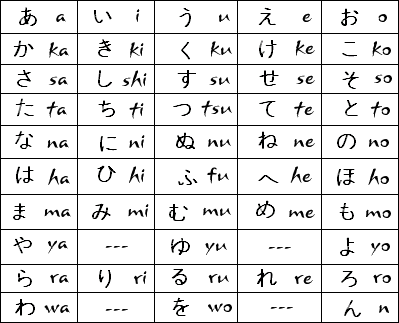
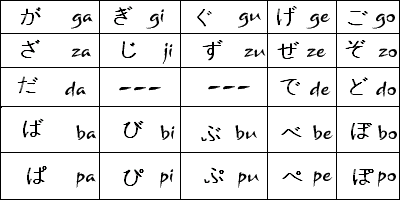
What Is This?: The letters and symbols you see above you are Hiragana. Hiragana is one of three forms of writing used in the Japanese language. The other two forms are katakana and kanji. Katakana is used for English words translated into Japanese (such as Ramune, a very popular japanese drink with a marble used as the lid, or 'haambaaga', the Japanese pronounciation of hamburger). Kanji is most difficult form of writing with thousands of characters used. A typical Japanese newspaper consists of over 1200 kanji. In a regular highschool class, you learn about 900*. However, kanji and katakana are both seperate lessons. :]
Hiragana is the most common writing form used, because it is so easy to learn and it is one of the first things you learn in elementary school.
What does it have to do with Japanese?: Some people start with vocab and sentences, but I believe that starting out our lessons with this will help you break down each word and understand that this language is based on syllables, and not phonetics. Each symbol is worth one syllable, so when you read a word, you can break it down to the syllables and it will make romanji, or 'romanized kanji'(japanese written in "roman letters" aka the English alphabet) much easier to read. :]
Oh, and from here on out, Japanese will be referred to as 'Nihongo'.
What do I need to learn?: Start off with just the basic sounds. "Ah", "ee", "ooh", "eh", and "oh". Then, just add the consonant before it as you go down. Fairly easy, right? You are welcome to start practicing the symbols. But here are some rules:
ichi. all horizontal lines go first.
ni. all non-horizontal lines go second. :]
pretty easy, huh? NOW GET OUT THERE AND PRACTICE!
What should I practice?: Practice drawing and memorizing the sounds. :]
Vocab:
ichi. Hiragana- pronounced "he-ra-gah-nah". Hiragana is one of three forms of writing used in the Japanese language.
ni. Nihongo- pronounced "knee-h-on-go". Nihongo is the Japanese word for Japanese Language. Any country with "go" at the end indicates a language. The only one that isn't is "Amerikago", because, well, there isn't 'American'. Nihon is Japan.
san. Nihon- pronounced "knee-h-on". Nihon is the Japanese word for Japan.
shi. Eigo- pronounced "eye-e-go". Eigo is "English". Ei is not England though.
go. hai- pronounced "hi". nihongo for 'yes'
roku. iie- pronounced "ee-yay". nihongo for 'no'. be careful to make it 'ee-yay' and not 'e-yay' because 'e-yay' means house!
nana. ai shiteru- pronounced "ah-ee-shi-teh-roo". it means 'i love you!' i threw this one in because i use it a lot. ^_^;
Nikore's Ultra Special Gift For You Extra Lesson!
Today, I'll teach you numbers! This will definately help, since I use nihongo numbers a lot! First, we'll do 1-10. :]
Ichi- "ee-chi" One
Ni- "knee" Two
San- "sah-n" Three
Yon- "yo-n" Four
Go- "go" Five
Roku- "roh-ku" six
Nana- "nana" seven
Hachi- "ha-chi" eight
kyuu- "ke-you" nine
jyuu- "je-you" ten
These can't be written in hiragana, so don't even try! :] Anyway, these can only be written in kanji or just written out in numbers or romanji, but the kanji is very, very simple!
I hope you enjoyed today's lesson and will come back next time!
THIS HAS BEEN NIKORE-SENSEI!
JA MATA!
UNTIL NEXT TIME! (^o^)!
Homework:
Copy down the Hiragana chart and work on it.
Memorize numbers 1-10.
Give sensei lots of love. <3
*= I'm just going by my friend who is currently in a Japanese class at his highschool. That's what his teacher told him.
sensei's hints and tips:
if you have trouble memorizing, pronouncing, or learning these, don't worry! just follow sensei's list of hits and tips!
one: EVEN SENSEI HAS TROUBLE! she taught herself most of this, so don't be discouraged if you make a mistake; sensei messed up too! and in japan, did you know they don't call it a mistake? if you get frustrated, PM or post something for L, and she'll get to you AS SOON AS SHE CAN! :]
two: WRITE EVERYTHING DOWN-- TWICE! sensei has quite a boggled mind, so she keeps a whole binder of notes with her. don't feel bad about writing things down, in fact, do it twice so it'll be easier to memorize!
three: DID YOU EVER HEAR THE STORY OF THE MAN WHO ATE A WHALE? how did he do it? ONE BITE AT A TIME! take your time when you do this and break it into pieces. and if you can't, sensei would be glad to cut it into easier, smaller, more digestable pieces. :]