. M . A . J. E .H ✧ . K . U. R . A . Y .A.M.I
x
Gray Guild || Familiar:Tenebrea ||
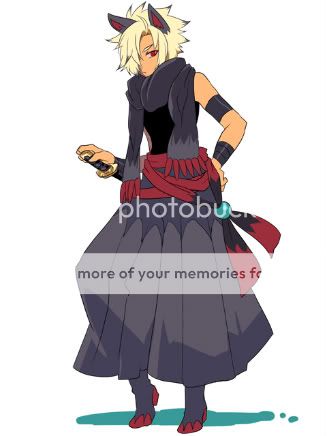
Walking through the graveyard is a tall, young man with long, black hair and gray eyes. His hair is tied into a ponytail and his bangs are swept away from his face.
He wears a long, black jacket with gold trimmings, opened with an upturned collar and rolled-up sleeves, wearing a long-sleeved white shirt underneath, straightened with an unorganized blue necktie with the kanji for Fear etched on it. Underneath, he wears black pants and white shoes. He carries an instrument case and moves toward the back of the graveyard.His name is Majeh.
"
"I wonder why this place was forgotten? " " he said as he walked.
"I feel lingering spirits here . " These words seemed to be absorbed by silence.
"
".Perhaps I'll try out my new instrument before I get to looking around.""
He was told the oboe was designed in response to the needs expressed by professional oboists. The bore shape, tone hole shapes and locations are a result of the manufactures research and close working relationship with a number of highly respected oboists. The result is an instrument with dark centered tone, excellent projection, flexible nuance, even scale and sensitive linkage.The tone of the oboe is warm, resonant, solid, and centered with a dense texture. These qualities give depth and character to short notes as well as long notes.
As Majeh holds the oboe he notices it has a key mechanism that feels smooth, small and comfortable to the hands. Key shape, key placement, and spring tensions are designed to help the his technique. He made sure to ask if instrument is hand-assembled in the small shop, from installation of posts to soldering and fitting of keys and springs. In assembling the keys on their rods and between their posts, great care is taken to make them an exact fit, thus preventing poor pad seating and lost motion. This attention to detail makes slurs smooth, permits light finger pressure and allows true full note production in fast technical passages.
He noticed how the register notes are in tune with the rest of the oboe.
The low register C# is one half step above the C natural and one half step below the D natural. It is not flat as on many other oboes.
The left hand notes on both registers are dark, having sufficient resistance and color to match notes in the right hand.
The middle D natural is warm, resonant and not sharp in pitch or low in color.
The middle register E natural is stable, in tune and resonates with a full tone.
The middle F natural is not flat in pitch and color.
The middle F# and G natural are up in pitch and color. They do not require special reed scraping or pinching the reed.
Slurs to the upper C# and D natural are made easier by tuning them slightly lower.The extreme high register is in tune and easy to slur to or articulate.
Lock screws are put on all pivot screw posts and all posts near the end of a joint to prevent the posts from turning.
Delrin inserts line all top and bottom joint tone holes to keep the instrument working even if it cracks, improve pad seating and ease pad maintenance.Its hand-crafted, silver-plated, nickel silver keys.
Impeccable scale, individually hand-tuned
Full conservatory system key-work, including left F, split E, F resonance, articulated G#, Eb and C#, and, on the Traditional model, 3rd octave key and low B-flat resonance key on bell
Fully inserted tone holes in the top and bottom joints for better sealing, reduction of maintenance costs, and protection in the event of a crack.
Solid magic-stone case, with case cover, screwdriver for minor repairs and, of course, a cork grease holder.
It even had Third octave key and high D key - which is very rare. It was a master piece. Majeh looked around for inspiration before playing an eerie tune.
Ominous




 Reply
Reply