Common Species
Many species are mass-produced for human use but die out in the wild, while some kinds that only had a few individuals created end up thriving outside of human influence.
It's not always obvious why some types succeed while seemingly more efficient forms perish.
Raptors are kimera designed to look like the famous dinosaur. They're the only species that's as intelligent as humanity(although some rare individual kimera also qualify).
- Scaly: This mutation is not even remotely anatomically correct for any dromaeosaur. Pointing this out to one, however, is a good way of getting yourself rearranged into an anatomically incorrect configuration.
Misc
-
Balaur Bondoc: Differs from the main type with heavy feathering(including a thick double crest along the neck), a stocky build, and double sickle claws on each foot.
- Vulture: A partial form of the scaly mutation, raptors born with this gene have mostly normal feathering except for a bald and scaly head and neck. The legs and entire underside may also be bare of feathering in many cases.
Despite their name, arnulves are entirely dog-mixes and have no pure wolf DNA. Claims of wolf-arnulves have consistently been proven fake or as cases of mistaken identity.
The biggest arnulves weigh only about 40lbs due to their hollow bones, but are the size of a german shepherd. Smaller arnulves are fairly common, but bigger ones tend to be an irresistible treat for the much larger griffins if caught alone.
Arnulves form packs, often as large as thirty individuals. They're considered extremely dangerous, but when raised by humans make excellent guard pets.
- Ratulf: This mutation tends to be on the smaller side, although huge individuals are also seen. Much more of the rat DNA in their makeup is apparent, and their sense of smell is thought to be the best of any kimera. Appearances aside, these are just as loyal and devoted as the main type.
Misc
- Cyclops: A rare sub-type with only one eye, no third limb set, and only the most vestigial claws remaining of rear limbs. Although their vision lacks good depth perception, this type has the ability to echolocate. Alongside their sensitive whiskers and powerful wings/forelimbs, this kimera is not to be underestimated.
-Octulf: These kimera are usually considered their own species, but genetic testing shows they're actually descended from common arnulves(and, presumably, an octopus. Life is mysterious.)
Misc
Dragoras
Dragoras are sapient plant creatures very distantly related to the venus fly trap.
Unlike your average flora, dragoras have a well developed nervous system with two main nodes(brains). The smaller of them is located in the head and controls movement, while the larger and more developed brain is safely cushioned in the root base. As long as the main brain is intact, dragoras can regenerate from nearly anything, although loss of the "head" will cause the dragora to fall into a state of hibernation until it regrows.
In the spring, dragoras grow a flower like most other plants. Unlike most plants, dragoras may find this utterly horrifying.
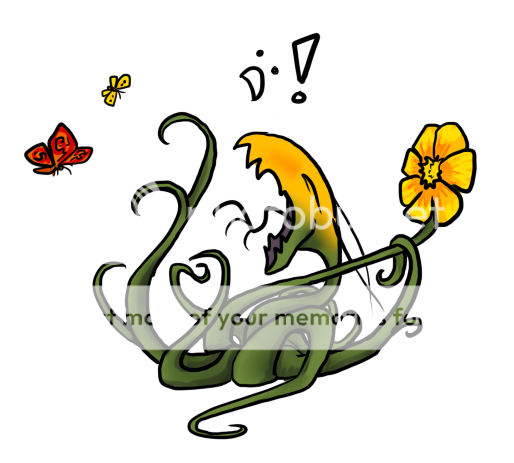
Other: Dragoras don't have eyes and are blind to light, however, they have very sensitive sensors that easily detect heat and,(though the exact mechanism isn't understood) possibly life.
They smell and taste via their antennas and detect movement through their roots like a snake.
Also, they can spit a horrible sticky green goo that never comes out in the wash, so approach with caution.
Misc
- Deadwood variation: These dragoras look like logs, driftwood, or rotted tree trunks. They're covered in bark and often play host to symbiotic fungi.
Being much better camouflaged than the average dragora, you may walk right by one and not notice unless it decides to bite you.
- Hybrids: Some dragoras seem to have more in common with a specific plant species than to each other.
Quetzals
Bat-typeGriffins
Common
Owl-griff
Rok-griff
Avisteline
Common
Misc
Spinx





 Reply
Reply
