|
|
|
|
|
|
|
|
|
 Posted: Mon Feb 21, 2011 5:05 pm Posted: Mon Feb 21, 2011 5:05 pm
𒀭𒆗
Sizwe 'Mouse' Magoro ◉◡◉
-and-
Shalmaneser the Lamassu icon Plague ◉◡◉
1. Welcome & thank you page
2. Sizwe (the guardian)
3. Shalmaneser (the plague)
4. Extra information
5. Reserved
To Do List:
proofread!!
...
Just wanna give a bigbigbig thank you to Zanaroo and (especially!!!) kotaline for helping me with the idea and answering all of my dumb questions! <3
AND EVERYONE ELSE IN PD LIKE HEDJ AND SNOOF AND SNIFIT AND RAVI AND NEON AND EVERYONE ELSE OK <33
love you guys <333
|
 |
|
|
|
|
|
|
|
|
|
|
|
|
|
Posted: Tue Feb 22, 2011 10:24 pm
Grimm
Name:
Sizwe 'Mouse' Magoro
Age:
24
Region:
Born and raised in Auvinus.
Occupation:
A local farmhand. He usually works on his father's land, but is known to help out neighboring lands.
Appearance:
General: Clean-shaven young man standing at a short 5'6, with a muscular solid build. He usually has a small smile on his face as he works.
Hair: Thick black curly mess for hair. He doesn't really know how to brush it.
Eyes: Warm grey eyes topped with thick black brows.
Skin: Tanned skin as he works under the hot Auvinus sun.
Clothes: He's not very well dressed most of the time (as he's a farm-hand), usually dressed in a shirt with the sleeves cut/ripped off (or maybe none at all! * u*!), slacks and a pair of worn down boots.
Sometimes, if he's to dress nicely, he'll put on a clean collared shirt and black slacks held up by suspenders, complete with a nice (but old) pair of shoes. He doesn't really have an occasion to wear this, usually when someone in the village gets married or something equally important he'll be wearing it.
Personality:
A reserved but otherwise good-natured man. Unlike other men his age that he works with, he's not brash and loud and doesn't go out of his way to try an impress a lady. Moreso, he's the type of the guy that's completely fine being the wallflower while his other friends chat up the dames in his village. He enjoys helping out other farmers in his village if he's done with his duties for the day.
Living on a farm all his life, Sizwe's never had the opportunity to go to school, and only learned basic arithmetic (how many bales of hay he sent out, counting money etc.). He's able to recognize bits and pieces of words, like his name and towns, but everything else is a no-go. Being illiterate isn't much of a big deal in his area, as it is more important to cultivate crops under the hot Auvinus sun than it is to discuss politics and other lofty ideas.
He's an easy-going guy, as he's never really been angry or ticked off by someone or their comments. He'll usually just laugh or shrug it off, knowing that they didn't mean it to be mean, and if they did, it wouldn't really bother him as he wouldn't know how to react to it properly as he's pretty quiet. Everyone in the village (including his family) call him 'Mouse' (which is short for 'field mouse') because of his short stature, and not being seen in the tall wheat. He almost always has a small smile on his face as he works.
As an easy-going guy, Sizwe is pushed around a lot, especially by his peers. If anything sparks into a debate or even an argument, Sizwe will always back down first to avoid conflict. Even though it has never happened, it is probably very easy for someone to take advantage of him and have him do whatever s/he wishes.
He's also a hard worker, knowing that most of the money that he and his father make off the farm will go straight to paying the medical bills for his sister and grandmother. To him, they are the two most important priorities in his life and everything goes to them first, than him and his father. He doesn't even stop working when he's ill, and at that point he has to be strapped down to a bed in order to rest up in order work again. Even though he and his father don't make much money to begin with, he still knows that every cent counts towards keeping his family healthy.
Ever since the death of his sister and grandmother and the chaos that ravaged through his village, Sizwe closed himself off, trying his hardest to ignore the villagers. He knows what they did to his family was very wrong, but it is not in his being to hold grudges and to retaliate harshly. To his misfortune however, Sizwe is unable to ignore someone who is in need of help no matter how hard he tries. If he happens to see his neighbor who is in need of assistance, he will go to help them out, resenting himself in the process. Since Sizwe has retreated into himself, this has impacted his work ethic negatively, much to his father's distress.
Relationship with Plague:
At first, when the stone icon transformed into Shalmaneser, naturally Sizwe was horrified out of his mind. Thinking the plague was some sort of possessed demon, he took the heaviest thing he could find (which was his shoe by the way) and was about to smash the plague to bits, until Shalmaneser spoke (very menacingly) to try and calm Sizwe down. That freaked him out even more, realizing the thing was capable of speaking to him.
As time went on however, Sizwe began to respect the plague, for Shalmaneser was extremely wise and offered the human advice every time he came to talk to him. He can't help but be in awe of the plague, because even though Shalmaneser is so small, his presence makes him seem so much larger. He knows the plague wants him to act more 'manlier' and have a stronger personality, but Sizwe knows that it will never happen as he really wouldn't know how to be 'stronger' personality-wise. Nonetheless, he knows Shalmaneser's good intentions and likes to think that he and the plague are on good terms.
History:
Generations before Sizwe and his family, his ancestors settled on Auvinus' fertile farmland, starting up a farm for themselves. Back then they were on the wealthier side of life, building a large manor surrounded by fields of wheat and other crops. As time went on however, his ancestors and their surrounding neighbors grew poorer as technology in the other regions advanced. They were still able to hold onto their farmland, though the many acres they used to own were now cut to only a few. His family had to now work for their money and lived a hard life.
Sizwe was born to Leila and Lungile Magoro. It was a warm breezy spring day the day of his birth, but there was no happiness to be had in the household. It was a tough childbirth for Leila, and soon after the birth of their son she passed away due to complications from the childbirth. It was a sad day in Erlend, Leila was liked very much in the village. Instead, he was raised by his grandmother Angola, and his older sister Inaya. Sizwe has no recollection of his mother, and doesn’t know how to react when the villagers tell him how wonderful his mother was.
Being the only son in the family, it was decided that he would be the one to inherit the farm when he was old enough. It was a tradition in the village; the eldest (or only) son would inherit the farm from their father when the boy was of age. As soon as Sizwe was able to walk, Lungile took him around the farm teaching him about their livestock, their crops, how to chop firewood (he was barely able to lift the axe when he was thirteen) among other chores that had to be done around the farm. Lungile was intentionally hard on his son, wanting to instill a good work ethic in his son. Sizwe lived a Spartan life, getting up in the early hours of dawn, eating a quick breakfast and helping his father around the farm and surrounding lands until dusk since he was a toddler.
He grew up to be a healthy young man, the complete opposite of his older sister Inaya who was born frail and weak. She was a big worry for the family, her sickly nature causing her to be bedridden for most her life. Most of the money they made went straight to her medicinal needs, though the medicine did very little to relieve her ailments. It got harder when Angola, their grandmother got older; as she began to succumb to the hardships of old age. Everything now depended on the efforts of Sizwe and his father.
On that fateful summer day, nothing in Sizwe’s life would ever be the same again. A group of Obscuvians had come into Erlend, come to spread their ideals and beliefs to the farmers. One of the members of the group was ill with the plague, had managed to keep it hidden from the other members of the group. The villagers, though suspicious of the group’s motives, listened to what exactly the Obscuvians wanted from them. Suddenly, the man fell down, dead from the plague.
Almost instantly, the farmers grabbed their heaviest farming equipment wanting the cultists out from their village. The chaos lasted for hours, people on both sides of the opposition dead. They had burned the dead bodies, in fear that the plague would fester in the bodies of the rotting dead.
A few days later, when the village found out the blacksmith also came down with the plague, the whole village erupted into chaos once again. Who would get it next? Suddenly no one could trust one another anymore. They stubbornly refused to believe that they themselves would come down with the Black Death, and the blame was all on their children, their parents, their spouses, and their neighbors. One by one, some of the villagers came down with the plague, and were immediately thrown out of their houses and onto the street left to fend themselves against the villagers.
Sizwe and his family naturally took the precautions of protecting themselves against the Black Death through the superstitious methods of posies and garlic hanging over their doors. Their family was most at risk from the insanity of the villagers because of Inaya and Angola. They were frail, and the easiest targets for the plague. Sure enough, they found black lesions all over Inaya’s back and Angola was coughing up blood as black as ink. Lungile, fearful of the terrible treatments that the villagers would inflict on his daughter and mother hid them underneath the cellar even though he knew it wasn’t the best place for them because of their current state. Sizwe tried his best to keep his sister and grandmother safe from harm, but to no avail when word got out that Lungile had hidden his sickened family from view. The villagers came in the middle of the night, approaching their house with pitchforks and torches setting their house on fire.
The father and son had managed to escape the house unscathed, but it was too late to save Inaya and Angola. As much as Sizwe struggled against his father’s grip to dive into the cellar to grab them, it was too late for them. They were gone, and nothing could be done about it.
It took a month for the plague to run through its course through Erlend, taking one-third of the population with it. Both Sizwe and his father had to start all over again, building a new house after they had cleaned out all the rubble from the fire. His father never really did forgive the villagers for what they had done, and Sizwe wasn't sure if he should either, but was finding it hard to harbor a grudge towards the whole village.
Family:
Lungile Magoro - (Aged 57) Sizwe's father and head of the family. Sizwe is the spitting image of his father, only Lungile's eye's are green and more cold. Much like his son, he is a reserved man, but much more silent than his son. He works hard for his family, putting the needs of his daughter and mother before him. Lungile is hard on his son, wanting him to be more successful than he was. He is often scolded by Angola for going too hard on the boy, even though she knows he's doing it for the best. He won't admit it to anyone, but he misses his wife terribly and visits her grave often, and wears the ring he gave her around his neck.
Angola Magoro - (Deceased) Sizwe's grandmother. She's a kind old woman with a sense of humor, fond of her grandchildren, but always criticizing (lovingly of course) her son Lungile (Sizwe's father). Her health hasn't been in the best shape lately, a big worry for the family. She hates being a burden on the family and refuses to listen to her family's pleas of taking things easy.
Leila Magoro - (Deceased) Inaya and Sizwe's mother. She died shortly after giving birth to Sizwe. Lungile refuses to talk about her, and forbids anyone talk of her. When Lungile isn't around, Angola describes her as a beautiful and kind woman and the best daughter-in-law any mother-in-law could ask for. Everything else about her is a mystery.
Inaya Magoro - (Deceased) Sizwe's older sister and firstborn of Lungile and Leila. A softspoken but stubborn woman with extremely pale skin, she was born a little on the unhealthy side. She doesn't let her ailments bother her, and much like her grandmother helps out around the farm and house even though everyone tells her not to. Inaya is especially fond of her little brother, going out of her way to pack him special lunches for the day. Inaya seems to be quite popular with Sizwe's peers as they always try to give her the time of day.
|
|
|
|
|
|
|
|
|
|
|
|
|
|
|
|
|
|
Posted: Tue Feb 22, 2011 11:54 pm
Plague
Item:
Lamassu Icon
Name:
Shalmaneser (Shall-ma-neezzer)
Name is from an ancient Assyrian King, son of Assurnasirpal II.
Shalmaneser means 'the god Shulmanu is pre-eminent'.
Shulmanu is the god of the underworld, fertility, and war.
Gender:
The Sun (Male)
Appearance:
As Putesco
----The icon is in fact extremely small. It measures only 4 x 3 inches, and has definitely seen better days. The icon is carved from a small rectangular piece of limestone, the relief of the lamassu practically weathered away. It is said that when it was first created, it was painted in bright ceremonial colors making them stand out. Much of the relief has eroded away, but the general imprint of the figure still exists. There is a series of black stains all over the front and back of the icon that resemble finger smudge marks. No matter how much one rubs at it with soap and water, it does not wash off. Lamassu Icon
As Excito
----He wears the Cahlian royal hat on his head. Shalmaneser's 'beard' is actually wisps of black smoke around his chin. He wears what scholars believe what Cahlian leaders wore in brilliant colors of blue and gold (basically Assyrian royal garb).
As Anhelo
----Like his guardian, the plague has a solid build, his body covered in battle scars and wounds. He's much taller than Sizwe, standing at a formidable 6'5. Shalmaneser is bald, but has a thick curly dark beard to make up for his lack of hair. His eyes are dark and fierce, complete with a large hook-like nose. Wears similar clothes to what his excito form wears.
Personality:
Shalmaneser is a proud and silent plague. He considers himself the 'king of all warriors' and does not hesitate to come to the rescue of someone in danger (imagine an excito saving you from a robber). He holds himself in high-esteem and won't hesitate to show his prowess. It is even safe to say that Shalmaneser has a big ego, as he considers himself better and more capable than others and usually judges others right off the bat. He doesn't talk much, or rather, he'll only talk when it is necessary. Usually his speech is rather abrupt and blunt, making him seem like a rather unsociable plague (which he kind of is), but it doesn't mean that he is cruel.
As valiant and vigilant as he may seem, the plague is brash and impulsive, his heart ruling his head. The plague believes that the only way to solve problems is through fighting and power. Shalmaneser doesn't think twice about his actions, and if he creates even a more larger conflict than before, he'll waste no time in trying to solve it with more fighting or force. He is rather good with his words, as he believes a leader must be both strong and well-educated and often offers words of wisdom to Sizwe. But the plague prefers to use his strength than to sit and compromise.
Even though he solves problems with fists rather than words, Shalmaneser will fight for what he believes is 'right'. He has a clear understanding of what is right and wrong, and will not hesitate to prove and fight for it. If a small child has been mistreated by an elder for no apparent reason, Shalmaneser will immediately come to the child's defense, even as an excito. To him, size does not matter in a fight (unless if the strong is picking on the weak) because sometimes, the smaller person will win (in this case him).
As a 'warrior', Shalmaneser has an extremely hard time conveying emotions. He doesn't smile or show sorrow because to him that is weakness. The plague's usual expression is usually devoid of emotion, his mouth curved in a small judgmental frown. Usually, he rubs everyone the wrong way, even if his comment was his way of saying 'thank you very much' or a 'you shouldn't have'. It is unclear whether this bothers him or not.
Relationship with Guardian:
At first, Shalmaneser was very much impressed with Sizwe, seeing that like him, the human was a very strong individual. But just as soon as the human opened his mouth, the plague was very much disappointed with him. To him, Sizwe seemed meek, not something he had anticipated. Shalmaneser has confronted Sizwe about this, stating bluntly that the human could not simply be a man with that demeanor. The Grimm merely chuckled, not taking the plague's criticism seriously. The plague was offended that he was brushed off so easily by the human, and began to resent him. But, he began to notice how hard the human worked to help provide for his family. Especially how hard he worked to keep giving his grandmother and sister medical assistance. To him, this was something to respect, because the plague believes that family is extremely important and decided that even though the human did not act the part of a man, he had very virtuous traits.
Shalmaneser regards Sizwe as a fine companion, but wouldn't consider him as his guardian as the warrior-plague doesn't believe he would need guidance and protection. He respects the Grimm, acknowledging the hard work he puts into providing for his sister and grandmother. Though, as strong Sizwe appears, Shalmaneser wishes that his Grimm would act more like how a 'real man' should act: silent and strong, instead of acting much like a boy at times.
Item History:
The lamassu is a mythical creature created by a nomadic tribe in Yirui centuries ago. Not much is known about the nomadic tribe, who are called the Cahlians, but it is known that they are the ones who have created this creature. To them, the lamassu was a protective deity usually hung over entrances, or carried around by the Chalians for protection. The artifacts of the icon usually found are small, as an icon too large would be hard to carry around. The nomadic tribe was known to have traveled along the west coast of Yirui, coming into contact with Panymium and other sailors. The sailors liked the idea of a powerful creature that was thought to protect them. They too took the lamassu icons with them overseas, as a charm that would protect them and keep them safe for the long months back and forth between the continents.
Though, suddenly, all traces of the Cahlians have vanished a couple centuries later, leaving the stone icons behind. Scholars still debate over what exactly happened to the nomads, but a concrete conclusion has not been reached yet.
This particular icon was one that was brought overseas by a Panynium sailor that happened to reside in Auvinus. There, it was sold and exchanged between many people. Overtime, the lamassu lost its true purpose and was just an old relic that was kept by collectors. Ever since the outbreak of the Black Plague, the icons have made a small reappearance to the the superstitious citizens of the continent, hoping that as a protective deity, it will protect them from sickness and death. The original image of the lamassu has been lost, as the stone icons have been worn down overtime, but the general concept of a benevolent and powerful deity has been the same. The current image of the lamassu looks more menacing and dragon-like, probably as means to 'scare' away the black death. This particular icon sat at the deathbed of many victims who have been inflicted with the plague. The victims prayed and gave offerings to this icon, wanting desperately to live. As an icon it could not do much, and merely hopped around from one inflicted person to the other.
It finally came into the hands of a radical priest part of the Obscuvians, who traveled in a group throughout Auvinus praying with the locals to the lamassu to spare them from the plague.
How it came to be in Sizwe's possession:
The radical priest and the Obscuvians reached Erlend on a hot summer day, come to spread the good word of Obscuvos to try and garner followers in the little village while looking for plagues to collect from the villlage. Unknowingly, they had brought the black death with them, one of the Obscuvians who had hidden the disease from the others.
The other members, unaware of this gathered up the suspicious villagers Sizwe in the crowd, trying to spread their 'good word' to the villagers, until the man dropped dead in the front of the crowd.
Chaos erupted almost immediately, the farmers taking action and driving them out of the village their most sharpest and heaviest weapons in hand. Obscuvos, both startled by both the death and the farmers' hostile reactions scrambled to get out of the village as fast as they could unscathed. Unfortunately, it didn't bode well for some of the Obscuvians as the farmers were much faster than them, beating down some of the slower Obscuvians, the radical priest included in the massacre.
Sizwe at this time, was lost in the madness, utterly confused by what was going on in the crowd and wanting to get out of there as soon as possible. He was not one for conflict such as this, especially violent conflict. With much struggling and shoving people aside, he made it out of the crowd, up onto a tree, unable to make it some other place. It was a terrible sight for him, seeing everyone he had known since childhood in such a state of violent frenzy and the unlucky Obscuvians being bludgeoned with little mercy.
It was hours when the chaos had died down, he was with the other farmers cleaning up the mess from the riot. It was his punishment from his father for going to see what the Obscuvians were doing; the sect that his father had an extreme distaste for. Before burning the dead bodies of both Obscuvians and some unfortunate villagers who were caught up in the riot, the farmers rifled through their pockets and belongings seeing if there was something the farmers could make use of. They had found some trinkets of value, but were unsure of their true purpose. When they were rifling through the body of the priest, they found nothing worth of value on him, only a small stone tablet, with something odd scratched onto it, covered in black smudges. The farmers and Sizwe were confused, wondering why a man would be carrying around a block of stone, but were unsure of what to do with it. No matter how much they rubbed at the black marks, it wouldn't fade away.
Sizwe offered to take it to his grandmother, a woman who seemed to know about a lot of things. The farmers, seeing no wrong in asking Angola about what the item might be, entrusted it to the boy, curious to see what it really might be. In truth, he was intrigued by the stone tablet, and wanted to examine it further when he was alone. He pocketed the tablet, surprised to see that it fit rather comfortably in his pocket, small and light enough to not be a bother.
A few days later, the blacksmith had black pustules all over his body, obviously blackened with the plague. Soon after, many people in the village, Sizwe's sister and grandmother included had come down in the plague, to perish not long after, causing another uproar in the village.
Sizwe never really did get to ask his grandmother what the small stone tablet was.
Concept:
-Wears clothes that scholars believe the Cahlians wore (basically Assyrian royal garb).
-His Cahlian horned headdress. (In Ancient Assyria, the hat is only worn by the gods or the 'god-kings'). In Cahlian culture, scholars believe it is worn by leaders of their society. It is very important to Shalmaneser as it shows that he too, is also of that status.
-Bald, but bearded! What he doesn't have on his head, he makes up for his chin hair! The beard grows down to his chest, and is made up of tight little curls called the 'kattuwas curls'. His hair is probably dark. (would this be two different bullets?)
-Warrior-like. He's a big guy and has big muscle. Something along to that extent. And maybe a few battle scars that show off what he's went through. Yeaaaaah
-(later stages) Dark-skinned. He's like the guy from the Middle East, so he is naked with dark skin.
The first four listed are the most important parts of his concept that need to be added onto him if he does become a plague.
|
|
|
|
|
|
|
|
|
|
|
|
|
|
|
Posted: Tue Feb 22, 2011 11:55 pm
Pictures of lamassu
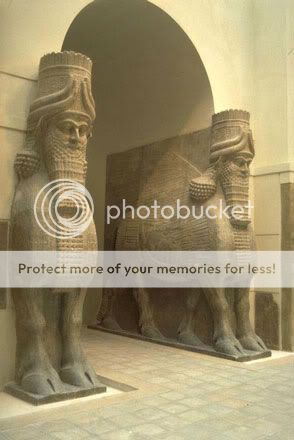
The lamassu is carved from a single block of alabaster gypsum, a very strong rock material that would ensure the statue's longevity because it was also responsible for holding the gates of the palace or citadel upright.

They are always found at entrances of palaces and citadels, because they are considered a protective deity. These statues are colossal in size, the second picture shows a full-grown man standing next to it to show scale.
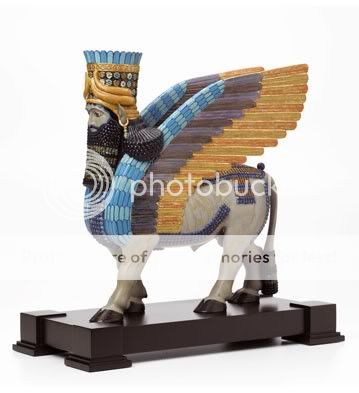
This is how they believed how a lamassu would've looked at the time of their creation. Statues and reliefs were always brightly painted in Mesopotamia, but of course if left to the elements unattended the pigment would disappear over time.
|
|
|
|
|
|
|
|
|
|
|
|
|
|
|
|
|
|
Posted: Tue Feb 22, 2011 11:57 pm
Additional Information
General history of the lamassu
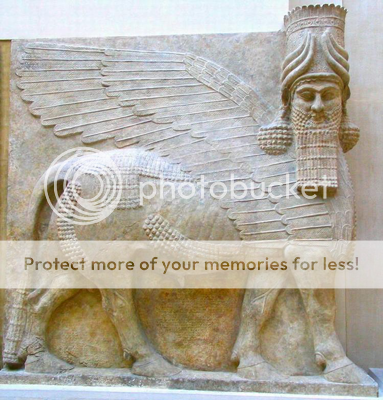
Lamassu is a Mesopotamian deity that was created around the time of the Assyrians. It has a human head, but the body of a winged bull. There are both male and female lamassu, called shedu and apsasu respectively. Their main purpose were guardians of the Assyrian Empire, as the Assyrians believed evil lurked in the corners of the cities and palaces. They created large reliefs of these beings and positioned them in the entrances of cities and palaces and other equally important buildings. The relief was created in such a way, that from the front the lamassu has two legs, but when looked at from the side it had four. It was created this way to show the versatility of the creature, showing the relief in motion.
The horned headdress of the relief is to signify it's divinity, a feature that was only shown on gods and kings. All lamassu have a human head, which signifies intelligence, a lion or bull body to signify strength, and eagle wings to signify versatility and insight.
It was during the reign of Assurnasirpal II (883-859 BC) that the lamassu started to take the face of the current ruler. Rulers after him like his son Shalmaneser III (859-824 BC) and Sennacherib (705-681 BC) started to follow suit, which explains why some lamassu's human faces look slightly different. The horned headdress is also different depending on the ruler, the lamassus belonging to Sennacherib for example are more ornamental and embellished in appearance, with feathers and rosettes adorning the rim, compared to Assurnasirpal II's which is a simple rounded headdress with no embellishments whatsoever.
The reliefs are usually made of alabaster gypsum, a rock mineral that was very sturdy that would stand the test of time. This explains why some of the lamassu excavated are in such excellent condition despite being so old.
Another thing to note, is that the lamassu are not a sculpture-in-the-round or statue, but rather a very high relief because one side of the relief was attached to the citadel wall.
General history in PD
This time, the lamassu is a being created by an ancient nomadic tribe in Yirui (they are more Middle Eastern than they are Asian) who are also called the Cahlians. The lamassu generally has the same meaning as it did to the real ancient Assyrians, but since their Yiruian counterparts are nomadic, they do not have the luxury to create colossal figures of the deities. They created small stone icons of these creatures, placing them in doorways of their temporary homes. The lamassu in Yirui is usually represented as a male, and female lamassu are rarely found. Panymium sailors who sailed along the western coast of the Yurian continent were fascinated with these small stone tablets, took some for themselves and kept them on their ships hoping that the lamassu will watch over them while they are overseas.
Oddly enough, when the sailors returned a few years later, all traces of the nomadic tribes were gone. They left nothing behind except for a few icons of the lamassu here and there. The sailors, puzzled didn't know what to make of this, but took some of the lamassu back to Panymium.
It has been centuries since the Cahlians had disappeared, but the lamassu icons have made a comeback in Panymium, the citizens hoping that the protective deity will protect them from the plague.
Village of Erlend
The tiny farming village of Erlend is located in southeastern Auvinus, two days away from the coast. It is small enough to be missed by travelers, but it is not inaccessible by any means. The people of Erlend have been living there since their ancestors have first settled on this land many, many years ago. Hence, the people of the village know each other very well, and privacy is not an option in this village.
The people are a bit disillusioned at times, believing that Erlend is protected because they are far from any major city or town. Therefore, they are wary of travelers that venture into the village, though they will not deny them hospitality. Even though they consider their neighbors as family, during times of hardship their own interests come first before all others.
|
|
|
|
|
|
|
|
|
|
|
|
|
|
|
Posted: Wed Feb 23, 2011 9:34 am
'When I grow up I wanna be a lamassu!' said Small Geko to her Geko-parents.
'Small Geko.' her Geko parents said, 'You're being dumb. You should want to be something more sensible like a doctor or lawyer.'
Small Geko still wanted to be a lamassu.
:TT
|
|
|
|
|
|
|
|
|
|
|
|
|
|
|
|
|
|
Posted: Sun Feb 27, 2011 6:54 pm
One day Small Geko ran into the kitchen, a badly made newspaper hat on her head, and a blanket wrapped around her haphazardly, "Look mother! she said, "I am a lamassu today!" she looked to her Geko-mother who was not pleased.
"Small Geko." she said, "What have I told you about those lamassus? I told you it is better being a doctor than those dumb things. Now go get changed and come down for breakfast, you'll be late for Geko school. she said, waving the spatula around menacingly.
Dejected, Small Geko about-faced and marched slowly back to her Geko-room to wear those boring Geko-clothes.
She would be a lamassu someday. And no one would complain.
:T
|
|
|
|
|
|
|
|
|
|
|
|
|
|
|
Posted: Wed Dec 28, 2011 6:09 am
The perpetual frozen winds of the Northern Sanct travel down to the rest of Panymium from the frigid mountains. Jack Frost's breath whips and nips at your dainty flesh, whether you be human or Plague. A harsh Winter, this one will be, and all folks poor and rich, comfortable or homeless, will have to work hard to survive. How does this Winter go for you and your Grimm? What hardships do you endure and how do you overcome them?This winter was most likely one of the harshest winters any Auvinian had the misfortune of experiencing. Even though the little village of Erlend had gathered a fruitful harvest in the fall, the winter’s frost came with little warning decimating whatever they had left. The farming village had nothing left to eat; most of their livestock had perished in the blistering cold. Many of the villagers had resorted to thievery, breaking into the homes of their neighbors, people they have lived with for as long as they could remember. Now, it was every man for themselves.
Sizwe Magoro trudged through the only main road of the village, the harness on his shoulders as he dragged a depilated wagon filled with firewood that he had managed to find. It was rather unfortunate that his horse had starved to death with the lack of food he was able to provide it, and they only had the donkey left, only alive through the sheer stubbornness donkeys were known for. “C-come now, Wiggles.” Sizwe grunted, glancing at the malnourished donkey next to him, “Just a little more an' we’ll be home.” Poor creature couldn’t bear to work anymore, his aging body already ailing in the freezing cold.
“That’s a terrible name for a beast of burden.” A small voice piped up from the wagon, “It isn’t even a proper name for a canine.” it continued, a tiny creature climbing up onto the edge of the wagon to get a better view at Sizwe.
“Well…” the farmboy grunted, practically doing all the work of moving the wagon, “Inaya name’ him when we were young…” he said slowly, trying not to think about his sister. If he thought about his sister, then he thought about this grandmother and that horrible summer. That horrible summer when-no. He would not think about that now, especially when they had other things to worry about. “Sh-Shalmaneser, how long do yah think the firewood would last us?” Sizwe asked, wanting to think of anything other than his sister.
“A week if we only use it at night.” Shalmaneser replied, taking a moment to adjust his headdress. It would be best if he didn’t say anything that would upset the boy. Death was a sensitive subject for many people after all. The excito cleared his throat, “We were quite lucky to find such a large amount of firewood, as well.” He felt quite useless at times, when the whole village was in such a time of hardship and he was a tiny little creature that could barely assist in even the simplest of tasks. If there was one thing Shalmaneser didn’t like, it was not being able to help someone in times of need.
“Yeah. We were real lucky.” Sizwe agreed, glancing around the surrounding houses that were seemingly empty. Some of the villagers did leave the village, hoping that if they moved further south the winter would be less harsh, and some of the villagers shut themselves up in their houses every time Sizwe came by. Ever since the appearance of Shalmaneser by his side, the villagers avoided him vehemently, refusing to even look at the boy. Even though Shalmaneser was a servos, noted by his glowing white body, it still wasn’t enough for the villagers to change their minds about him. They were even plotting to run him out of the village, had it not been for Lungile, Siwze’s father. Lungile was a formidable man both in appearance and personality, striking a fearful respect in the villagers. He was thankful for that, though he was unsure about how his father truly felt about Sizwe and Shalmaneser. The boy could tell that his father liked Shalmaneser’s personality, which was quite similar to his father’s, but didn’t know if he approved of the Plague.
*--*
Slowly, but surely, the duo finally made it home, and with a loud sigh of relief, Sizwe pulled the harness from out over his head and nearly crumpled to the ground, his body unused to this sort of labor. Immediately, Shalmaneser climbed down from the wagon and onto Sizwe’s shoulder, nudging at him, “Get up, get up. A man does not fall down into a heap on the ground because of some little extra labor.” If only the excito was bigger so he could prop up Sizwe to his feet so they could start bringing this firewood to the porch.
“J-just regainin’ my breath tha’s all…”, Sizwe huffed, surprised that his back and sides would ache so much. He was a strong boy, still very young and very fit. He didn’t think his body would actually ache from pulling a wagon around all day.
“Boy, wha’ d’you think you’re doin’.” A gruff-looking man came into view, glaring at his son as he released Wiggles from his harness. The donkey let out a whining grunt, using the last of his energy to make it back into the barn. Almost immediately at the sound of his father’s voice, Sizwe shot straight up, “Nothin', sir.” Sizwe replied trying his hardest to keep the surprise from his voice, hurriedly dusting himself off.
“We still have lots to do before sundown, an’ this is no time to be relaxin’.” Lungile said, casting his son a disapproving look. “The rest of the chickens were killed today. Some kinda wolf or rogue dog.” It was obvious that this did not please his father at all, which probably explained his slightly darker mood. “Than'fully the sheep are fine. Get rid of the chickens, will yah?” he went around to the back of the barn wagon in tow, not waiting for Sizwe to reply.
“That’s not good…” Shalmaneser commented, climbing down Sizwe, “I’ll go bring the tinderbox, Sizwe. I’ll meet you at the barn.” The excito ran into the house, he too, not waiting for the farmboy’s reply.
Scratching his head, and feeling rather stupid, Sizwe slipped on his gloves and headed to the barn. He couldn’t help but grimace at the carcasses of the chickens flung about on the frozen ground. The dull thud coming from behind the barn reminded Sizwe of his father’s presence, and knew that he would not be able to dawdle. He bent down, wincing at the pain in his body, picking up the carcasses and bringing them to a small blackened pit outside. He gathered a few twigs and pieces of stray hay around him and piled them up on top of the chickens. He heard the small pitter-patter of Shalmaneser’s running footsteps and he crouched down to receive the tinderbox.
Sizwe lit up a match and threw it into the pit. He watched it go up in flames in silence, one of their vital sources of food now gone. They would have no choice but to kill one of their remaining sheep tomorrow, the only livestock that had managed to live so long because of their thick curly pelts, in order to have a source of food.
“What we gon’ do Shalmaneser?” Sizwe asked, there was no doubt that they would survive the winter, but what would happen to their farm when spring came? They had the seeds from fall’s harvest, but plants didn’t just grow overnight; it would take weeks before they could collect any food.
“There’s nothing we can do.” Shalmaneser said grimly, adding more twigs to the fire, “Except to get through this winter as best we can.”
|
|
|
|
|
|
|
|
|
|
|
|
|
|
|
|
|
|
|