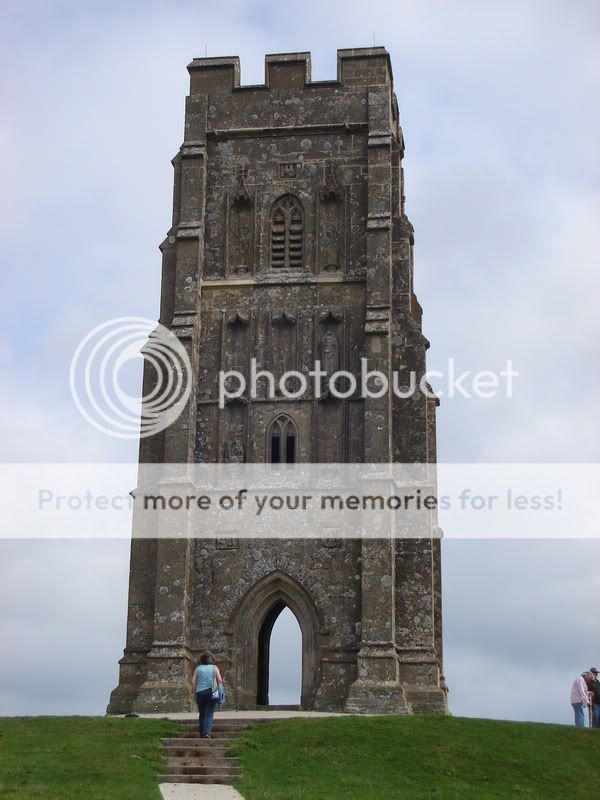


The Tor has been associated with the name Avalon, and identified, since the alleged discovery of King Arthur and Queen Guinevere's neatly labeled coffins in 1191, with the legendary hero King Arthur. Modern archaeology has revealed a fort, dated to the 5th century.
With the 19th-century resurgence of interest in Celtic mythology, the Tor became associated with Gwyn ap Nudd, who was first Lord of the Underworld, and later King of the Fairies. The Tor came to be represented as an entrance to Annwn or Avalon, the land of the fairies.
A persistent myth of more modern origin is that of the Glastonbury Zodiac, an astrological zodiac of gargantuan proportions said to have been carved into the land along ancient hedgerows and trackways. The theory was first put forward in 1927 by Katherine Maltwood, an artist with an interest in the occult, who thought the zodiac was constructed approximately 5,000 years ago. The vast majority of the land said to be covered by the zodiac was, at the proposed time of its construction, under several feet of water.
Christopher Hodapp asserts in his book The Templar Code For Dummies that Glastonbury Tor is one of the possible locations of the Holy Grail. This is because it is close to the location of the monastery that housed the Nanteos Cup.
Another speculation is that the Tor was reshaped into a spiral maze for use in religious ritual, incorporating the myth that the Tor was the location of the underworld king's spiral castle.