Q & AQuestion: What fabrics and lace should I use?
Answer: Natural materials are the best for Lolita. Which typically means cotton fabric-- Kona Cotton for solid colors, or quilting weight broadcloth. It should be thick enough to not be sheer, but shouldn't be super heavy. Velveteen or a microsuede could be used during the winter, but polyester and other synthetic fabrics (
especially anything shiny) should be avoided. For ribbon, grosgrain is preferred over shiny satin ribbon, but satin ribbon can be and is used, it's all a matter of
in moderation.Keeping with a preference for natural and/or high quality items,
scratchy synthetic lace is frowned upon--
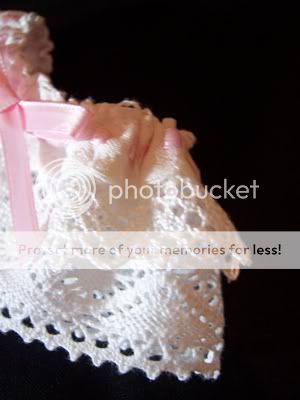
Cluny lace,
eyelet,
venise lace, and
net lace are the most commonly acceptable.
The Lolita Handbook: A Quick Guide to LaceQuestion: Wait, I'm still confused about lace! When do I use which types? Are you sure I can't get away with cheaper lace?
Answer: The use of lace is very garment and style specific, in my opinion.
Venise can be used for almost any style. Because you're able to find more unique shapes in the lace than what you usually find in cluny, like bows or roses, I've seen it work with sweet garments, classical garments, or gothic.
Eyelet lace is 9/10 only really suitable for sweet outfits.
Cluny works best with sweet, but can be used here and there with gothic when dyed black. It doesn't seem to fit well for classical styles, unless it's very minimal, like a thin row along a bottom hem, and/or dyed the same color as the garment.
Net lace, which is generally only seen in ivory or white, and best suited for classical outfits (
like so). However, some of the custom lace that Moi meme Moitie has created could be considered net lace, that they've dyed in the factory to accent/match their garments-- so using it with gothic styles isn't out of the question, it's just incredibly difficult when sewing at home where you can't really dye it.
Now that I've covered the standards of what the best types of lace are, I'll touch on quality in general. It's not a complete 100% requirement to use those types of lace. The main keys to using cheaper synthetics are to use it in moderation, and definately nothing too wide. It's best to shy away from contrasting colors, and definately touch and feel the lace to make sure that it's not SUPER scratchy-- there are softer synthetics out there.
I would also like to point out that there are more problems with the cheaper synthetics than it just not looking as nice as other types. Such as the problem of it tending to curl up if it's washed, and it melts under an iron. Even if it's subtle and looks nice along a hemline, it's going to make it incredibly hard to iron that hemline flat if you need to later on.
The higher quality materials that you use on a garment IS going to make a difference and give you a garment that looks better and lasts longer. You do not have to use them, but I would personally suggest it. There are brands that still use synthetics, such as Metamorphose, but most are shying away from them, and even Meta is using a little more cotton raschel and torchon lace (Cluny) than they used to.
Question: What is the difference between rouching and shirring?
Answer: (by spuntino) Rouching and shirring aren't that different in technique, but they are used to create different effects. Generally, rouching on garments is a vertical element and done to create a sort of "scallop" shape on a hem, to gather a neckline down into the bodice [usually done with camisols or jersey knit tops in mainstream fashion], or to make light crinkles. There usually isn't more than one or two lines and they're often far apart.
Shirring is usually horizontal [and rarely vertical] and serves as faux smocking. It's both a decorative element and a tailoring element, unlike rouching. Rows of shirring are usually spaced no more than an inch or so apart and create a tight pattern rather than the light "folds" and gathers that rouching tends to cause. The elastic used in shirring also ensures that the garment will fit you snugly with a minimal amount of specifically tailored elements.
Question: What should a petticoat be made out of?
Answer: Stiff tulle, netting, organdy/organza, or for a very light poof, you can use a thin broadcloth that's heavily gathered. When using tulle or netting, it's best to make a lining out of broadcloth, to keep the material from scratching your legs.
Question: What is Princess-Line?
Answer: (by spuntino) A princess line and an A-line are very similar, actually [technically,the princess line is a type of A-line]. The shape is more or less the same, the difference is that A-lines usually have a seam at the waist and princess lines usually have none. They're fitted to the body throughout rather than just at the waist with a separate bodice. For skirts, either term can be used but ordinarily you'll see "princess line" applied to a high waist skirt. In the case of lolita, the skirts are much fuller than just an ordinary A-line as well.
Question: Should I line my skirts/dresses?
Answer: It's really up to you if you want to line a garment, or not. Lining and interlining help the garment to lay much more smoothly on the body and can add strength, stability, and a longer life to the piece of clothing. Skirts are more flowy because the outer layer isn't clinging to skin or the netting on a petticoat, and it also helps to eliminate possible lines from undergarments-- such as the waist of your petticoat or bloomers, if they sit too close to the waist of your dress/skirt.
It's not a requirement for something to still be considered good quality and nicely finished, but it's an extra step that can take it from good quality to great quality. I'm personally a freak for high quality, so I love to work with lining, and I've been working on some even more specialized tailoring techniques like incorporating interlining between the layers for extra stability.
Question: How do I make a lining? It's like making a second garment, right?
Answer: When lining something-- yes, you are basically making a second garment, and it should be cut to the same size as the original. You want all seams to match up when you sew the lining to the outer layer, so be careful to make sure you're using the same seam allowance on the outer layer as you do the lining when you sew them. If you're going to accidentally take in more seam allowance on one layer versus the other, try to make sure it's the lining that's more snug than the outside, so it doesn't look bulky under the other layer. No one would notice if the fashion layer is a tiny bit bigger than the lining, but the other way around can prove frumpy looking.
wink The only difference between the two patterns is that you'll want the lining layer to be a little bit shorter than the outer layer, so it does not peek out the bottom when you move. Just hemming it an inch or two shorter than the outside layer is fine.
The only exception to the rule of hemming it shorter would be with a petticoat, when you'd want the lining layer roughly an inch longer than the tulle/netting so it doesn't scratch your legs.







 Reply
Reply