Welcome to Gaia! ::

Reply [OOC] The RP
~ The Fafner Facts ``

Quick Reply

Enter both words below, separated by a space:

Can't read the text? Click here

Submit

Lady Fraenir
Captain

PostPosted: Sun Aug 10, 2008 7:08 pm


The FAFNER Facts

User Image

To roleplay in this guild, you MUST be well-knowledged in the below facts.

This is all the current information on the Fafners, and more may be added later on - so be sure to check back here once in awhile.

If you roleplay in a fashion that does not correspond to the given facts, you will be warned to change your posts. If you do not comply after three warnings, do not be surprised to find your post DELETED. Failure to listen to ANY of the Admins and Mods will result in being BANNED from this guild.

Administrators
Shikai-chan
SilverStarrSapphire
tiredchipmunk

Moderators
NA

User Image

Last Updated: August 10, 2008.
PostPosted: Sun Aug 10, 2008 7:11 pm


The Fafner

User Image

Fafners are canines, and as one would expect, possess a heightened sense of smell. Their vision and hearing is fairly normal, though they can see almost as well in the dark as they can in the light. One strange trait they have is retractable claws, which are only used in hunting, fighting, and gripping to the ground when running. Otherwise, they are no different from an average canine, social animals that live in packs. But as with any species, personalities differ from individual to individual.

Fafners are extremely adaptable creatures and can live in just about any weather and environment. During the winter, their fur grows longer to keep in the warmth, and they shed during spring in preparation for the warmer summer months. They prefer even terrain, though they can make themselves at home in rocky mountain valleys and meadows within forestlands. They're quite the skilled swimmers as well, and some have even learned the craft of fishing. But strong currents are dangerous whirlpools are still treacherous to them, especially those in the Edda Strait.

Fafners are warm-blooded and so give live birth to their young, ranging anywhere from 1 to 5 children per litter. They typically only give birth once, maybe twice a year, but do not have a specific breeding season. However, a pair will almost always mate for life since they are extremely loyal and easily attached creatures, and separation is actually frowned upon in their society. When they mate, the female carries the unborn babies for around four to five months, then moves to a secluded cave a few days before she is about to give birth.

Fafners are very caring towards their young, who take about a month to grow from a little baby ball into a child with limbs. Babies do not have developed vocal chords so they can only make audible noises, but they are taught the Fafner language after a month old. The children take around two or three months to grow into a full-sized adult, which is when they begin learning the tools of their trade. They choose whatever rank they believe suits them the best, and take as long as necessary to learn under an older and more experience member until they are ready to work by themselves.

Fafners are omnivores that eat just about anything edible, from small game to berries and fruits. They do not hunt prey larger than themselves, mostly because they are probably the largest creature on the Isle, usually hunting small to medium-sized rodents. Hunting alone or in packs is based on a Fafner's personal preference, and strategies also differ between individuals. Harvesters don't need to work in groups though some do it for the company. They forage for ripe berries and fruits within ground's reach since they aren't built to climb trees.

Fafners do not breed livestock for food, nor do they grow and farm crops. They eat what they hunt and harvest for that day, though vegetation may sometimes be stored for up to a week in storage huts. But the raw meat is always eaten by the day's end since they have no way of preserving foods. Although during the winter, those living in snowy regions have been known to store meat in the cold snow for a day or two. However, they do not cook because they cannot make fire, and as canines, they prefer their meat warm and fresh. Neither do they season their food, though some do like to mix some seeds or berries into their meat when they eat.

Fafners are capable of using very simplistic form of tools, since they do not have the dexterity to hold objects with anything other than their mouths. In simple tasks, they can use rocks to crack open nutshells and they also know how to make dyes by mixing specific ingredients. For more complex tools, they've learned to make simple hunting traps, such as a hole covered with sticks, leaves and loose dirt, and fishing nets from weaving vines together. Other than using these and other types of natural tools, they cannot create their own tools since they do not know how to produce fire nor can they hold objects properly.

User Image
 

Lady Fraenir
Captain


Lady Fraenir
Captain

PostPosted: Sun Aug 10, 2008 7:12 pm


The Rank

User Image

Fafners are assigned specific tasks to do known as their rank. They are trained specifically for and excel in their task, though rank changes occur from time to time if a Fafner finds that he/she is more adept at another task. Each rank has shifts, usually divided by morning, afternoon, evening and night. Fafners usually do not change shifts since some work better at certain times of the day, but to do so, they must find another Fafner willing to switch with them.

Speaker
An extremely honorable rank, there are only 1-2 Speakers per clan. As population grows, the demand for Speakers may start to grow since they are pretty much the teachers for the children. They know the legend and histories of the Fafners, passing on their knowledge to the children of their clans in stories, songs, and even plays. They often act as babysitters when the children's parents are off working, but they are also the ones who help teach the young about what is expected of an adult Fafner in their society. Values and morals are taught by parents as much as Speakers, and they are highly respected by the clan for their wisdom.

Hunter
One of the most common ranks, Hunters are the ones in charge of bringing fresh meat to the their clanmates on a daily basis. There are three hunting shifts: sunrise, midday, and just before sunset. Hunters can bring in as many as four small prey animals at one time, though some can even come back empty-pawed when the game scarce. The Hunters usually know where certain game can be found during the different weathers, and even follow the migration patterns of some of the larger game. But once meat is brought back to the clan after each shift, a portion of it is sent to the Nobles while the remaining is split among the clan's population.

Harvester
The other most common rank, Harvesters bring in any edible vegetation up to four times a day: sunrise, midday, early afternoon and sunset. They usually only forage in the early afternoon if the Hunters are having a hard season, otherwise the only go out during the times the Hunters are out. Harvesters look for seeds and nuts, berries and fruits, and even mushrooms. They well-knowledged at what type of vegetation is in season at what time of the year, and know where to find it as well. The Harvesters each have a makeshift pack, which is basically a large piece of animal hide. Once they bring their gatherings back to the clan, a portion is sent to the Nobles while the remainder is usually split among the clanmates, although some may be stored if the pickings were particularly good that day.

Healer
A more recently implemented rank, Healers did not come about until the Fafners realized that specifics herbs could relieve pain and help heal wounds. This rank requires extensive training in the field, learning what herbs to use and how to use them properly. A Healer will often take on one apprentice at a time to teach them the craft, but many fail to learn the techniques and so fall out to other ranks. Healers usually work together in groups, having a large medical hut of their own where they see and treat patients. They take turns going out to gather the necessary herbs, which grow at different times of the day at different places, and they always try to have every type of herb in stock.

Sentinel
Unlike the other ranks, Sentinels are trained by the Nobles' Chevaliers. They are chosen mostly for their skill in physical combat as well as their sense of loyalty. In the past, Sentinels mostly kept patrol along clan borders at all times of the day to ensure that other clans do not trespass onto their territory. But clan disputes have lessened since the Nobles started implementing stricter rules that keep residents in their own lands. While Sentinels used to patrol alone quite often before, now with the Rebel uprising, Sentinels have started grouping together in what are called Patrols, with individual and paired Sentinels being very rare. Each Patrol consists of 3-6 Fafners, sometimes more if Rebels have been spotted in a particular area, and they patrol a specific region of their clan's territory. They are usually assigned to patrol a third of a day for six days a week, and shifts change quite often from month to month. Sentinels are not supposed to kill another Fafner unless in a life or death situation; otherwise, they are supposed to capture and turn in any Rebels to the Nobles. But Sentinels still retain their original roles as lawkeepers, ensuring that all Fafners follow the royal laws. Any lawbreakers and taken to the Chevaliers for punishment, usually in the form of giving up some material good and rarely isolation from the clan.

Craftmaker
A difficult rank to obtain, Craftmakers are trained by the first of its craft - Stardust of the Loki clan. Only she knows how to produce fire, a dangerous but useful ability, and how to use the Chupins to help craft jewelry. The theory is that fire is used to melt and shape metals like silver and gold, and sometimes gems can be placed in the jewelry with the help of their Chupins. The Chupins are needed to hold sticks made of fire-resistant wood which is used to move the metals while they are in the flames. But the specific skills and techniques required are known only to Stardust and her apprentices.

Keeper
The most recent rank, the only Keeper on the Isle is Stelmaria because she is the only one who knows how to raise and tame Minis. The Keeper is a rank that Stelmaria created for herself once she started collecting small creatures and trained them to be companions for Fafners. She then sells the Minis to owners that can handle that specific species, though the majority of Fafners cannot handle owning more than one Mini at a time.

User Image
 
PostPosted: Sun Aug 10, 2008 7:13 pm


The Clan

User Image

Fafners once lived in small simplistic packs like wolves, roaming specific territories and hunting/harvesting within these lands. They were aggressive and protective against other packs when dealing with territory, even though game was plentiful for the small populations. But then the Nobles appeared and started establishing the clans, staking a large amount of territory and setting up villages for the once migrating packs to settle into. In return for the knowledge of how to build and the safety assured by the creation of the Sentinels, the Fafners would pay "taxes" to the Nobles in the form of giving a portion of their daily hunts and harvests to the Nobles.

Fafners now live in clans, currently four on the Isle, each of which have a specific territory marked by their Nobles. Somewhat centered within each territory and next to a water source (usually the largest lake) is the village, which is where all the Fafners live in huts. Because of the large population of Fafners, the villages are quite large, with new huts constantly added to the perimeter for all the new adults. In the middle of the village is an open area where Speakers often gather the children, with the storage hut close by, while individual living huts are located around this open "court". The Healers' medical hut is usally set off to the side closest to the water source.

Fafners usually help each other in building their huts, which are small triangular structures made of sticks and a special type of mud. Kind of like a teepee, sturdy branches are chosen to act as the skeletal frame for the hut, which is usually built large enough to fit two adult Fafners and three or four growing children. The structure is then covered by large leaves, and then layered over with a sticky mud that helps keeps all the pieces together. The huts are extremely insulated during winter and keep the warmth in, but also do not absorb the sunlight during the summer so it keeps the interior cool when it's hot outside. Most huts have a makeshift door, probably a piece of hide hung over the entrance, which may be taken off during the summer to allow a breeze inside.

Fafners stay within the villages for most of the year. The only time they leave their huts is when they pair up to breed, during which they will venture a mile or two from the main village and find a secluded cave to give birth to their young. During this time, the female is almost always isolated in the cave to protect her newborn babies, leaving only to get a drink of water at a nearby water source. The male is in charge of hunting and harvesting, providing sustenance for his growing family. Once the babies have grown into children, the family returns back to the village and settles into their hut. Mated Fafners usually do not live together in a single hut until after they have bred, and the other hut is then given to one of their children when he/she grows into an adult. But Fafner pairs from different clans frequently choose to live separately in their own clans, each parent taking one or more of the children under their wing.

Nobles live in their own larger structures a mile off from the main village, their homes made of the same materials as that of the huts but much larger and more complex. The only time the commoner Fafners venture towards the Nobles' home is when a Sentinel is reporting to their Chevalier leaders or bringing a lawbreaker in for sentencing. Otherwise, the specific Fafners are selected to send a portion of the hunts and harvests to the Nobles three times a day. For the most part, the commoners avoid passing too closely to the Nobles' home mostly in fear of the infamous Chevaliers, and the Nobles rarely leave their luxurious homes, even during breeding. However, once a month, the Nobles will visit the villages as an inspection to ensure that everything is running smoothly with their clan.

User Image
 

Lady Fraenir
Captain


Lady Fraenir
Captain

PostPosted: Sun Aug 10, 2008 10:06 pm


The Society

User Image

Royals
Come Soon!

Nobles
Coming Soon!

Rebels
Coming Soon!

User Image
 
PostPosted: Tue Aug 12, 2008 4:43 pm


The World

User Image

User Image

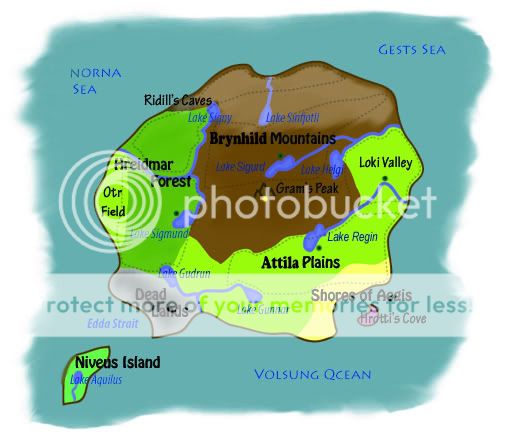
The Isle of Andvari is a small island, with an approximate area of 550 square miles, located on the northern hemisphere of an unknown planet. The top fourth of the island is covered completely in ice during the winter months, the frozen landscape making it an inhospitable and even treacherous place during the cold season.

To the northwest is the Norna Sea and to the northeast is the Gests Sea, both of which have extremely cold waters all year round and even freezing over at certain points during the winter. To the south, encompassing a little under half of the island’s perimeter is the Volsung Ocean, thought to be the largest body of water on the planet.


Brynhild Mountains

This mountain range covers nearly a third of the land mass of Andvari, stretching across the entire northern region and narrowing down the center of the island before disappearing in a small tail a few miles above the southern shores. The peaks are highest near the middle of the range, forming a descending ‘T’ if seen from an aerial view. The northern rim stops directly at the sea, where the cliffs grow steadily lower and flatter towards the east and west ends.

During the winter, and even a cold fall month, the top half of the range is covered completely in ice and snow. Blizzards are a common occurrence during this time, so few dare to venture into these treacherous areas as not many have ever been seen again. But come spring, the meadows and fields found in the lower altitudes can be found in bloom from frequent rain, and the temperature rises to tolerable levels in the summer.

Gram’s Peak
The highest point on the island, Gram’s Peak is essentially part of the Brynhild Mountains and located at the exact center of the island. Its height has never been measured, but rumors say that if you can reach the top of the peak, you’ll be able to see the entire island around you and even the seas that touch the shores. But such a expedition is extremely risky, for many have tried and few if any have lived to tell of the treasures that embellish the peak. At the top of Gram’s Peak is something called the Light of Andvari, named for the seemingly eternal light that shines all around as a guiding beacon for any lost travelers on the island, or even at sea. It is assumed that the light is merely a reflection of the sun during the day and the moon at night, for the only time the light disappears is during an Eclipse or a New Moon.

Ridill’s Cave
A series of caves found at the base of the northwestern tail of the Brynhild Mountains, these caves can only be accessed during late spring and summer through early autumn when the ice thaws from the entrance of the caves. The tunnels lead through the caves like a maze and few have found anything of interest in the caverns, and some have even failed to find the way back out.

Lake Sinfjotli
The northernmost lake on the island, Sinfjotli is in the middle of the northern range of the Brynhild Mountains, and like the rest of the northern mass, the lake is frozen over with a few meters of solid ice during winter. A small river dubbed the Sinfjotli River runs a couple of miles northward from the lake, eventually reaching the northern rim of the island where the Norna Sea meets the Gests Sea.

Lake Sigurd
One of the larger lakes, Brynhild is located a few miles directly north of Gram’s Peak. It then travels northeast as the River Sigurd to merge with the Helgi River just a mile before the larger lake.

Lake Helgi
A small and slender lake in the northeast of the island that sits between the Attila Plains and the Brynhild Mountains, Helgi is the third northernmost lake on the island but does not freeze over in the winter like Sinfjotli and Signy. It has a river known as the Helgi River that runs north and divides the mountains from the plains, encircling the upper half of the northern valley of the Regin Plains before opening to the Gests Sea.


Hreidmar Forest

Covering a little less than a fourth of the island’s surface area, the forest stretches down from the northwestern rim of the island and extends over most of the southwestern area of island from there. Most of the trees are tall evergreens, although there are seasonal plants in the north.
Most of the northern third of the forest, from the horizontal run of the Sigmund River and up, is stripped bare and becomes coated with snow during the winter and most animals migrate out of the area during the cold season. But the rest of the forest remains thick and green all year round, extremely hot and humid during the summer in the southern region.

Otr Field
A small area of green pastures on the western shore of the island and surrounded on the other three sides by the Hreidmar Forest, the field is a little over six miles in diameter. The field is located just south of the Sigmund River, which is also the source of the many springs and ponds that are found in the region. The grass is fresh and green during the warmer months, blooming with a variety of flowers in the spring. But in the fall, the flowers wither and the grass dries into tanned stalks in the winter.

Lake Signy
The smallest lake on the island, it is the second northernmost body of large water and also freezes over during the winter but not as thickly as Lake Sinfjotli. Lake Signy is located at the northeast inner corner of the Brynhild Mountains, with the small River Signy traveling southward down the eastern edge of the mountain range before merging with the Sigmund River.

Lake Sigmund
One of the largest lakes on the island, Lake Sigmund is located slightly southwest of Gram’s Peak at the edge of the Brynhild Mountains, and also leads into the Sigmund River that travels north. Like its lake source and the River Signy, the Sigmund River divides the eastern edge of the Sigurd Mountains from the western border of the Hreidmar Forest, before meeting the River Signy and pivoting west to end where the Norna Sea meets the Volsung Ocean.


Attila Plains

Over a fourth of the island’s surface area consists of a variety of grasslands that stretch from the northeastern rim and extend down the edge of the Brynhild Mountains to cover most of the southeastern region of the island. Aside from the northernmost part of the plains, the rest of Attila is prairies and savannas where the southernmost inland areas become increasingly hot and dry during the summer.

Loki Valley
The northernmost range of the plains, known as the Loki Valley, is slightly enclosed by a small trail of the Brynhild Mountains. The valley is situated directly south of the Helgi River and north of a small part of the Regin River, but the region is not far north enough to see ice or snow during the winter. The grass is fairly green throughout most of the year, only withering during the coldest month of winter.

Shore of Aegis
A small area on the southeast shore of the island, it is the only part of the southeastern region not encompassed by the Attila Plains. The shore is a sandy beach that stretches for nearly seven miles in a semicircular shape, encircling over half of a small bay that pushes a mile into the island. The bay is the only place on the island that contains warm waters, even during the winter, and likewise the beach has is the only shore on the island with soft warm sand.

Hrotti’s Cove
A strange U-shaped rocky land mass in the middle of the bay, the small cove points inward towards the Shore of Aegis and is about a mile away from the main island’s shore on all sides. During low tide, the top of a cave entrance can be seen inside the U of the cove, but rumors say that the inner caverns are extremely low and the tunnels are so much of a maze that exploring the cave is impossible. Not much else is of interest at the cove for its moss-covered rocky surface is either too slippery or sharp for comfort.

Lake Regin
The largest lake on the island several miles southwest of Lake Sigurd and directly southeast of Gram’s Peak, Lake Regin also separates the Attila Plains from the Brynhild Mountains. The lake has a river that runs almost straight north at a slight eastern angle before turning sharply to travel southeast for two miles mile and then straight east to meet the Gests Sea. Known as the Regin River, it closes off the Loki Valley from the rest of the Attila Plains.

Lake Gunnar
One of the smaller lakes on the island, Lake Gunnar is situated right in the middle of the southern region of the Attila Plains, a few miles southeast of Lake Regin. But strangely enough, the lack of rains in this area during the summer causes the lake and its River Gunnar to nearly dry up in the hot season. Its accompanying river slows to a small stream at this time, flowing westbound until it merges with the much larger Gudrun River.

Lake Gudrun
A murky lake at the edge of where the Attila Plains and the Hreidmar Forest meets the Dead Lands, the water here is thought to be polluted because of its black and thick quality. But oddly enough, its Gudrun River becomes cleaner as it leaves the lake, turning completely clear by the time it merges with the River Gunnar halfway through its trek to the Volsung Ocean. The Gudrun River acts as that which separates the Attila Plains from the Dead Lands.


Dead Lands
As its name suggests, few if any have survived after trekking through the dark and treacherous Dead Lands. Essentially “no man’s territory,” no life exists in this region as the earth has been blackened and the area smells of rot. The exact reason behind the inability to live is unknown, though pollution from an unidentified source is thought to be the cause.

Edda Strait
The part of the Volsung Ocean that separates the main Isle of Andvari, namely the Dead Lands, from Niveus Island is known as the Edda Strait. The waters here are extremely unpredictable with many undertows and even a few whirlpools near the mainland. The waves are calm and cool around Niveus Island, but it’s the swim there that’s perilously impossible.


Niveus Island

A small mysterious island a few miles off the southwestern coast of the main Isle of Andvari, Craftmakers are the only ones who have ventured onto this islet because it is located right off the shore of the Dead Lands. The island is thought to be approximately 35 square miles, and is the native home of Chupins and Serpins.

Lake Aquilus
The small and only lake on Niveus Island, Lake Aquilus is a fresh spring water lake that acts as a main source of water for the life on the small island. But like its island, little else is known about the lake.

User Image
 

Lady Fraenir
Captain

Reply
[OOC] The RP

 
Manage Your Items
Other Stuff
Get GCash
Offers
Get Items
More Items
Where Everyone Hangs Out
Other Community Areas
Virtual Spaces
Fun Stuff
Gaia's Games
Mini-Games
Play with GCash
Play with Platinum