|
|
|
|
|
|
|
|
|
 Posted: Mon Nov 01, 2004 4:04 pm Posted: Mon Nov 01, 2004 4:04 pm
DisclaimerWelcome to our little beginner's guide, and our host of the day will be Sai and Hikaru. wink  Sai: Yoroshiku onegaishimasu.. ::bow::  Hikaru: Yoroshiku smile There will be four Classes; each class is divided in 5 parts. Click on the class link to see the material and exercise. Class 1. Introduction to the game GO
1-1. The board and stone
1-2. Counting the area
1-3. Capture a stone
1-4. Prepare for a match
1-5. Determining wins and loses
Class 2. Rules of Conduct
2-1. Places you can't put your stone.
2-2. ATARI! Block
2-3. The KOU Rule
2-4. (Are your stones) Dead or Alive!?
2-5. SEKI first come first serve!?
Class 3. Basic Tactic
3-1. Offence & Defense
3-2. HUSEKI setting up your ground (beginning of the game)
3-3. Fight! The war has begun! (middle of the game)
3-4. Attack vs. Escape
3-5. YOSE (keep your ground) (end of the game)
Class 4. Basic Maneuver
4-1. SICHOU
4-2. GETA
4-3. UUTEGAETU
4-4. OIOTOSI
4-5. Crane nest maneuver
Now that you have finished your classes, lets tryout with the practice questions! More GO Info:
|
 |
|
|
|
|
|
|
|
|
|
|
|
|
|
Posted: Mon Nov 01, 2004 4:05 pm
Class 1. Introduction to the game GO (IGO: ee-go) 1-1. The board and stones
Go is a game for 2 people played on the GO board with stones. The black and white stones are placed on the board alternately claiming the territory for each player. The person with the most territory wins the game.
The GO board has 3 different sizes.
Standard GO board 19x19
Medium GO board 13x13
Beginner GO board 9x9
The 9x9 GO board is smaller and easier for the beginners, and we will be using this board for our class as well.
The stones are either Black or White colored, and they are placed on the intersection of the lines. Even the outer most border (HEN) is playable. The corners (SUMI) are also playable.
1-2. Counting the area
In the GO game, the person with the most territory (ZI) wins the game. Player can gain a territory by circling off an area with his stones. Each intersection will count as one MOKU (space/stone) gained.
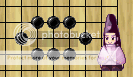 In this case, Black owns 3 MOKU. In this case, Black owns 3 MOKU.
Question: what is the territory count for White?
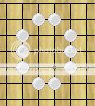 Answer: 6, 16, or 20?6 Answer: 6, 16, or 20?6
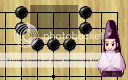 In this cause Black has 6 MOKU, because the intersection on the edge counts. In this cause Black has 6 MOKU, because the intersection on the edge counts.
Question: what is the territory count for White?
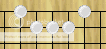 Answer: 0, 3, or 8? 3 Answer: 0, 3, or 8? 3
Question: what is the territory count for White here?
 Answer: 6, 9, or 15? 6 Answer: 6, 9, or 15? 6
TIP: Utilize edges and corners of the board to help you to gain more territory with fewer stones.
1-3. Capture a stone
Once a stone is placed on to the board, it cannot be moved, unless it has been captured. To capture a stone, is to block all the escape roots of a stone.
 -> -> 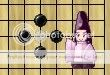 Now the white stone can be removed. Now the white stone can be removed.
The same goes for multiple stones.
 -> ->
This works on the edges and corners as well.
 & & 
WARNING: the person with the most captured may not be the winner at the end.
1-4. Prepare for a match
Before the game can begin, the players have to determine who gets what stones. This is because black stones (KUROBAN) always go first, thus giving the player the upper hand of leading the game. Usually, the higher ranked player would use white stones (SIROBAN), and the lower ranked player will have black stones to compensate for the skill difference.
In a large skill level difference, the black stones go to the less skilled player and some handicaps (compensation stones) are allowed. The number of handicap stones will be agreed upon and placed on the GO board before the game. Of course this means white goes after the handicap has been placed. (Remember in Hikaru no GO, Touya Koyo said that he would let Touya Akira place 3 stones on the GO board before they start the game. Those stones are handicaps.)
If both players are of similar level then NIGIRI takes place. In NIGIRI, the person closest to the white will take a handful of white stones and hold them in hand on the go board. The person closest to the black stones will pick out 1 or 2 stones. 1 means the person holding the white stone has an odd number of stones in hand; 2 means they have an even number. If black guesses right, that player gets to play black stones, else he gets white. To compensate the difference for the white player, a certain amount of KOMI (compensation points) are given to the white player to be added to whites score at the end of the game. In here we use 5.5 KOMI. The reason for the 0.5 is to make sure there will be a winner, not a draw. (This number changes from country to country; I think it is up to 7.5 in China.)
1-5. Determining wins and loses
At the end of the game (SHUUKYOKU), the territories are counted and the winner is the person with the most territory. (Note, the Chinese and Japanese way of counting is different, the counting used here is the Japanese way where only the spaces are counted not the stones.)
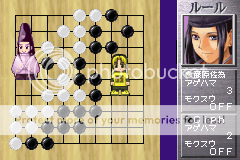
To count territories, the players would prepare their territory in a process called SEITI. First, all the free spaces are replaced with stones. The stones that are surrounded by the other color are counted as captured stones; and are removed from the territory and added to the captured stones.
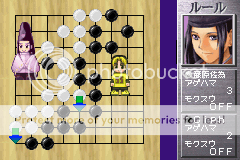 > >
Then all the captured stones are placed into the territory of their own color; black in black territory, white in white; taking up the space within their territory.
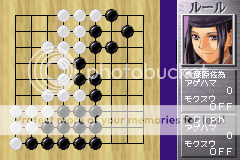
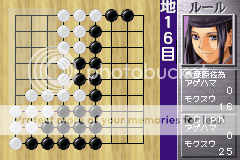
Now with only the countable space available on the GO board, the counting begins. To simplify the counting, stones are rearranged within their own territory into rectangles. (Remember Hikaru caught Mitani cheating at the end of a GO game? This is when Mitani cheated by moving the stones into the other person's territory.)
|
|
|
|
|
|
|
|
|
|
|
|
|
|
|
|
|
|
Posted: Mon Nov 01, 2004 5:01 pm
Class 2. Rules of Conduct 2-1. Places you can't put your stone.
There are places in GO where you will not be allowed to place your stone.
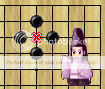
The Eye: An intersection with all the escape routes blocked. We have an Eye made with four black stones. If a white stone is placed into the middle it will be captured immediately because all the escape routes are blocked.
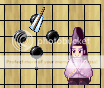 -> -> 
Question: In the following matches, where are the places a white stone cannot be placed?
 B B A A
The exception to the rules:
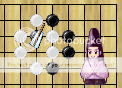 -> -> 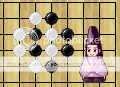
In this setup, black needs to put a stone on an intersection where all the escape routs are blocked in order to capture the two white stones. In this case the black can place a stone there. In other words, if you can take out your opponent's stones by placing a stone into an Eye, you can do so. However, this has to be on the move that you catch the other stones, not before.
2-2. ATARI! Block
In order to catch stones, you will need to block the escape routs of the other player's stone. This move is called ATARI.
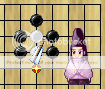
Here is where the problem begins, if you are black, and you blocked white on the left, white will be able to gain additional escape routs by placing a stone on the bottom.
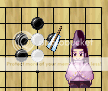 -> -> 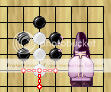
Here the black should be placed on the bottom; limiting white stone's escape routes.
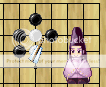
Question: You are white, how do you catch the black stone(s)?
 C C
2-3. The KOU Rule
In GO there is a special rule called KOU. In this game play, an eye interlocks with another eye. Black can place a stone in the white eye and take one white stone, and white can do the same again. This can continue until the stones run out.
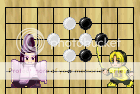 > >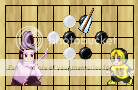 > >
In such a situation, the KOU rule will apply:
First, the black can take the white stone by placing a stone in the white eye.
-> 
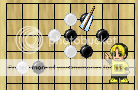
Now the white cannot place a stone into the black eye and take the black stone. The white needs to place a stone elsewhere before placing a stone in to the black eye, like so:
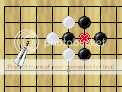 -> ->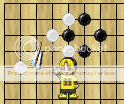 -> ->
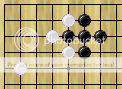
Because white has to place a stone elsewhere, black can close the eye with its own stone and eliminate the interlocking eye.
->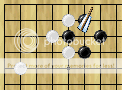 -> ->
Sai: This is very confusing to beginners; however, with practice you will be able to become a great player.
2-4. TUKATU(Are your stones) Dead or Alive!?
The alive stones are the stone clusters that cannot be captured. The dead stones are the ones that are not able to be saved from being captured.
In this play, black is completely surrounded by white. However, black has two eyes within its territory. These eyes are the places that stones cannot be placed into unless that move can capture stones. White cannot place any stone into the eye, because whereever it goes it cannot take the black stones in that move. As long as black keeps the two eyes open, white cannot touch them. So the black stones are alive.
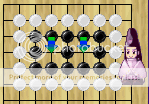 These two eyes are called NIGAN. These two eyes are called NIGAN.
In here, however, black has one eye inside its territory, surrounded by white. White can place the stone into the eye because it can capture all the black stones in that move.
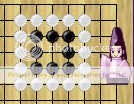 -> -> 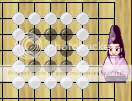
In the end, the black stones are dead.
Question: In this play, are the black stones alive or dead?
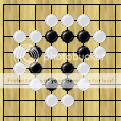 died died
2-5. SEKI first come first serve!?
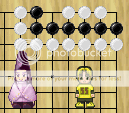
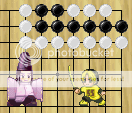
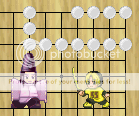
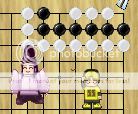
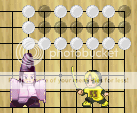
When the order of the stones being placed determines the life or death of stones, it is called SEKI.
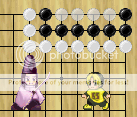
In here, black goes first, but the last hand is placed by white, therefore the black stones are captured.
 > > > >
 > >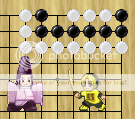 > >
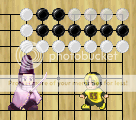
However, if the order is reversed where white goes first; the outcome changes and the white stones are captured.
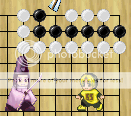 > >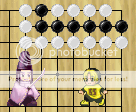 > >
>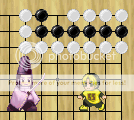 > >
This is where the SEKI becomes very important, if you make the wrong decision, you might lose all your stones and territories.
|
|
|
|
|
|
|
|
|
|
|
|
|
|
|
Posted: Sun Nov 28, 2004 3:28 pm
Class 3. Basic Tactic 3-1. Offence & Defense
3-2. HUSEKI setting up your ground (beginning of the game)
3-3. Fight! The war has begun! (middle of the game)
3-4. Attack vs. Escape
3-5. YOSE (keep your ground) (end of the game)
|
|
|
|
|
|
|
|
|
|
|
|
|
|
|
|
|
|
Posted: Sun Nov 28, 2004 3:29 pm
Class 4. Basic Maneuver 4-1. SICHOU [staircas/ladder: the shape that white stone makes]
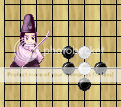
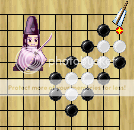
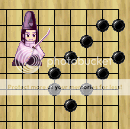
Now lets talk about some basic maneuvers used in GO game. Lets talk about the most common maneuver to capture stones. SICHOU is the most basic maneuver. It is a surround and capture move. In this game play, the black is chasing the white toward the upper right hand side. With black around the bottom, and left, the white have 2 escape root left; up or right. Now black take the right except root, the white has to go up; the black block the escape root above the white again, and leaving only the right escape root for the white. Black would do this continuously, until black force the white all the way to the edge of the board, and take all the white stone with in the territory.
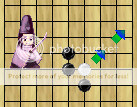 > >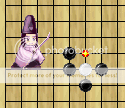 > >
>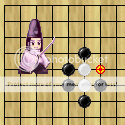 > >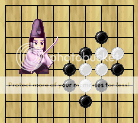 > >
>
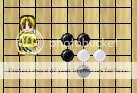
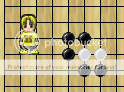
However, if the black block the except root to the top of the white stone, the white would go left; only now the white would have 3 escape root instead of 1. This would make capture white harder for black having to block 3 places in order to surround the white. It is very important to see the situation, and limited your enemy's options.
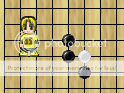 > >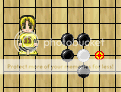 > >
>
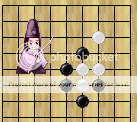
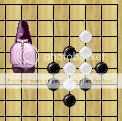
Now, white have planed a stone way above as a backup. In this play, the black does the same thing, limiting the escape root of the white. However, when they get close to the white backup, the white can link all the stone up, and come up with 4 escape root instead of 1. Now black have just wasted all its time trying to catch the white. This backup move is called..
>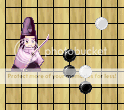 > >
>
4-2. GETA [net]
GETA is the move (position) that is necessary to catch enemy stone. In this play, the black wants to catch the white, in order to do so, black put a stone right in the middle of the two with stone. Now white needs to find a way to escape, placing a stone to the right. Black can just block the escape rote. Now white have to go the other way, and black blocks again also capture all the white stones in the reign.
4-2_1 ~4-2_6
Lets try another approach. The black wend offensive and proceeds to block the except roots. However, as the game proceeds, white was able to link up with the other white stone and escape. This is the result if GETA was not played.
4-2_1, 4-2_7~4-2_11
Now the question: It is black's move, how can black take the white in this game play.
4-2_12 C
4-3. UUTEGAETU
4-4. OIOTOSI
4-5. Crane nest maneuver
|
|
|
|
|
|
|
|
|
|
|
|
|
|
|
Posted: Sun Nov 28, 2004 3:30 pm
Practice Question (Beginner)

|
|
|
|
|
|
|
|
|
|
|
|
|
|
|
|
|
|
Posted: Sun Nov 28, 2004 3:31 pm
Practice Question (Intermediate)

I have used these as puzzles, there for I will just link over to the thread in that case.
-cipher Questions
|
|
|
|
|
|
|
|
|
|
|
|
|
|
|
Posted: Sun Nov 28, 2004 3:32 pm
Practice Question (Advanced)

|
|
|
|
|
|
|
|
|
|
|
|
|
|
|
|
|
|
Posted: Sun Nov 28, 2004 3:34 pm
|
|
|
|
|
|
|
|
|
|
Posted: Sun Nov 28, 2004 4:40 pm
|
|
|
|
|
|
|
|
|
|
|
|
|
Posted: Sun Dec 05, 2004 7:33 pm
Ranking
9P
|
1P (pro dan: professional) <- this is where Hikaru and Akira end up at..
----
9D
|
1D (dan) <- think of black belt and up eqiuvalent in Martial arts
-----
1K
|
30k (kyu) <- absolute beginner, where most of us are.. ._.
|
|
|
|
|
|
|
|
|
|
|
|
|
|
|
Posted: Thu Apr 14, 2005 6:31 pm
Disclaimer:
I want to make it clear that I do not by any means own any content in this class. They belong to their original creators, artiest, writers, and KONAMI corp. I have nothing against, you using anything from this thread for your webpage, but please display a disclaimer stating that they belong to their original creators. I will not take any responsibility for any issues other than translating error and spelling mistakes. 3nodding sweatdrop
|
|
|
|
|
|
|
|
|
|
|
|
|
|
|
|
|
|
|