|
|
|
|
|
|
|

Wolf Nightshade Vice Captain
|
 Posted: Sat Aug 05, 2006 1:13 pm Posted: Sat Aug 05, 2006 1:13 pm
|
|
|
|
|
|
|
|
|
|
Posted: Sat Aug 05, 2006 1:20 pm
|
Wolf Nightshade Vice Captain
|
|
|
|
|
|
|
|
|
|
Wolf Nightshade Vice Captain
|
Posted: Sat Aug 05, 2006 1:28 pm
|
|
|
|
|
|
|
|
|
|
Posted: Sat Aug 05, 2006 1:54 pm
This thread is to clear up some bs about the boztepe/cheung fight. The article was too long so its on 2 posts. The Germany Incident: Ten years After Written by Marty Goldberg Interview by Russ Urquhart 10 years ago, what many consider to be the most degrading crime ever committed in martial arts history occurred in Cologne, Germany. Grandmaster William Cheung, of Traditional Wing Chun, had been asked to take time out of his busy seminar schedule to give a special two day seminar in Germany. Always happy to accommodate people, Grandmaster Cheung added the two days, unknowingly stepping in to a detailed plan set up by Leung Ting to defame him. The end result was an illegally distributed and highly edited video clip that wound up as an addition to Leung Ting's video tape Dynamic Wing Tsun, and did nothing more but to further hurt the image of Wing Chun Kung Fu. This article, composed of interviews with the Grandmaster done over 1994-95, will explain for the fist time in the pages of IKF, Grandmaster Cheung's explanation of what went on that day in Cologne. Also for the first time in print, a detailed account of Leung Ting's four stage plan for the Germany ambush that was recently exposed by another senior student of Grandmaster Yip Man's that resides in northern Europe. ---------- Background ---------- At the time of the Germany ambush, there was much turmoil going on within the Wing Chun family as to who had seniority, who was most qualified, etc. The general public was exposed to this through letters back and forth between many of the seniors and juniors, that appeared in this magazine as well as others. GM Cheung: "Well, many many years prior (to the incident), Leung Ting and I were on speaking terms. But, I think it was just some misunderstanding or something. And also, the other...there was a lot of question and answer back and so on, on the magazines. Relating to who's seniority, and who's more qualified. So..you know, it never was in my mind that he would try something like (the Germany ambush)." The missunerstanding in question is a result of two pieces of misinformation. One was an incorrect interpretation of one of Grandmaster Cheung's letters to state that he would "fight anyone, anywhere, anytime". Those knowledgable in tradition, know that you can not challenge a senior. One of the first things taught in any Kung Fu is that no members of the same family should fight amongst themselves, and secondly to respect your seniors. The second misinterpretation was an incident that occurred in New York, several months before the Germany ambush. Leung Ting was giving a seminar in New York on his art Wing Tsun. Unknown to Grandmaster Cheung, several of his students had chosen to attend this seminar. Leung Ting wanted a volunteer to help him demonstrate his superior reflexes. He chose one of GM Cheung's students, who happened to be wearing a World Wing Chun Kung Fu Association (the governing body of Traditional Wing Chun) t-shirt. The student managed to get through Leung Ting's guard and slap his face a couple of times. One of Leung Ting's bodyguards immediately jumped in, several other of GM Cheung's students jumped in to help, and a large confrontation occurred, until one of GM Cheung's students finally calmed the situation down. The event was not planned, and later upon hearing of the disturbance that occurred, GM Cheung severely reprimanded the students who had taken part. -------------------------------- What Actually occurred in Germany -------------------------------- GM Cheung: Several months later, somebody asked me to organize a seminar in Germany for Traditional Wing Chun.The person who asked it, doesn't practice Wing Chun, so he teamed up with a Wing Chun instructor that had a school there. So they organized two days, Saturday and Sunday. Russ: Now the seminar that they asked you, was this part of kind of what you're doing now, this was a set of seminars you were doing, and someone said we want one in Germany? GM Cheung: Yah, yes. Russ: Had you been to Germany before this? GM Cheung: No.....yah, I've been there once before, but it was just on tour. Russ: Did you have much of an organization or a lot of Traditional Wing Chun people in Germany at that time? GM Cheung: No, not one single person. It was just someone that came out from the blue and said "Look, let's do a seminar in Cologne". Before I went to Germany, I was warned by a friend to keep out of trouble with the law there because they dealt barbarically with foreigners, putting them in jail for months without even questioning them if they broke the law. This was a fact that stuck in my mind. Also, as I was only in Germany to do one seminar, I did not obtain a work permit, so I knew if this was discovered I would be in a lot of trouble and probably be detained there for a long time. On Saturday, the seminar began at 11am, and the organizer, Augustine Yiu was late to pick me up. By the time I arrived at the university basketball stadium (gym) where the seminar was to take place, the participants were already inside. We were approached by two people, a photographer and a journalist, from a German martial arts magazine who said they wanted to interview me during the break. They wanted some photos straight away and asked me to change in to my Kung Fu suit and slippers. I complied and they took some photos of me in various poses. Because things were running very late, I didn't have time to change back to my normal track shoes and outfit. It was time for the seminar to start and there were almost a 100 people there. So I started with some warm-ups, light warm-ups, Wing Chun punching, and coordination drills. So after about fifteen or twenty minutes, I sort of went around to check everybody's movements. So, one chap came up with a couple of other guys walking behind him. One of them introduced himself as Emin Boztepe, a student of Keith Kernspecht. He was holding an issue of Combat Magazine in his hand that contained a copy of an open letter which I had written to Lok Yiu, Leung Shung, Tsui Shun Tin, and Wong Shun Leung some time ago. He wanted to ask some questions about what I had previously said in the article. So I said, "Look, you just read it, it's very clear". He said, "No, no, no, I want to challenge you." I said although he did not have the seniority, by all means I would humour him after the seminar. But let's please do it after. And then I just walked away and didn't take much notice. When I started the second sort of technique drill, he came over again, and I noticed there's about 10-15 people walking behind and around him. And as soon as he came up, they went and formed a circle around us. And he said, "I want to fight you now." And I said, "Well, that's different. You said you wanted to spar and now you want to fight." I said, "Let's do it after class." And he began mumbling something, and I said, "Look, you know, I granted you the fight after the class. And strictly speaking, you're not even in my seniority." So I walked away, but I knew he more or less was going to try something. So after I walked away, the third step he rushed in and threw a round punch with his right arm. Russ: What did you think when this happened? Had you ever been in a situation like this where you're teaching and someone had done this to you before? GM Cheung: No. In the exact same terms, when I first came to New York (in 1983), in the seminar, they always want to test this and test that. I always give them a chace. But this one, I knew it was different because he had a whole group of people. When the second time he came up, there's another 14-15 people with this time I noticed. So when I started to walk away, the circle had been formed. They sort of put their arm up, so that the other students could not get close. I had a German interpreter standing next to me, and as it happened, someone put him in a headlock and pulled him back behind the circle. And I knew it wasn't one person at that moment, though I didn't know what the numbers were. So, you know, he just jumped in and threw the punch and then I swung around and shot out a Bil Sao (thrusting arm), which stopped his sucker punch. At the same time, I front kicked him. It was always in the back of my mind, if I hurt somebody it will involve the law and it will be so complicated. So I more or less kicked just to push him away. But because I was wearing the Kung Fu slippers, and the floor was polished timber and very slippery, I slid away on impact. That was the other thing in my mind, that is why I wanted to do it after the class (besides the reason that it was not proper to interrupt other people's time that they are paying good money for), that way I could change my shoes. Boztepe rushed in again throwing punches furiously, so I sidestepped. I did the Jut Sao (jerking arm) and Huen Sao (rotating wrist) to diffuse his punches. Then I used Pak Sao (push block) to control his elbow. Because the floor was so slippery, I wound up behind him. So I put him in a headlock, because my intention was only to restrain him, not to fight him. Then I thought for a moment I was going to...you know, might as well poke him in the eye and finish it right there. He was struggling like a wounded mule because he had no countering technique against the headlock. Because of the slipperiness of the floor and my shoes, I was sliding around like I was on roller skates. At that time, I started slipping, and then he fell as well. He was more or less lying on top of me. Then he was sitting on my stomach, and tried to throw a few punches which I blocked with Bil Sao's to the elbow. Then I arched my body so he was trying to balance more or less, and then I kneed him a couple of times. After that, somebody called out, Boztepe got up and ran away. And as I got up, then I saw at least 20 people run out from the gym. Somebody said that they had video cameras and regular cameras. http://www.defend.net/deluxeforums/showthread.php?t=11857The video
|
|
|
|
|
|
Wolf Nightshade Vice Captain
|
|
|
|
|
|
|
|
|
|
Wolf Nightshade Vice Captain
|
Posted: Sat Aug 05, 2006 2:11 pm
Boztepe went on to challenge other people such as Gracies as well. Here is what he wrote: A WORLD-WIDE OPEN CHALLENGE TO THE GRACIE-FAMILY Los Angeles, 26th October 1994 Emin Boztepe 5th level Practician EWTO / IWTMAA Headman of the AWTO (American WingTsun Organization) "After having watched your "Ultimate Fighting Championships" held by the Gracie-Family, I cannot find them very "ultimate" but only amusing. These so-called "ultimate fights' may impress laymen or beginners, but in fact they are no more real than the professional Wrestling shows on TV. What depresses me is that I heard of some rumors that I would not dare to accept your challenge. In fact I have never received any such challenge! Do you want me to appear like a coward? When I talked to Benny Urquidez in Germany, he told me that you people had played him the same dirty old trick for propaganda. Not long ago you even challenged the great man of American wrestling Gene LeBell. A very brave act indeed, since Mr. LeBell is over 60 years old. Now in the second "Ultimate Fighting Championships"-Show you people even (ab-)used two stupid wing chun-men to perform some funny movements so as to represent "Kung Fu". And at the same time you claimed to have defeated two "wing chun'-fighters in the first bout. Although I am a WingTsun-Fighter of the Leung Ting WingTsun-System, which is very different from the generic wing chun-style in theory and practice and is highly compatible in ground-fighting, I feel bad that you brothers use these kinds of dirty tricks to put down the late Great Grandmaster Yip Man's other students, their schools as well as other respectable martial arts styles or stylists! I keep the record of over 300 bare-hand fights and have never been defeated. However, I have never talked bad about my losers and all the other styles. But so as to educate you Gracies to respect the others, my students I hereby turn the tables on you by challenging all you people of the Gracie-Family. I can send 5 or more fighters from the AWTO to fight the Gracies. If you have more fighters in the Gracie-Family, just inform me and I shall report this to the International Headquarters and we will satisfy you with as many fighters as necessary. We like the so-called "No rules at all" Game as advertised in your propaganda. No gloves, no time-limit, the person who knocks out his opponent is the winner. This is exactly the way we WingTsun-people fought in China in the olden times. We do not mind fighting you people in the ring set up by your own organization. The only thing that we want is to fight openly, so all the audience, reporters, TV-people and martial artists can see if you can really fight against us. We only want two conditions: 1) We only fight you Gracies. For we do not want to give you the chance to use any helpful idiots to protect you as "shields". So we will only fight you directly and no others! 2) The winner takes all the money. We only want our expenses paid. The rest of the money will all be used for charity. If you Gracie-brothers dare not to accept our challenge, I do not mind. But remember: Never put down any other martial art styles from now on. This letter was sent to the Gracies and published in many (international) ma magazines. I have added here a question and an answer of this related matter. This 'fragment' came from a complete interview that was placed in the OCT 95 edition of the Martial Arts Illustrated, Frank Schäfer Sifu. Thomas Nilsson: "People have often claimed that if you don't compete, you can't prove how good (or bad) your martial art is..." Emin Boztepe: "Well, I think this attitude is beginning to change a bit now. I challenged the Gracie brothers because of their big mouth and now they are only excusing themselves, they only want to fight in their own environment. They no longer accept any challengers outside the UFC or even outside the state of California. The truth of the matter is, Gracies never fight outside of their own school and their own environment. Now, when they say they won't accept any outside challengers any more, I say "what any more?" I never saw them fight outside of their own organisation in America! Basically, they are just talking around and I don't want to get too deep into this now. But in short, I recently had a phone call from Rorion Gracie who respected everything that I had said, two of my friends listened in on a speaker phone. And Rorion said that this thing would go on and on forever, letter would be sent back and forth forever and the fight will never take place. I said: Listen, Mr. Gracie, you are the one who has called me a coward, but it's not on me, it's you who is the coward. Just take off your suit and tie and come out on the street! And now he even refuses to admit that he once challenged (Mike) Tyson, but he did just that in an article entitled "The Amazing Gracies", published in American Kung Fu and Karate Illustrated. Obviously they (the Gracies) did this for publicity and now they are accusing me of challenging them as a publicity stunt! I'm alone in the USA. I don't have a family to hide behind and everyone who knows me, knows that I didn't challenge the Gracies just to get personal publicity. Now they (Royce Gracie) are calling me a circus clown, but look who's fighting in a cage! I am not a clown, I'm a serious martial artist and I have many famous martial arts champions backing me up as my friends; Gene LeBell, Bob Wall, Bill Wallace, Benny Urquidez as well as my own students who know I'm for real. I didn't go out looking for personal publicity. Okay, I beat up William Cheung once because he was trying to pull the same stunt as the Gracies are doing now. The point is, the Gracies are hiding out in their own environment or they go out five, six brothers together..." Here are some clips of Boztepe: http://www.weboutsourcing.com/wingtsun/wt_defenses.mpa http://www.weboutsourcing.com/wingtsun/sifuemin_chi-sau.mpa full page. x
|
|
|
|
|
|
|
|
|
|
|
|
|
|
|
Posted: Sat Aug 05, 2006 2:25 pm
WING CHUN & TOURNAMENTS
From time to time I receive questions as to Wing Chun, and how it applies to tournaments. Many are shocked when I answer that I do not advocate participating in tournaments, nor was Wing Chun even designed for such, at least as far as tournaments in the United States. I wish to delve into this subject more, so that those seeking to know more about Wing Chun may have a greater understanding.
There are two reasons as to why Wing Chun does not work well in a tournament setting: One, Wing Chun and its forms were not designed to be showpieces, or for grace and beauty. Two, the rules that exist in modern US tournaments.
To look at the first reason, one must understand that the Wing Chun forms (i.e., Siu-Nim-Tou, Cham Kiu, and Biu Zi) are designed to teach position, motion, and power. They are esoteric in nature, and do not relate to the idea of dance or shadowboxing, like the forms of the majority of Chinese arts, and the arts of Japan and Korea. The forms are really nothing more that tools, which are meant to serve in creating better Chi Sau or fighting skills, and in working the Qigong skills. The same is true of the sword (Baat Zam Dou) and pole (Luk Bon Dim Gon) forms. The wooden dummy form (Muk Jan Zong) is seen as some to be a form wherein the Wing Chun practitioner is "fighting" the dummy, but this is not the case: rather, the practitioner is learning correct position, and how to sequence their strikes, as relating to Dim Mak. Lacking in the flashy-looking kicks, spins, leaps, yells, and so forth found in other martial arts, the Wing Chun forms look dull to most. When I used to attend tournaments, to try to introduce Wing Chun to the public, many responded to what they saw by saying "Gee, you don't do much kicks," and "That does not look very effective!" Bear in mind, though, that looks can be deceiving! The forms are highly effective, and are compact with information. Wing Chun, being a system of effectiveness, simply lacks the things that are useless to fighting.
The second reason, the rules that can be found in tournaments, offers many restrictions placed on the participants to prevent injury to each other. Tournaments are meant to be friendly meets, designed for sportsmanship and competitiveness, with trophies and other such prizes being handed out to the "winner." Even tournaments that offer "full contact" restrict what may be done. Any participant who is seen to be using "excessive" force are booed by the audience, and disqualified in disgrace.
To this end, the vast majority of martial arts in the US train to fight according to tournaments. When I had studied Kenpo, kicks to the lower extremities, elbows, grabbing an opponent's leg, or blocking a kick with another kick was unheard of. Once contact in sparring was made, the two "fighters" would be separated, and the sparring would be begun again. The problem in training this way is that a student learns only those things that relate to tournaments, which skills serve no value when it comes to a street fight. A street fighter will use any and all tools to beat you. Tournaments say that kicks and punches must be pulled to prevent injury. When done in this way, the student learns to automatically do so, and power is lost in a real fight.
Wing Chun trains solely in the art of combat. Students learn to attack all targets of the body, with all of the various armed and unarmed weapons of the art. While control of the strikes are required, the students is taught how to strike with power, if the need arises. Kicks may be grabbed or kicked against, and elbows, finger strikes, and so forth are used. The Wing Chun student learns to respond with what he or she is taught, without rules. When placed in a tournament situation, the person using Wing Chun would be disqualified based upon the fact that they would seek to take the opponent by any means. The Wing Chun fighter keeps an attack up until the opponent surrenders of their own volition, or until serious injury to them leads to their being effectively taken out. There is no "one strike-return to starting position" rule in Wing Chun, and more importantly, on the street. How could one effectively judge a Wing Chun fighter who has delivered 10-20 attacks in a manner of seconds, when in a tournament, as I have seen, it takes several seconds to deliver a single blow! In fighting in the Wing Chun way, one could not be effective in a tournament, as he or she would be seen as using excessive force, and would be thrown out.
Therefore, if you are seeking an art that emphasizes tournaments, trophies, and glory, Wing Chun is not for you. If, however, you want to learn a martial art that will help you to survive serious combat, then Wing Chun is the art for you.
by Sifu Robert Anthony - http://www.mainewingchunkungfu.com
http://www.wing-chun-training.com/wing-chun-articles.htm
|
|
|
|
|
|
Wolf Nightshade Vice Captain
|
|
|
|
|
|
|
|
|
|
Wolf Nightshade Vice Captain
|
Posted: Sat Aug 05, 2006 2:39 pm
Bruce Lee - Master of Bait & Switch By Sifu Tony Massengil Normally when the terms “Bait & Switch, and New & Used” are mentioned, we think of car lots, not Martial Arts. But these terms not only apply to Martial Arts, they can be appropriately used in reference to the man who is perhaps the greatest Martial Artist of our time, Bruce Lee. Of course we will need to change the spelling of the word new, to knew, because we will be discussing what Bruce actually ” knew and used”, compared to what he “knew and taught”. This is where the terms Bait and Switch will come into play. Bruce Lee arrived in the United States at the age of eighteen. He had no real job skills and very little money. Aside from his training in Kung Fu, he had very little he could do. So consequently he began teaching Kung Fu. Bruce’s only formal training had been in Wing Chun Kung Fu. There has been a lot written over the years about the numerous systems from which Bruce created Jeet Kuen Do, many of these claims from J.K.D. instructors who have added to what Bruce had taught, and are attempting to sell what they are teaching as what Bruce taught. It has been acknowledged by Linda Lee, Bruce’s widow, that Bruce’s only teacher was Wing Chun Grandmaster Ip Man. Bruce Lee was a very intelligent Martial Artist, and an excellent Martial Art researcher, but the foundation on which Bruce built his personal expression of the fighting arts was Wing Chun. It is physically impossible for a building to be any stronger than it’s foundation. Bruce realized this, and used Wing Chun as the Foundation on which his life's work would be built. J.K.D. it has been said, is hard to define. In fact it has been so hard to define, that factions have formed within the ranks of those claiming to represent Bruce Lees “creation”. Even with all of the confusion , among those recognized as experts in J.K.D., one thing can not be disputed. That fact is that Wing Chun was the foundation upon which Bruce Lee learned to view the world of fighting methods. His training in Wing Chun influenced every phase of his development as a fighter. Ask yourself these questions. What made Bruce Lee stand out as different from all of the other Martial Artist in the 1960’s? What brought people like Kenpo Black Belt, Dan Inosanto, and Heavy Weight Karate Champion Joe Lewis to his doorstep? Was it that he was teaching techniques such as Jab, Cross, Hook, and Uppercut, or was it his unique kicking methods such as roundhouse, side, hook, and back kick? The answer is NO. Everybody had those weapons at their disposal. The thing that set Bruce Lee apart from every other Martial Artist in the U.S. at that time was Wing Chun. No one else in the U.S. had knowledge of the Wing Chun system. What made Bruce Lee different was things like Chi Sau (Sticky Hands), the Wing Chun principle of simultaneous defense and attack, The Wing Chun principle of Jeet (Intercepting) techniques. These were the things that made people who were already experts in other fighting methods seek Bruce Lee out. When Bruce Lee first began teaching, he was teaching what he knew of Wing Chun. Because he hadn't completed his Wing Chun training before leaving Hong Kong, and because his teacher Ip (Yip) Man refused to allow the teaching of Wing Chun outside of the Chinese people, as was tradition, Bruce called what he taught Jun Fan Gung Fu. Lee Jun Fan was Bruce’s Chinese name. At that time Bruce taught a rather pure form of Wing Chun. In later years his teaching moved away from the Wing Chun and into a direction that more resembled a Kick-Boxing style. There has been much speculation as to why he made these changes. There are two events, which clearly indicate Bruce’s reason for removing Wing Chun from what he taught his students. The first was recorded by James DeMile, who was an early student of Bruce’s. His recollection of that event was this: *This is an excerpt from a letter from James W. DeMile to the editor and staff of Inside Kung Fu, and Hawkins Cheung. The latter who had a series of articles published on Bruce and JKD, to which resulted in the following reply. "What Sifu Cheung did not feel when he touched hands with Bruce's second- and third-generation students is some key elements that Bruce left out in his later teaching. Bruce made a statement to me that made everything clear as to why he changed certain aspects of his teaching. Jessie Glover, Bruce's first student and probably the best fighter in our group, and I were visiting Bruce when he was teaching a Jun Fan class in a Chinatown basement (Oakland). We noted that Bruce was teaching some things that seemed incomplete. We asked Bruce about this and he said, "Why should I teach someone to beat me?" It was true. Why should he spend all his time developing his personal style and then give it away to someone else who might one day challenge him." The second event was recorded in an interview with Dan Inosanto that was conducted by Black Belt Magazine. Bruce Lee with his #1 student, and personal training partner Dan Inosanto From Black Belt Magazine August 1995 p42-44 BB: Were there certain topics you learned from Lee, but couldn't impart to other students? INOSANTO: There were 13 things I could teach on the classical list, and that was it. He used to say that under no circumstances could I teach double pak sao(slap block).Pak Sao bil jee (slap block/finger jab) and pak sao lop sao (slap block/grabbing hand) were big big secrets. He was the head man, so I kept it exactly the way he wanted me to teach it. NOTE: The restricted techniques were all PURE Wing Chun. These two events clearly indicate that Bruce Lee made a conscious decision to discontinue the teaching of Wing Chun to his students, not because, as some have claimed, that the techniques and methods of Wing Chun were inefficient, but because he realized that Wing Chun was the thing that set him apart from everyone else. Indeed, Bruce realized that if all things are equal, such as knowledge, skill, and ability, then size and strength become a major factor. But if there is a significant difference in knowledge and skill, then size and strength can easily be overcome. If Bruce had taught students such as Joe Lewis, recognized by many as the most skillful and powerful Karate fighter of all time, all that he knew, then at 145 lbs, Bruce would have been at his mercy. In China, Bruce Lee was of average size, but in the U.S., most of the Martial Artist that he came into contact with were much bigger, so secrecy became a necessity for survival. Thus began the Bait and Switch. Bruce Lee commanded everyone’s attention because what he was doing was so much different than the Martial Art systems that were then being taught in America. This brought people to Bruce’s door. Bruce somehow was successful in bringing people in with his personal method of fighting (Wing Chun), and then teaching these people something entirely different. x
|
|
|
|
|
|
|
|
|
|
|
|
|
|
|
Posted: Mon Aug 07, 2006 1:56 pm
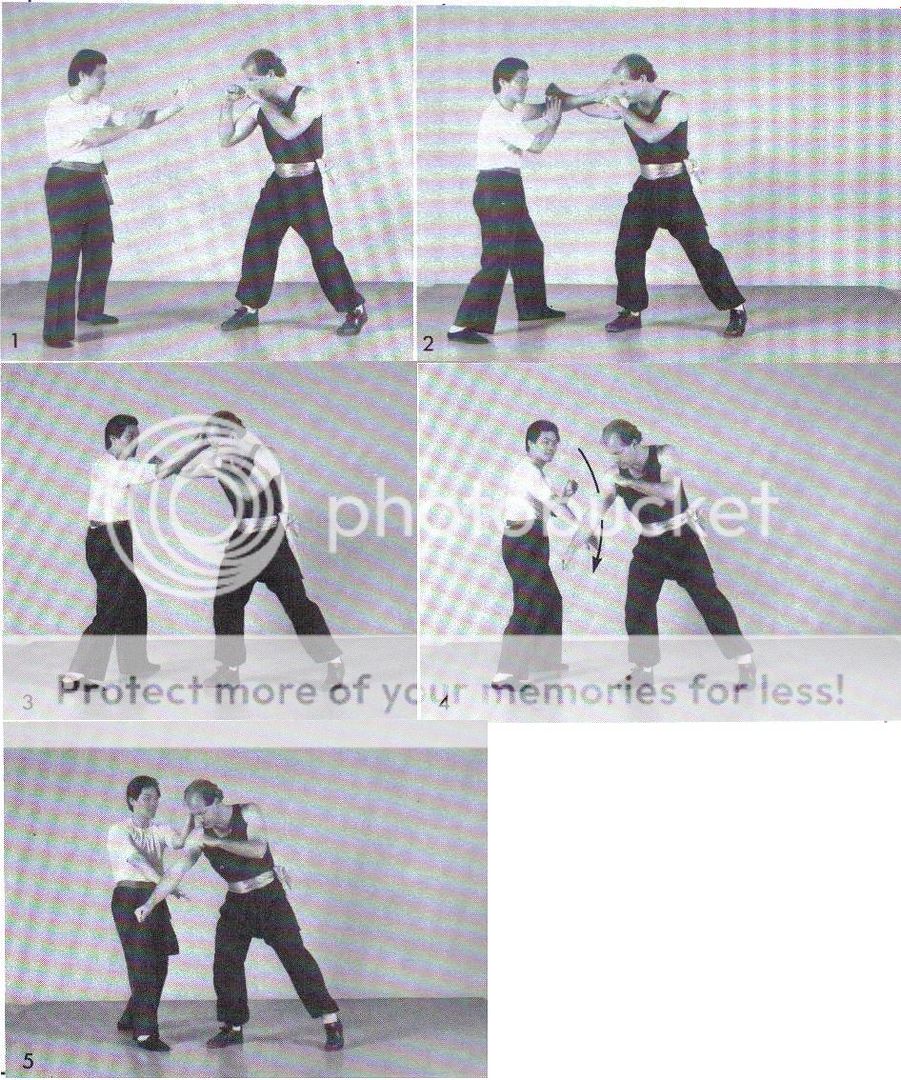 (1) The defender establishes a left neutral side stance to face the attacker. (2) The defender blocks the attacker's right round punch with a left thrusting arm block as he steps into a left foward stance and (3) follows with a right punch to the head. (4) He shifts into a left neutral side stance as he swings his right arm around to execute a right rotating arm block exposing the a ttackers right side. (5) The defender strikes with a left punch to the temple.
|
|
|
|
|
|
Wolf Nightshade Vice Captain
|
|
|
|
|
|
|
|
|
|
Wolf Nightshade Vice Captain
|
Posted: Tue Aug 15, 2006 3:27 pm
Wing Chun's Standard! 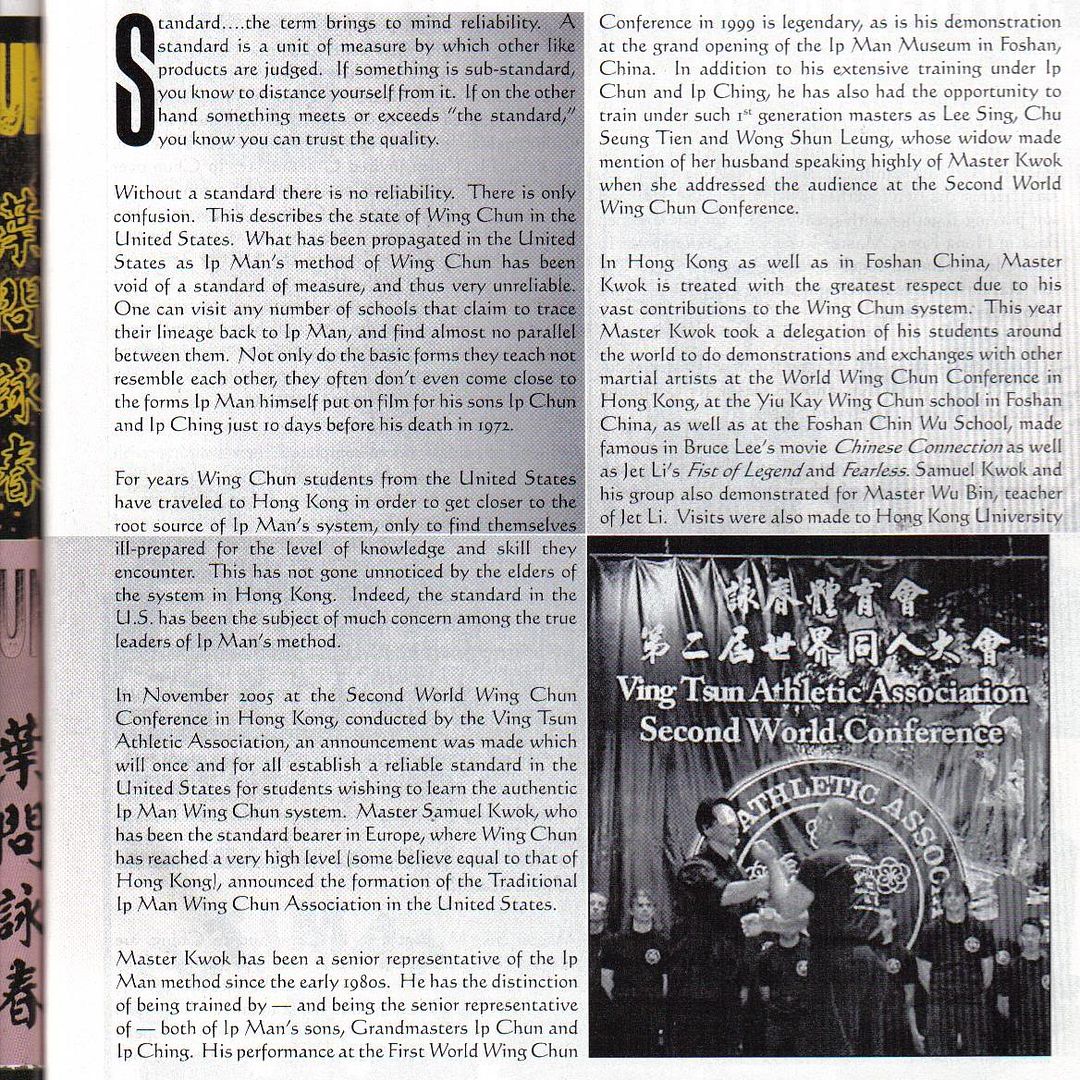 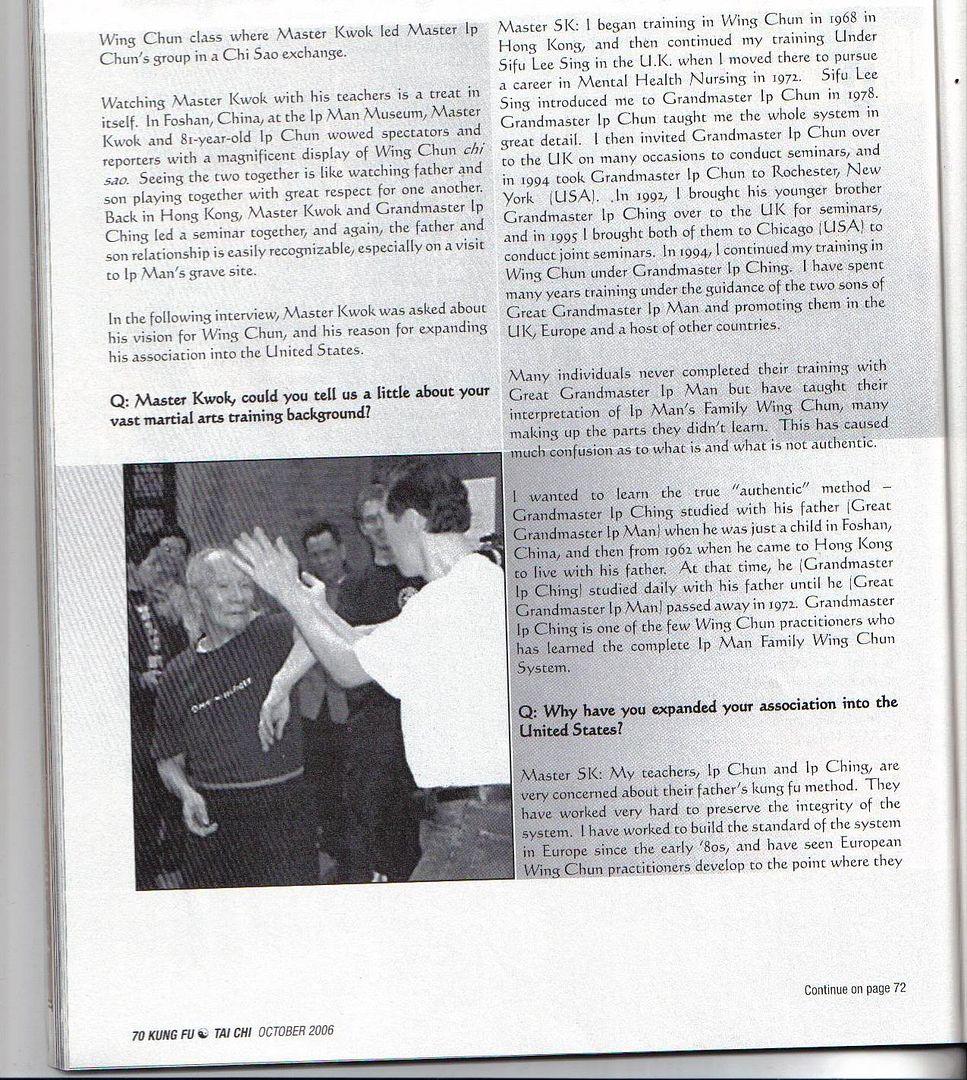  Kung Fu Tai Chi Magazine
|
|
|
|
|
|
|
|
|
|
|
|
|
|
|
Posted: Sat Sep 02, 2006 12:56 pm
|
Wolf Nightshade Vice Captain
|
|
|
|
|
|
|
|
|
|
Wolf Nightshade Vice Captain
|
Posted: Sat Sep 02, 2006 1:05 pm
|
|
|
|
|
|
|
|
|
|
Posted: Sat Sep 02, 2006 1:15 pm
In reply of the William Cheung Interview Feb 1996 Mitcham Kwoon.
The following letter appears in Martial Arts Magazines
VING TSUN ATHLETIC ASSOCIATION LTD
3, Nullah Rd., 2C/fl., Kowloon,
Hong Kong Tel 3-816044
Dear Sir,
RE: Point Three of the minutes of the 11th General Meeting
Recently we have received many letters and complaints about a person
called William Cheung who has distorted many affairs with ulterior motive.
As the board of directors of the Ving Tsun Athletic Association -- the
general association of the WHOLE Ving Tsun (Wing Tsun / Wing Chun) system,
which was founded by the late Grandmaster Yip Man and most of his senior
students since 1976, we have the responsibility to clarify the following
points:
1/ William Cheung has NEVER been regarded by anyone of his fellow-students
as the grandmaster or the leader of the whole Wing Chun Clan.
2/ NOBODY is recognized as the so-called "No 1 student of Grandmaster
Yip Man" and we have NEVER heard of William Cheung as the "No. 1 Fighter
of the Wing Chun Style".
3/ "Footwork" in the Wing Chun System is regarded as a most advanced
technique. We do not deny that some of the students of Grandmaster
Yip Man did not learn the whole system, but it is NOT TRUE that
William Cheung is the ONLY person to have ever learnt the entire
Wing Chun System" as what he announced in his advertisement.
4/ There have NEVER been any techniques in our system called "DIM-MAK" or
"Disabling Pressure Points", NOR any so-called "Missing Techniques" since
the creation of the Wing Chun System by Ng Mui.
5/ When Grandmaster Yip Man taught the techniques to his students he asked
NO-ONE "to take an oath not to reveal the secret to anyone during his life
time." He taught according to the potential of his students, teaching
the most advanced techniques to the most talented ones.
In the mid of 50's there had been a kid called William Cheung who had studied
in Grandmaster Yip Man's school for a few years intermittently and left
Hong Kong when he was 18 years old, and since then had become isolated from
his instructor and all the other fellow-students. During his short training
he surely gained the wrong impression in thinking that Grandmaster Yip Man
never taught the advanced techniques to students other than himself. And yet
we do not know how much William Cheung really learned himself.
It is regrettable that his lies have gone so far (i.e he told the
reporters that Grandmaster Yip Man had taught only him the so-called
"traditional Wing Chun", but had taught all his other students the
"modified Wing Chun").
However, any average person could easily analyze his techniques and see
this statement must be a lie. It is unthinkable that Grandmaster Yip Man
would choose to cheat all the students except one impudent kid, who actually
had little respect for him!
We feel sorry to have such an ignorant person in out clan, We want
to establish our position: we have NEVER AGREED with his Crazy
self-promotion, though we do understand his motive in casting himself as the
"Superman" in the William Cheung's Wing Chun System.
Yours faithfully,
The Board Of Directors and Attendance in the meeting of clarification
the distored affairs.
Wong Shun Leung (Chairman)
Leung Ting (Vice Chairman)
Tong Chao Chi (Vice Chairman)
Lok Yiu (President)
Yip Ching (Vice President)
Ho Kam Ming (Vice President)
Siu Yuk Man (Secretary)
Chan Tak Chiu (Treasurer)
Tsui Sheung Tim (Membership Management)
Koo Sang (Membership Management)
Lee Wai Chi (Public Relation)
Victor Kan (attendance)
Yip Chun (attendance)
|
|
|
|
|
|
Wolf Nightshade Vice Captain
|
|
|
|
|
|
|
|
|
|
Wolf Nightshade Vice Captain
|
Posted: Sat Sep 02, 2006 1:19 pm
William Cheung's response to a letter from the
leading masters of Wing Chun. This version comes from Australasian fighting Arts
Vol 10 nr 3.
********************************************************************
Firstly, I want to point out that the statement by the Ving Tsun Athletic
Association in their letter that the "the association was founded by the late
grandmaster Yip Man and most of his senior student since 1976" is not true,
because Yip Man died in 1971. So he couldn't have founded the Ving Tsun
Athletic Association in 1976 as claimed.
I shall attempt to answer their letter point by point:
(1) I am the leader of the Traditional Wing Chun because I am the only person
who inherited the whole Traditional system of Wing Chun. Furthermore, I also
know the modified version thoroughly, and know that it is inferior to the
Traditional system. I therefore proclaim myself the Grandmaster of the
Traditional Wing Chun Kung Fu. If anyone does not think so, he can come and
see me and I will be more than too pleased to show him.
(2) I was the only person that Grandmaster Yip Man chose to carry on the
whole Traditional Wing Chun system. I am the best fighter in the Wing Chun
Style. This was acknowledged by the late Bruce Lee, and recognized by many
famous masters of other styles. I anyone needs proof, I would only be too
pleased to oblige.
(3) Nobody - I say nobody - was taught the traditional Wing Chun footwork but
me. I Leung Ting and company knew it, they would be showing their students. It
is like the case of the Bil Jee form. Nobody knew the proper form except me
and that is why they have been telling people that the Bil Jee form was too
dangerous even to show it; in order to cover up the fact that they don't know
it. I was the first WEing Chun master to put Bil Jee in a book so that
everyone can learn the correct version.
(4)Dim Mak or disabling Pressure Point Techniques was passed on to me, along
with the whole Traditional system of Wing Chun. If you have read my article on
the subject you might understand how it works. However, ther is no medicine for
ignorance; Leung Ting and company deny the existence because they don't know
it. At least this time they admit their ignorance. My book on Dim Mak, or
Disabling Pressure Point Techniques, will be on the market soon. Keep your
eyes open. In china there is a Kung Fu monk who could stand upside down on one
or two hands. Some people can break a half dozen inch boards with a punch.
Maybe there are people who can stand on a dozen eggs. I can stand on two
without breaking them. All these can be called tricks if you like, but the
fact is that I am still "the best Wing Chun Fighter". I dare anyone to prove
otherwise.
(5) It is irrelevant to argue whether Yip Man had made be take an oath before
he taught me the complete Traditional Wing Chun System, because no-one else
was privileged to witness it. The fact is, that after 36 years of training in
Wing Chun, I have the confidence to say that I am the most knowledgeable
master in the Wing Chun System and I am the best fighter, and I am willing to
prove it to them at any time, anywhere. Unlike Leung Ting and company, as
shown in the photo, you only have to take one look at them to realize that
none of them look that part of martial artists. I could safely say that none
of them have done any hard training in recent years. They certainly don't look
very impressive!
In the 50's I was a kid . . . so was Bruce Lee . . . full of enthusiasm and
energy. We learned Wing Chun together and we were determined to make a name
for Wing Chun and ourselves. And we did. In the 50's Leung Ting was still "in
his diapers". He didn't learn Wing Chun until the 1960's from Leung Chun,(Yip
Man's student) of his own admission. He is one generation behind Bruce and me.
However, according to the article published in "Secrets of Kung Fu" Vol 2
1977, hundred of Kung Fu masters in Hong Kong - including Leung Chun, Yip
Shun, Tsui Sheng tin, and Wong Shun Leung - denounced Leung Ting in very
strong terms (I have enclosed copies) Leung Shun was reportedly saying that
Leung Ting wasn't learning from him, but from his student Jah Bak. This makes
Leung Ting two generation behind Bruce Lee and I.
And Leung Ting's claim that he was Yip Man's closed door student is on what
grounds? In the 60's, Yip Man was a heavy drug user, and did not enjoy very
good health. There was no way that Yip Man could have taught anyone in that
state of health. Even his own sons, Yip Chun and Yip Ching, who came to Hong
Kong in the 1960's, had to be content to train with Yip Man's senior students.
Wing Chun is a system which was developed for one to be able to master in
three to four years. Grandmaster Yip Man, from age of twelve to sixteen,
learned four years part time the modified version of Wing Chun with Chan Wah
Shun and, from age 17, he learned 2 years traditional Wing Chun from Leung Buk
(Leung Jung's son) in Hong Kong. Wong Shun Leung only learned modified Wing
Chun for three years part time and he began teaching in early 1955. Loh Liu
probably started teaching after only 2 years part time training in the
modified version.
I studied Wing Chun for 4 and one half years part time in the modified
version, and then 2 and one half years full time in the traditional version,
when I was living with Yip Man. I learned the modified version as well as the
traditional version. After I completed my learning, I have continued to
practice for a further 28 years, and I still practice daily.
From these factors you can see that I am the most qualified practitioner in
both modified and traditional versions of Wing Chun Kung Fu. I proclaim myself
the most knowledgeable master and the best fighter in the whole Wing Chun
style.
I would like to close off with a very famous Chinese proverb : "Practicing
Kung Fu is like paddling upstream - if you don't go forward, you must go
backward, and seldom you stay in the same spot". It is no surprise to find the
whole group in the printed photo appear to have gone so far backward that I
would be ashamed to be associated with them.
William Cheung
Grandmaster
|
|
|
|
|
|
|
|
|
|
|
|
|
|
|
Posted: Sat Sep 02, 2006 1:28 pm
The Secret History of Wing Chun: The Truth Revealed (also appeared as "Wing Chun Controversy: Is this the truth about Wing Chun's History") By Benny Meng and Alfredo Delbrocco "The first casualty when war comes is truth." -- Hiram Johnson Preface Although the world itself has not gotten smaller, life in the Information Technology Age (via the media of email and Internet) has made contact and communication with people around the globe easier. Consequently, it is now harder for information and research to be constrained or concealed, or for only one perspective to be put forward. Most importantly, it means that certain myths will not be perpetuated. Information pointing to the historical origins of Wing Chun kung fu is one of them. Put simply, the harsh truth is this: the myth of the Buddhist nun, Ng Mui and her disciple Yim Wing Chun, the supposed founders of the Wing Chun system, is just that - a myth. As the internet has brought information more readily to us, it has come to light that the story of Ng Mui and Yim Wing Chun was merely a way to conceal the truth about the system's origins and the identities of the political rebels who truly developed it. After almost 400 years, mounting evidence is pointing to the truth of Wing Chun's creation and evolution. The question is: is the kung fu world ready for it? There is no doubt that the information about to be disclosed will ruffle feathers to say the least. This is mainly because many Wing Chun instructors throughout the world are naively, and through no fault of their own, imparting a romanticized, fantastical history of the Wing Chun system. They are telling and retelling a story that is little more than a fairytale. A view of the traditional legends with an eye on history reads as an even more fascinating point of view. And no less deserving of the term `legendary'... Secrets in the Shadows of Shaolin As near as history can testify, Wing Chun was developed around 400 years ago in a time of civil unrest. Between 1644 to 1911, the Manchurians ruled China, where 10% of the population (the Manchus) ruled over 90% of the population (the Hons). To maintain control over the Hons, the Manchus ruled with an iron fist. Aggression and oppression were the cornerstones of the Dynasty and the Hons were banned from using weapons or training in the martial arts. Thus, in order to overthrow their oppressors, rebel activity was instigated by martial arts masters in hiding. Rebel activity developed rapidly in the Buddhist monasteries, which were largely left alone by the Manchus out of respect for the Buddhist culture and religion. These Shaolin/Siu Lam sanctuaries were ideal places for renegades to conceal themselves - they simply shaved their heads and donned the monastic robes of the disciples of the temple. During the day, the rebels would earn their keep by doing chores around the temple. At night, they would gather to formulate their plans to overthrow the Manchus. There are some that maintain that Shaolin/Siu Lam sanctuaries possessed no political leanings. They further emphasize that the Buddhist teachings of these monasteries would have prevented their support for rebels and secret societies. Such a position is emotional at best with no grounding in historical fact. Religious leaders throughout history, in both the Western as well as the Eastern world, have influenced politics and government since the beginning of time. Churches have forever harbored political victims sought by authorities believed to be oppressive. In the case China, serious precedent for such behavior on the part of the monasteries had already been set 400 years earlier. As verified by Ving Tsun Museum research, Jyu Yuhn Jeung, the man who led the Chinese revolt against the Mongol and established the Ming Dynasty was himself a Buddhist monk. Upon meeting, the revolutionaries identified themselves to each other with a secret hand-signal that would come to be the formal greeting or courtesy of Wing Chun. In fact, the traditional greeting or courtesy common to many of today's kung fu styles has two meanings. The first meaning recognizes the style's Shaolin origins - the left hand symbolizing the union of the Green Dragon (the left hand) and the White Tiger (the right hand), the fighting animals of the Shaolin monks. In the Hung Fa Yi (Red Flower Righteous) Lineage of Wing Chun, however, the hands are reversed: the left hand forms a fist and the right hand is open palm. It still retains its significance to Shaolin but it also refers to the secret society. In this context, the fist represents Yat (the Sun) and the palm represents Yuet (the Moon). Combined, these two characters mean "Bright" which reads and sounds like "Ming." This is the name of the previous Dynasty - the one overthrown by the Manchurians who formed the "Ching" Dynasty in its place. Hence, during the time of rebellion, when a Wing Chun practitioner or secret society member saluted with a fist and open palm pushed toward you, they were saying "Return the Ming, overturn the Ching." Obviously, this was not a sentiment shared by the Manchus. Late in the 1600's, the Manchurians became concerned about the Siu Lam Temples' rebellious activities and their continual development of the fighting arts. Therefore, they sent spies (many of them Manchu military leaders) to infiltrate the rebels and learn the traditional Southern fist systems as taught secretly in the Temples. The rebel kung-fu masters, realizing this, clandestinely developed a new system that was two-fold in purpose: firstly, it had to be learned quickly and efficiently, and secondly, it had to be devastatingly effective against the existing fighting systems that the Manchus were learning and teaching to their soldiers. Thus, Wing Chun was born. Their spy rings compromised, the Manchus decided to eliminate the threat of spreading rebel activity by simply exterminating the Siu Lam monks. Eventually, the Southern Siu Lam Temple was burned and destroyed. Extensive research conducted by the Ving Tsun Museum points to a generation of inheritors following the Southern temple's burning. Among them was a gentleman named Cheung Ng (referred to as Tan Sao Ng in other texts). Of this generation of inheritors, Cheung Ng is one to date that has proven to have historically existed. After establishing the Beautiful Flower Society Association (the precursor to the Red Opera and the public name for the Red Flower Society) and providing Wing Chun training to the secret societies, Cheung Ng went into hiding, disappearing from the public eye to escape Qing Dynasty persecution. He was hidden by distant relatives, a f** Gin business family named Chahn. The Chahn Sih Sai Ga (Chan family) were well established and wealthy. Through indirect action they were willing to help Cheung Ng. Staying with the family for over a decade, Cheung Ng taught the family the art of Hung Fa Yi Wing Chun. It was preserved by the family for four generations before it was taught to outsiders. The direct members of the Chahn family were never directly involved with the secret societies themselves, resulting in a low profile in Praise Spring Boxing history. The last generation of the Chahn family to learn the art was a distant nephew, a high level secret society leader, Huhng Gan Biu. In Qing archives as well as historical research into Chinese secret societies, a person by the name of Chahn Biu was recorded as the leader of the Heaven and Earth Society. He was caught and executed by the Qing authorities. Due to similar names appearing in difference sources at around the same timeframe, there is much debate as to whether the Opera's Biu and the Heaven and Earth Society's Biu were the same person. According to members of the Hung Fa Yi Wing Chun clan, Huhng Gan Biu was the 4th generation leader of the Hung Fa Yi Wing Chun clan and his Wing Chun descendants have preserved the system through to the 8th generation Master Garrett Gee and his 9th generation students in today's modern era. It was at the fourth generation that history and truth parted ways and the myth of Wing Chun's origins was created. The Myth of Ng Mui and The Truth About Yim Wing Chun To protect the identities of the creators and the perpetuators of the Wing Chun system, a smokescreen was thrown up in the form of a story - the story of Ng Mui and Yim Wing Chun. The legend was told that among the survivors of the Shaolin/Siu Lam massacres was a Buddhist nun named Ng Mui. Ng Mui was believed to have been the sole custodian of a streamlined, highly practical and effective martial arts developed within the temples. In turn, Ng Mui is said to have passed her knowledge onto her chosen disciple, a young girl named Yim Wing Chun. As Yim Wing Chun taught the system to others, it became known as Wing Chun. The story spread and today many versions of it exist around the world. However, there are three important considerations to make when regarding the story of Ng Mui. Firstly, outside of the legend, there is no other evidence that Ng Mui - in her capacity as a kung-fu grandmaster or founder of a kung-fu system actually existed - no records, no historical documents - nothing. Secondly, it would have been forbidden for a nun to live in, let alone train within, a celibate monastic environment like the Siu Lam /Shaolin Temples. Thirdly, and perhaps the most important, after escaping from a life and death situation as a revolutionary, it does not make sense that Ng Mui would teach an advanced level fighting system to a local girl with romantic problems and no connection to the revolution. At that time in Chinese history, the Qing dynasty had devised a special form of punishment for traitors and rebels. After being made to confess his or her crimes, the guilty party was executed. Afterwards, Qing officials would hunt down members of the guilty party's family down to nine generations and execute them as traitors as well. Teaching Yim Wing Chun a martial arts would directly put her life at risk. With regards to the Yim Wing Chun element of the legend, consider once more the relevance of secret rebel societies. `Yim' can be translated to mean `prohibit' or `secret.' The term `Wing Chun' referred to a geographic location - the Siu Lam Wing Chun Tong (Always Spring Hall), where the rebels perhaps practiced martial arts and orchestrated their seditious activities. The use of the term Spring symbolized the rebirth of the Ming Dynasty and Always referred to the reestablished dynasty lasting forever. After the destruction of the Southern Shaolin temple and its Wing Chun Tong, the survivors changed the character of Wing from Always to Praise. The term Praise referred to the fact that the revolutionaries had to spread the word about the revolution after the destruction of their base. Thus, `Yim Wing Chun' was actually a codename, meaning (protect) the secret art of the Wing Chun Hall. If we now know that the destruction of the Siu Lam/Shaolin Temples occurred but that the story of Ng Mui was a diversion, the question remains: who were the real custodians of the Wing Chun system? Enter the Hung Suen We do know that many (not the legendary five) monks and rebel leaders escaped the Manchurian massacres and that, to aid the secrecy of the system, historical material was passed directly from teacher to student. Thus, the elders told of two Siu Lam monks/rebels who survived the temple raids and were able to keep their Wing Chun system alive. One of these was a monk, a 22nd generation Siu Lam Grandmaster, Yat Chum Dai Si from the Northern Shaolin temple. The other was a rebel training under him in the Southern Temple, named Cheung Ng. Fleeing the Manchurian persecutors, Cheung Ng founded the Kihng Fa Wui Gun (Beautiful Flower Society), the roots of the (in)famous Hung Suen (Red Boat) Opera Troupe. Historically, we know that rebel activity flourished in the Red Boat Opera Troupe. The Red Boats allowed talented stage performers, accomplished in kung-fu and gymnastics, to form their own secret societies to overthrow the Manchu Dynasty. The Troupes provided the ideal sanctuary for fleeing rebels as the performers wore elaborate costumes and stage make-up, providing excellent but natural/plausible disguises for them. Additionally, the performers adopted and were known by their `stage-names', further cloaking their secret identities. When Cheung Ng founded the Opera Troupe he became known as Tan Sao Ng - not only a stage-name but also a sly nod to his skillful deployment of the Wing Chun deflection/striking technique, Tan Sao. An important fact to note is that so suspicious of the Manchus and their spies were these secret societies, that the true identities of the leaders, members and real nature of their activities were known only to an inner-circle within the society. Thus, genuine knowledge of kung-fu was passed only from a master to select, trusted disciples, thus protecting the purity and origins of the system. In conclusion With the development of many different lineages of Wing Chun over the centuries (over 10 are known to date), Wing Chun could simply be seen as a generic name for a style with so many lineages - no different to `karate' being a generic term to describe the various Japanese arts - varying and similar. However, this article has focussed on shedding light on the origins of Wing Chun. Indeed, to chart the development of the various lineages would require an entire book more complete than anything currently written. A complete historical and political analysis of Wing Chun's origins and development is currently being compiled in book form by the Ving Tsun Museum and should be available through major publication sources within the next twelve months. A hypothesis that Cheung Ng was indeed the inheritor of the art from Southern Temple and the guiding force behind its employment as a complete combat training system for rebels certainly has more historical weight behind it than the legend of a young girl. It represents a much more plausible explanation of Wing Chun's roots considering the completeness of the art in terms of total combat effectiveness. It also gels with the historical background of the times preceding the Red Boat Opera travels. However, as with all historical study, one hypothesis can give great impetus to further in depth study giving rise to even more revelations. In short, more study grounded in the proper structure and atmosphere of true historical research will get us even closer to reality. Hats off to the Ving Tsun Museum staff and researchers for moving our search into the realm of scientific investigation and giving us another starting point for serious research! Myths are often created to simplify something or to disguise the true nature of the subject to make it more palatable to the mind. Consequently, sometimes people want to believe the myths despite scientific or historical evidence to the contrary. A fiction can be more comforting than the truth; a fairytale easier to grasp than a treatise. The legend of Ng Mui and Yim Wing Chun is a great story. It just isn't true. In light of being told one story for centuries, it will be difficult for some to accept the truth in minutes, hours or even months. But studying the martial arts (and Wing Chun in particular) is a continual quest for truth - personal truth, social truth, spiritual truth and - yes - historical truth. I trust you have enjoyed your enlightenment on the true origins of Wing Chun. An internationally published author, Sifu Benny Meng is the founder and Curator of the Ving Tsun Museum in Dayton, OH, USA. A practitioner of Wing Chun for over 15 years, Sifu Meng has come into contact with most of the major families in Wing Chun. More information is available on the Ving Tsun Museum at http://www.vtmuseum.org or by mail at 5715 Brandt Pike, Dayton, OH 45424, phone/fax (937) 236-6485. Sifu Alfredo Del-Brocco has been training in Wing Chun for over 15 years, firstly under the guidance of Grand Master William Cheung, then under Master Rick Spain. Today he teaches around 350 active students in his Brisbane Kwoon. Sifu Alfredo was also the recipient of the 1998 Australasian Blitz Kung Fu Instructor of the Year Award. Sifu Alfredo can be contacted at http://www.wckfo.com.au or by phone / fax : (07) 3229 8694 http://home.vtmuseum.org/articles/meng/truthrevealed.php
|
|
|
|
|
|
Wolf Nightshade Vice Captain
|
|
|
|
|
|
|
|
|
|
Wolf Nightshade Vice Captain
|
Posted: Sat Sep 02, 2006 1:44 pm
One thing I must add if you do Wing Chun or have seen the Biu Gee form you should know that the fingers are used to hit pressure points in some of the articles above people have said Dim Mak dose not exist in Wing Chun. This is strange I have seen people like Ip Ching selling Wing Chun pressure point posters. http://www.wckfc.com/supplies/post.htm
|
|
|
|
|
|
|
|
|
|
|
|
|
|
|
|
|
|






 Reply
Reply