|
|
|
|
|
|
|
|
|
 Posted: Fri Apr 25, 2008 10:40 pm Posted: Fri Apr 25, 2008 10:40 pm
Table of Contents
Elements
Ninjutsu
Taijutsu
Genjutsu
Tools
Chakra Control
Custom Jutsu & Learning Jutsu
Summons
|
 |
|
|
|
|
|
|
|
|
|
|
|
|
|
Posted: Fri Apr 25, 2008 10:43 pm
Elements 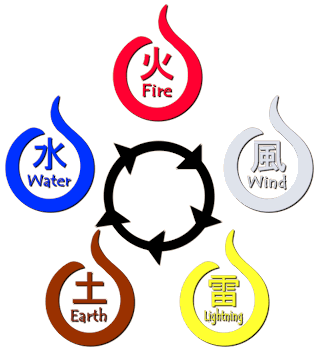
The elements share a strong/weak relationship. Thus, in the follow order shows the left element is strong against the one to the right of it:
Water --> Fire --> Wind --> Lightning --> Earth --> Water
That means that if someone uses a lightning jutsu against an earth jutsu of an equal rank, the lightning jutsu will usually win. That is because, whenever a jutsu of one element goes against a jutsu of an element that the former is strong against, the weaker element is reduced in power by one rank. However, X-ranked jutsu can never be affected by this.
When someone is aligned to two elements, there is an occurrence when the two makes it possible to wield a sub element that is not of the original five. Water and Earth makes the wood element. Wind and water makes the ice element. There are many more out there, but have yet to be revealed. If one wishes to create their own element through use of two combinations of the basic elements, then they may, as long as it's reasonable.
A character with a single natural element will be more proficient in that element than someone with the same element and another one. For example, Ninja A has only an affinity to fire, whereas Ninja B has an affinity to fire and earth. Though Ninja B has a specialty in both elements, only Ninja A has the most potential to master fire. Therefore, you may find elemental jutsu of high ranks that can only be learned by those with only one element being of that element.
This also reflects in jutsu usage of one's natural element. When using that jutsu, the rank of the jutsu will get an increase, thus increasing its power/effects without increasing anything else, such as the number of handseals and chakra cost. However, it depends on if your character has an affinity with one element or two. If the character has only one element affinity, jutsus they use of that element is increased by one half of a rank. For example, a B ranked jutsu becomes a B+. That means that it's almost as powerful as an A rank, but not there yet. If a character has two element affinities, they get no jutsu power increase.
|
|
|
|
|
|
|
|
|
|
|
|
|
|
|
|
|
|
Posted: Fri Apr 25, 2008 10:46 pm
Ninjutsu Quoted from Wikipedia:Ninjutsu (忍術, "Ninja Techniques") is a vague term referring to almost any technique that uses chakra and allows the user to do something that they otherwise would be incapable of doing. The earliest forms of ninjutsu are said to have been created by the first owner of the Rinnegan. Unlike genjutsu, which makes the opponent see illusions, the effects of ninjutsu are quite real. Ninjutsu relies on chakra and, most of the time, hand seals (each hand seal showing a different animal in the Chinese zodiac) to be effective. The hands are put in sequential positions that mold chakra in the necessary manner to perform a jutsu. This is not always consistent, however, and some of the simpler jutsu seem to become second nature to experienced ninja, after which they can perform them at will. Additionally, some ninjutsu can be classified as an elemental jutsu, in those cases where a specific element (earth, fire, lightning, water, wind) is used. The phrase "Ninja Art" (Ninpō) is occasionally added to the beginning of the jutsu.
|
|
|
|
|
|
|
|
|
|
|
|
|
|
|
Posted: Fri Apr 25, 2008 10:49 pm
Taijutsu Quoted From Wikipedia: Taijutsu (体術, "Body Techniques" or "hand-to-hand combat") refers to any techniques involving the martial arts or the optimization of natural human abilities in general. In other words, taijutsu is executed by accessing the user's stamina directly, rather than converting the user's stamina to chakra in order to execute a ninjutsu or genjutsu technique, meaning that taijutsu is much quicker to execute than (though not always as powerful as) ninjutsu and genjutsu. In some cases, chakra is used to enhance the techniques, particularly in the Hyuga clan's Gentle Fist style where the user sends small bursts of chakra into the persons body to attack the chakra system or chakra points, and in the case of Tsunade and Sakura, who combine chakra into their attacks to cause great damage. Generally speaking, however, most taijutsu users rarely use chakra in their attacks, such as Rock Lee and Might Guy.
|
|
|
|
|
|
|
|
|
|
|
|
|
|
|
|
|
|
Posted: Fri Apr 25, 2008 10:50 pm
Genjutsu 
Using Genjutsu
Deciding whether a genjutsu will affect a person or not depends on the rank of the genjutsu and the level of the Genjutsu attribute of the target(s). To decide the chance of this, a dice roll of 100 will be used, or in simpler terms 1d100, which means one roll of a dice of 100 sides. When a person uses a genjutsu, the target must make a roll. Based on what the result is, they are either caught in the genjutsu or not.
If the target is caught, they must make the same roll again each post to see if their character notices the jutsu/can break out of the genjutsu. When they do make a successful role, their will then overcome the genjutsu, allowing them to break out of it. To fully remove themselves from it, however, they must place their hands into the tiger handseal and use the "Kai" technique, which stops the flow of chakra for a moment, then releases it at full burst to stop the genjutsu's effect entirely. The "Kai" jutsu is a ninjutsu one must learn, however, much like any other ninjutsu. All genjutsu have set time limits however. Genjutsu can also be stopped by a person touching the affected and the person using their own chakra to stop the genjutsu. Until then, the affected is usually just standing there dazed, unless the genjutsu still allows physical movement, which is sometimes genjutsu that affect the environment more than just the person themselves.
Below is the rolls the afflicted must make in order to overcome a genjutsu based on the level of their Genjutsu attribute in relation to the rank of the jutsu used:
E
Legendary: Not affected
Superb: Not affected
Great: Not affected
Good: Not affected
Fair: 10 - 100
Poor: Unable to overcome
Terrible: Unable to overcome
D
Legendary: Not affected
Superb: Not affected
Great: Not affected
Good: 10 - 100
Fair: 20 - 100
Poor: Unable to overcome
Terrible: Unable to overcome
C
Legendary: Not affected
Superb: Not affected
Great: 10 - 100
Good: 30 - 100
Fair: 51 - 100
Poor: Unable to overcome
Terrible: Unable to overcome
B
Legendary: 10 - 100
Superb: 21 - 100
Great: 31 - 100
Good: 51 - 100
Fair: 76 - 100
Poor: Unable to overcome
Terrible: Unable to overcome
A
Legendary: 31 - 100
Superb: 41 - 100
Great: 51 - 100
Good: 76 - 100
Fair: 91 - 100
Poor: Unable to overcome
Terrible: Unable to overcome
S
Legendary: 41 - 100
Superb: 51 - 100
Great: 76 - 100
Good: 91 - 100
Fair: Unable to overcome
Poor: Unable to overcome
Terrible: Unable to overcome
X
Legendary: 81 - 100
Superb: 91 - 100
Great: Unable to overcome
Good: Unable to overcome
Fair: Unable to overcome
Poor: Unable to overcome
Terrible: Unable to overcome
So for example, if someone a Good attribute wishes to overcome a genjutsu, they must roll a 1d100. If the result is 30, 100, or a number inbetween it, then the person is successful. However, rolling a number lower than 30 will result in a failure.
|
|
|
|
|
|
|
|
|
|
|
|
|
|
|
Posted: Fri Apr 25, 2008 10:54 pm
Tools Using tools is no different from using taijutsu. Weapons are only an extension of your body, a dangerous extension at that. Therefore, what applies to taijutsu applies to tools, too. In that, they use SP. However, there are different rules to follow. To draw a weapon usually takes up one part of the person's post. So, if done on the defensive part of the post, the person has a chance of using it in the offensive part. However, if it's drawn in the offensive part, then they must wait their next turn to use it. You will learn more about the makeup of a post in the Combat System thread. However, depending on the rank of the weapon and the level of their Tool attribute, the person may have the ability to draw the weapon quickly. This allows them to draw it as a passive action without using up any part of their post. This applies to sheathing it, too.
Each tool has a rank, meaning how powerful it is, from weakest to strongest just like jutsu: E, D, C, B, A, S, and X. And just like jutsu, X ranked weapons usually are a two-edged sword in terms of drawbacks. When two weapons oppose one another, the one with the higher rank will usually win. To keep anyone from wielding high ranked weapons, however, weapons usually have attribute requirements to use them or else they are useless in the person's hand. Think of holding a very heavy sword and never being able to lift it. More details on equipment can be read in the Equipment thread.
A person's Tool attribute also shows how many weapons a person can throw, such as kunai or shuriken. The higher it is, the more they can throw.
Just because a person has a requirement for a weapon, however, doesn't mean they are trained in using that type of weapon. Unless your character is a regular sword user, they shouldn't be able to pick up any sword and be able to wield it expertly like that. To be able to learn a weapon, they'll have to train with it.
To draw or sheathe a weapon as a passive action without using up any part of your post, the person must be at least the given level in their Tools attribute for each rank:
E Rank - Any
D Rank - Any
C Rank - Fair and up
B Rank - Good and up
A Rank - Great and up
S Rank - Great and up
X Rank - Superb and up
The number of projectiles a person can throw in a single post are based on the person's Tools attribute:
Legendary: 100
Superb: 50
Great: 10
Good: 5
Fair: 3
Poor: 2
Terrible: 1
|
|
|
|
|
|
|
|
|
|
|
|
|
|
|
|
|
|
Posted: Fri Apr 25, 2008 10:56 pm
Chakra Control Chakra Control jutsu are special jutsu that show a ninja's skill in using chakra effectively. Chakra can be used in a variety of ways outside of just ninjutsu and genjutsu, such as increasing the strength of one's punches or increasing their speed. Other things they are known to do are use chakra as defense in raw form, and even allowing a person to perform jutsu with one or no handseals, though this usually increases the cost of the jutsu. For a list of Chakra Control techniques, check the Universal Jutsu thread.
|
|
|
|
|
|
|
|
|
|
|
|
|
|
|
Posted: Fri Apr 25, 2008 10:57 pm
Custom Jutsu & Learning Jutsu A person can make their own jutsu, but there are some guidelines to follow.
The rank of the jutsu needs to be appropriate for its effects. Custom jutsu are going to have to be approved in this guild, anyway, in order to use them in the thread, so you will get advice and be told how to balance a jutsu. Looking at the set list of jutsu of the different villages can also help you get an idea on how to create your jutsu. Though trial and error comes with matching a jutsu's effect with its rank, the one thing that will be sort of specific is the amount of damage a jutsu can do, if it does any at all.
Below is a range of specific values that should be for a jutsu based on its rank. When you submit a jutsu, you leave the damage field blank, for which then, the judge will use the random number generator to determine what value it's going to be in the range provided for that jutsu.
Ninjutsu/Chakra Control
E Rank: 1 - 3
D Rank: 3 - 7
C Rank: 7 - 15
B Rank: 20 - 30
A Rank: 30 - 60
S Rank: 60 - 100
X Rank: 100 - 300
Taijutsu/ Tools
E Rank: 2 - 8
D Rank: 5 - 12
C Rank: 12 - 20
B Rank: 15 - 45
A Rank: 35 - 70
S Rank: 60 - 110
X Rank: 120 - 500
Genjutsu
E Rank: 1 - 3
D Rank: 3 - 7
C Rank: 7 - 10
B Rank: 12 - 25
A Rank: 30 - 45
S Rank: 50 - 65
X Rank: 70 - 100
Genjutsu doesn't actually do physical damage, but more of mental damage, which can bring a person into unconsciousness if their mind takes too much genjutsu. This will be explained in the Combat System thread.
Learning Jutsu
To learn a jutsu, your character must learn it through extensive roleplay that will take place primarily in the guild. There may be exceptions where a mod may have the training session be in the thread itself, but to keep things organized, it would be placed in the Training subforum of this guild. There are four methods to learning jutsu:
Student-and-Teacher
A character of one roleplayer teaches the character of another roleplayer. This is when the teacher character knows the jutsu, and attempts to teach it to the student. Anyone can be a teacher, even a Genin. When a training session is over, a judge grades the session with an E, D, C, B, or A. However, if the session is graded badly, the student will fail to learn anything. The grade accounts to both the teacher and the student's quality in this training session.
NPC'ing
A roleplayer has an NPC they make or already exists teach them the jutsu they are wishing to learn. This requires self-roleplaying and demands a large number of posts. You cannot learn jutsu of over countries, however, through this method.
Scrolls
Obtaining a scroll that has a jutsu or list of jutsu on it, the character proceeds to teach themselves through the information on the scroll, much like Naruto did. However, scrolls can only be given through a mod roleplaying giving it to your character, either by them going to a shop to purchase one to obtaining one in some other way. Just as much work as the NPC method, but adds a little more availability to what you can learn.
Self-Taught
This is the most complicated method. The character attempts to learn a jutsu through observation and understanding how it works alone. This is by far the longest process and demands a good roleplay in order to achieve success, for example, knowing the specifics of the jutsu.
Below is the requirements for each method based on the rank of jutsu you are trying to learn:Quote: Members (requires 1 post from the other member before you can post again. The total grade is the average of the teacher's mark and the learner's mark) E-Rank: Minimum 3 posts from the learner, total grade must be E-ranked or higher. D-Rank: Minimum 4 posts from the learner, total grade must be E-ranked or higher. C-Rank: Minimum 4 posts from the learner, total grade must be E-ranked or higher. B-Rank: Minimum 5 posts from the learner, total grade must be D-ranked or higher. A-Rank: Minimum 6 posts from the learner, total grade must be C-ranked or higher. S-Rank: Minimum 7 posts from the learner, total grade must be B-ranked or higher. X-Rank: Minimum 8 posts from the learner, total grade must be A-ranked. NPCs (must use an approved NPC that resides in the sato) E-Rank: Minimum 5 posts from the learner, overall grade must be E-ranked or higher. D-Rank: Minimum 6 posts from the learner, overall grade must be E-ranked or higher. C-Rank: Minimum 6 posts from the learner, overall grade must be E-ranked or higher. B-Rank: Minimum 7 posts from the learner, overall grade must be D-ranked or higher. Scrolls (must have bought the scroll) E-Rank: Minimum 4 posts from the learner, overall grade must be E-ranked or higher. D-Rank: Minimum 4 posts from the learner, overall grade must be E-ranked or higher. C-Rank: Minimum 5 posts from the learner, overall grade must be E-ranked or higher. B-Rank: Minimum 6 posts from the learner, overall grade must be D-ranked or higher. A-Rank: Minimum 7 posts from the learner, overall grade must be C-ranked or higher. S-Rank: Minimum 8 posts from the learner, overall grade must be B-ranked or higher. X-Rank: Minimum 9 posts from the learner, overall grade must be A-ranked. Self-Taught (must cite where you saw the jutsu, and you need good detail on the explanation/reasoning behind the mechanics of it) E-Rank: Minimum 5 posts from the learner, overall grade must be E-ranked or higher. D-Rank: Minimum 6 posts from the learner, overall grade must be E-ranked or higher. C-Rank: Minimum 7 posts from the learner, overall grade must be E-ranked or higher. B-Rank: Minimum 8 posts from the learner, overall grade must be D-ranked or higher. A-Rank: Minimum 9 posts from the learner, overall grade must be C-ranked or higher. S-Rank: Minimum 10 posts from the learner, overall grade must be B-ranked or higher. X-Rank: Minimum 12 posts from the learner, overall grade must be A-ranked.successful. And there's one more rule: there can only be up to two posts from each roleplayer per day. This is to avoid people learning jutsu at super speed.
|
|
|
|
|
|
|
|
|
|
|
|
|
|
|
|
|
|
Posted: Fri Apr 25, 2008 10:59 pm
Summons 
Legendary: Legandary summons are the greatest creatures of the otherplanes. They usually forge contracts with people of the human realm so that they may manifest with the power of another's chakra and be seen in their magnificence and revered as they perform feats beyond that of typical people. It is said that each legendary summon owns its own plane of existance and has an abundance of kin, due to such manifested and controlled land. However, at any given time, there is only one leader of these tribes. It is not unusual for legendary summons to detest other deities of the same status and fight for territory and supremacy.
Custom: Custom summons are intelligent creatures. Like the Legendary Summons, with a blood pact, the Custom Summon is allowed to manifest in the human world for long periods of time. They come from a universal part of the otherplanes where there is no set rule and various clans fight amongst one another. It is highly unusual for a creature in this category to live for prolonged periods of time, so there is no set leader of any tribe, just varying levels of strength. Usually, they are nowhere near as great as the leaders of legendary status. All custom summons strive to seek their own otherplane world so that they may live in security.
Legendary Summons
-Up to 5 levels, 5 being the leader/boss/whathaveyou
-Must be part of the summoning contract to summon
-Requires straight chakra to summon, but in larger quantities
-Summon lasts based on provided chakra
-Summon is harder to tame (requires more time before it allows you to 'contol' it)
-Cannot be easily acquired, such as from a store. Usually, more high ranked shinobi have possession of these or some wealthy person.
Custom Summons
-Up to 3 levels
-Must have necessary summoning contract
-Requires chakra and blood to summon
-Summon lasts based on provided chakra
-Summon is easier to tame (less time required to 'control' it)
-Summon Scroll are usually bought from a special scroll store.
Format for Summon
Name: (The name of the summon)
Type: (Legendary / Custom)
Tribe: (Frog, Snake, Slug, etc.)
Affection:
Description:
Personality:
-Attributes-
Ninjutsu:
Taijutsu:
Genjutsu:
Tools:
Handseals:
Chakra Control:
Strength:
Speed:
Endurance:
-Jutsus-
Affection
For every post that you train with the summon, granted it is a good post, the affection level increases by 1. If it is a good post, 2, a great post, 3, and an OMG *drools* wow post, 4. Based on HOW you treat it, thats how it'll respect you. If you are nice and caring, the summon will revere you, if you're cold and instill fear, the summon will respect you out of fear. Affection works on the following formula: [Affection/Summon Level] = Respect
Respect 0 : The summon has no care whatsoever for you, but respects the fact that you summoned it. Outside of that, it doesnt give a crap about you.
Respect 1-2: The summon still doesnt care about your life but respects the time you put into perfecting form with it or whatever you do.
Respect 3-4: The summon respects you. It will now really take time to learn combat forms with you, or what have you. You can begin teaching it jutsus at 4.
Respect 5-6: The summon will fight alongside you as a partner. It will not take the hit for you, but it will stand up and defend you if necessary. It cares, but not above itself.
Respect 7-8: The summoned creature sees you and it as equals in a bout. It will truly concert it's combat to fit yours and you both seem to work in tandem.
Respect 9: The creature empathically understands you. You both work together, and share the same aspirations, almost like brothers (or sisters... whatever)
Respect 10: The summon cares for your life more than it's own. It will take the hit for you if necessary to make sure that your dreams are fulfilled. It is, for all intents and purposes, part of your family.The number before the ='s is the level of the summon.Base Summon Cost: (1 = 15) (2 = 30) (3 = 50) (4 = 80) (5 = 150)
Extended Summon Cost: (10 CP * Level) per post
Summon Maintainance Cost: (20 CP * Level) per post
Explanation of Extended Summon Cost and Summon Maintainance Cost:
Extended Summon Cost - Right after your post summoning whatever it is that you summoned, you may pay additional chakra at a cost of (15 * Level) chakra per post in advance. The reason for this is, because it's a greater initial value, however it costs less in the long run.
Summon Maintainance Cost - Don't feel like thinking strategically? Or maybe not have enough chakra to pay for posts in advance, well, you won't be penalized much. For (20 * Level) chakra per post, you're able to keep your summon in battle/whatever to finish its job.
Attributes and Jutsu of your Summon
Level One - Given 7 points to increase attributes. No attribute can go to Great. 2 E-Rank, 1 D-Rank jutsus.
Level Two - Given 12 points to increase attributes. Only one attribute can go to Great. 2 E-Rank, 2 D-Rank, and 1 C-Rank jutsus.
Level Three - Given 18 points to increase attributes. Two attributes can go t Great, or one attribute can go to Superb. 4 E-Rank, 2 D-Rank, 2 C-Rank, and 1 B-Rank jutsus.
Level Four - Given 27 points to increase attributes. Three attributes can go up to Great and one attribute can go to Superb. 6 E-Rank, 3 D-Rank, 3 C-Rank, 2 B-Rank and 1 A-Rank jutsus.
Level Five - Given 32 points to increase attributes. Any number of attributes can become Great and Superb. Only one attribute can become Legendary. 6 E-Rank, 4 D-Rank, 3 C-Rank, 2 B-Rank, 2 A-Rank, and 1 S-Rank jutsus.
Base Stamina Per Level Summon:
1 - 80
2 - 160
3 - 320
4 - 640
5 - 1280
Base Chakra Per Level Summon:
1 - 80
2 - 160
3 - 320
4 - 800
5 - 1700
Based on the Summon's Endurance attribute, they may get a bonus to their stamina. A mod will use a random number generator to determine how what bonus you get in the range of numbers.
Legendary: 200 - 400
Superb: 100 - 140
Great: 70 - 90
Good: 40 - 60
Fair: 10 - 30
Poor: 0
Terrible: 0
Based on the Summons's Endurance, Ninjutsu, and Genjutsu stats, they may get a bonus to their chakra.
Endurance
Legendary: 60 - 80
Superb: 45 - 60
Great: 25 - 40
Good: 15 - 25
Fair: 5 - 10
Poor: 0
Terrible: 0
Ninjutsu
Legendary: 80 - 125
Superb: 70 - 80
Great: 50 - 65
Good: 30 - 40
Fair: 10 - 20
Poor: 0
Terrible: 0
Genjutsu
Legendary: 80 - 125
Superb: 70- 80
Great: 50 - 65
Good: 30 - 40
Fair: 10 - 20
Poor: 0
Terrible: 0
Since some summons will have no hands, they can use jutsu right off the bat after drawing in some CP into their chakra pool. But as a downside, the cost of jutsu doubles.
|
|
|
|
|
|
|
|
|
|
|
|
|
|
|
|
|
|




 Reply
Reply