|
|
|
|
|
|
|
|
|
 Posted: Fri Oct 26, 2007 8:01 am Posted: Fri Oct 26, 2007 8:01 am
Okay. I've got a thread, two loose-leaf pages, half an idea what I'm doing, a quarter of an idea what I just did, and a pair of anti-flame shades.
*cracks knuckles* Let's get this overwith. I hope it's not an English cipher.
Everyone can post here now. Constructive criticism is welcomed, so that I may get better at conlanging when I try my hand at another.
~~~
Gonn doesn't particularly mean anything, before you ask. I just think it's a cool-looking and -sounding name.
~
Vowels: Long and short 'A', 'E', and 'I', plus the short 'O'.
Constonants: English 'C', 'D', 'F', 'G', 'H', 'J', 'L', 'M', 'N', 'P', 'R', 'S', 'T', 'V', 'W', 'Y', 'SH', 'TH' (unvoiced), 'CH', and that sound that goes by 'ZH' in dictionaries that I can't remember a word that uses right now. Plus: German rolled 'R', and German 'CH'.
The orthography is rather straightforward. Constanants that use the English alphabet are unaltered. 'SH', 'TH', 'ZH', and English 'CH' get...well, I already said 'em. Defective orthography; sue me. German 'CH' is represented by 'K', and the rolled 'R' is represented by 'RR'. Long vowels are doubled: 'sit' is 'sit', but 'sight' is 'siit'.
~
Conscript:
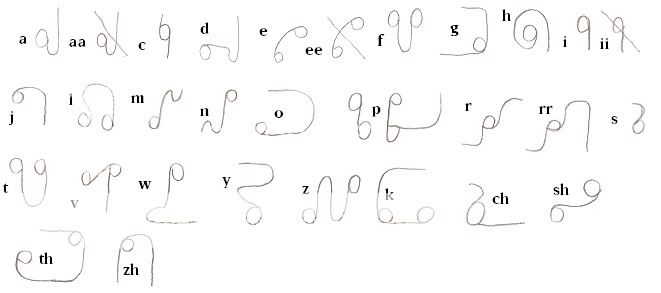
There are two 'p' symbols to make the language more natural. The one on the right is derived from a symbol in another fictional culture that used the english 'b' sound.
~
If the last letter in a word is a constonant and the last vowel is short, the constonant gets a backslash over it, like what you see on the long vowels. There is no instance where you'd use a backslashed conscripted 'o', so it has been adopted as the symbol of the conculture's central government.
The history behind this backlsashing rule: The concultrue used to double the end constonants istead of backslashing them, but that took some extra time. As a result, they changed it to the simple backslash. This is the reason 'Gonn' is spelled with two 'n's in the romanization.
~
Stress the first, third, and sixth syllable of each word, if the appropriate syllables exist.
~
Phonetic constraints: (C)(C)V(r, rr, l, n)(C).
~
Gonn is a non-tonal language.
~
Word order: SVO.
~~~
That's enough for one post. More information in next post.
|
 |
|
|
|
|
|
|
|
|
|
|
|
|
|
Posted: Fri Oct 26, 2007 8:17 am
Gender:
There are four genders in Gonn: Masculine, Feminine, Neutral, and General.
Concrete nouns are neutral, except for people, who get Masculine or Feminine according to gender.
Abstract nouns like (Anger, Distractedness, Serendipity) are feminine. Basically, all the nouns based off adjectives.
Other abstract nouns (Motion, Repetition, Thought) are masculine. Basically, all the nouns not based off adjectives.
All nouns are also General.
~
Verbs get a suffix according to how they are...[n00b]I don't now how to say it. Cojugated?[/n00b]
For past tense, add -a to the verb. Present tense merits -e, and Future tense receives -i.
If the tense is a perfect tense, also add an -r.
If the subject is plural, the added vowel is long. For example: Present perfect tense, plural subject gets -eer.
A constonant is also added to the end according to the subject's gender. Masculine = -d, Feminine = -l, Neutral = -n, and General = -c.Passerby But Kazyan, you said all nouns in Gonn are General and something else....
Oh, if the verb ends in a vowel, stick an -h between that suffix thing and the verb.
~
Helper verbs go just before the main verb. Helper verbs do not get that little one-syllable suffix thing I just mentioned. It's already taken care of.
~
While we're on the topic of helper verbs, the verb "to be" does not exist in this language. It's just sort of omitted. I'd like to think tense and number could be just 'understood'.
~
I'm not sure how to say this in technical terms. The english 'X's Y'? The X's possessive tag is formed by adding an -on if the verb ends in a constonant and -n if it ands on a vowel. For plural forms of nouns, you do the same thing, except with an 'r' and not an 'n'. If a noun is plural and possessive (is that how you say it?), you add -(o)rn.
~
Compound nouns are created by joining the words with a hyphen.
~~~
|
|
|
|
|
|
|
|
|
|
|
|
|
|
|
|
|
|
Posted: Fri Oct 26, 2007 9:24 am
~~~
For Y/N questions, add a particle (zaan) just after the word being specifically questioned. If no particular word is being questioned, zaan goes at the beginning of the sentence. It's like: "T/F: Statement"
~
For other questions, put the interrogative pronoun in place of what you want answered. It's sorta like 'fill in the blank'.
~
While we're on the topic of pronouns, Gonn uses a very simple pronoun system. Who, what, when, where, something, no one, everywhere...cross it out. Gonn sticks to one pronoun for interrogative and relative pronouns: tri. To denote if it refers to a person, place, thing, adjective, time, method, or reason, you just say so after the pronoun. In English, you would say "What color is the ball?" and "Who is this man?", but why the distinction? That is the reasoning behind this system.
"tri" denotes a query, whereas "trii" is relative.
~
Other pronouns:
1st person na*.
2nd person ve*.
3rd person ti*.
3rd person alternate pi*. (Used when more than one he/she is referred to as a pronoun, or in situations suggesting politeness.)
To pluralize, make the vowels long.
For a 1st person plural that includes the 2nd person, use faa*.
The hypothetical pronoun (English: one) is ke*.
~
Relative clauses go before the noun they pertain to, using the appropriate relative pronoun. Relative clauses go after any adjective that pertain to the noun, and if one of those adjectives is a non-article, use vban before the relative clause. (vban is the Gonn word for 'and', by the way.)
~
Noun phrases are head first. Article > Adjectives > Relatives Clauses > Noun.
~
Prepositional phrases are quite different than in English. The preposition is added as a prefix to the verb, and the rest of the phrase goes directly after the verb.
Preposition-Verb (Rest of Phrase)
What if there are two or more prepositional phrases?
PrepX-PrepY-PrepZ-Verb (PhraseZ) (PhraseY) (PhraseX)
~
|
|
|
|
|
|
|
|
|
|
|
|
|
|
|
Posted: Fri Oct 26, 2007 9:24 am
~~~
To negate a phrase, add a particle (I defined it this time: cnazh) at end of negated clause. Woot for being able to use it in a relative clause/prepositional phrase. Adding cnazh to the beginning of a sentence is understood as negating the sentence.
~
Imperative sentances are constructed as "I order you to X", or some variant for politeness.
~
That "to X" up there is an infinitive, right? Invinitives are simply the verb without the Tense-Number-Gender suffix.
~
Conjuctions are all derived from vba. Add vba to the end of conjoined clauses. However, vba gets a suffix depending on which conjuction is used.
and: -n / or: -l / and-or: -ln / but: -t / nor: -r / even though - although: -p
~
Articles:
a: ze*
the: li*
Got pluralization of the noun? Make the vowels long. zee*, lii*
~
For comparisons, we have the "X pertaining to Y than Z" format, right? Add a suffix to X, the suffix being appropriate to the comparison word:
Most - -(h)epit
More - -(e)po
Equal - -(h)aagi
Not Equal - -(h)aago
Less - -(e)to
Least - -(h)etit
For a long X, I.E. "number of people that have thrown garbage in", add the particle yen after the long X.
We get "X-suffix Y than Z" now. 'Than' is the same word for all comparisons: gziit
~
The Gonn conculture uses a base 6 number system, but also deals with base 10.
The prefix to denote one level up in base 6 is ka-. Thish is two, kathish is 12.
For two levels up, use ika-.
For three, use tika-. Four is katika-. Five = ikatika-.
Tikathish = 6^3 * 2 = 432.
For six levels, mika- does the trick. 6^6 = 46,656. Seven gives you kamika-. Eight = ikamika-.
Nine levels = zika-, 10,077,696. Ten = kazika-...Get the idea? There are these levels of 6 to the power of some whole number times three, and for the levels one and two higher, add ka- and ika- to the prefixes, respectively.
12 levels = rrika
15 levels = zhika
...and that's all I need for now.
What about base ten? Easy: replace every instance of 'k' in those prefixes and you're done. Mipa- = 1,000,000* instead of 46,656.
Gosh, that was confusing. PM for clarification if you need it.
~
|
|
|
|
|
|
|
|
|
|
|
|
|
|
|
|
|
|
Posted: Fri Oct 26, 2007 9:26 am
Oh yeah, I totally suck at explaining stuff.
The Gonn conculture sees no point in having multiple words to mean the exact same thing, so the vocabulary is rather simple. I.E. "sleep" and "slumber" is reduced to just one word.
Update: I finally have some words! @.e
A/an – Ze*
Able – Viv
All – Mni
Ask – Cerrte
Bad (Undesirable) – Moco
Call (Yell out to) – Pisag
Case (Happening) – Loprikensh
Case (Casing) – Protwe
Child – Dizee
Come - Tlin
Company (Other people) – Tetipaan
Dark – Fero
Day (24 Hours) – Drrind
Day (Light Hours) – Azor
Different – Hens
Do (Perform) – Jizh
Early – Rle
Eye (Anything that sees) – Hwaa
Fact – Rya
Fear – Liij
Feel (Physical) – Ncech
Feel (Emotional/Both) – Mcech
Few – Kenii
Find – Dilee
First – Acep
Get (Receive) – Nim
Get (Fetch, Go find and return) – Rripon
Get (Understand) – Down
Give – Nam
Give (give in) - Nin
Go (Travel) – Thaag
Good – Miiwii
Good (Morality) – Eminaa
Government – Ow
Great (Sarcastic) – Soet
Group – Chip
Happy – Isee
Have (Own) – Gink
High (Up) – Seaa
High (Hyperactive/Drug effect) – Slic
Important – Neegeeda
Know - Rinis
Large – Vak
Last – Ptifi
Leave – Jitafa
Long (extended, i.e. time/length) – Clo
Look (Turn sight to) – Pti
Look (Seem) – Wlip
Man (Male Person) – Rac
Make (Create) - Friinj
New – Vnif
Next – Csi
No – Aach
Number - Thaanc
Off (Not upon) – Ev
Off (Idle, Electronics) – Ye
Old – Rronee
On (Upon) – Ov
On (Working, Electronics) – He
Other – Kens
Pain - Nonaa
Person – Stedee
Place (Location) – Srotho
Point (Small/Sharp end) – Yima
Point (Notable Argument) – Tsaa
Point (Show by aiming finger) – Honp
Problem – Onelgee
Public – Zmokinaarr
Right (Correct) – Ees
Right (Direction) – Nolpe
Sad – Ong
Same – Snehe
See (Percieve through sight) – Eseench
Say – Thalen
Small – Sfiirr
Strong – Fteep
Take/Steal – Rrocaat
Tell (Discern) –Pyinam
Tell (Inform) – Psosho
Thing – Inf
Think (Thought) – Spaad
Time – Syocit
Try (Attempt) – Taki
Try (Test) – Spaabii
Use – Zhot
Very (Any meaning intensification) – Me
Year – Zhe
Young – Salath
Way (Method) – Ncon
Way (Direction) – Hta
Week – Epsii
Work (Job) – Paltinaa
World (Planet) – Ipeea
Life (Person’s lifestyle, lifetime) – Vnorr
Life (Living creatures) – Yantig
Hand (End of arm) – Pyaa
Hand (Pass to) – Zhya
Part (Piece of) – Kim
The – Li*
To (Dative case marker) – Ed
Want - Pfaash
Woman – Lewo
Work (Labor/Do duty) – Paaranj
Yes – Shii
What I really need now is prepositions. >.>
|
|
|
|
|
|
|
|
|
|
|
|
|
|
|
Posted: Sun Oct 28, 2007 4:13 am
OMG! PRETTY SCRIPTY! mrgreen I ♥ the script! I wanna see samples!
|
|
|
|
|
|
|
|
|
|
|
|
|
|
|
|
|
|
Posted: Wed Oct 31, 2007 8:48 am
Updates:
Oct 31 '07: Updated pronoun system to reflect simple-mindedness of Gonn conculture. Decided how compund nouns are formed.
...It occurs to me that there will be a low information content in this language, but fewer non-compound words.
Where 1 is "NO U" and 10 is "In actuality what slanderous statements that have been transcribed onto this thread more appropriately refer to the poster of such statements, contrary to the opinoin put forth that they accurately describe me", Gonn is...well, it depends on what you want to say, and there ain't gonna be too many wys to say it.
Nov 03 '07: The lexicon has been expanded by 104 words. That brings it up to...120, I think. >.> Also narrowed 'the english TH sound' to unvoiced. Preemptive strike against confusion.
|
|
|
|
|
|
|
|
|
|
|
|
|
|
|
|
|
|